Moby-Dick Week One
Welcome to the first of our weekly re-caps and discussions of Moby-Dick. If you were part of the crew that took a thirteen-week cruise on the U.S.S. Infinite Jest, then you are familiar with the format we will follow on this voyage; weekly posts wherein the plot is summarized and reflections are shared prior to in-person meetings where we bounce ideas and impressions around. One of the things I loved about the Infinite Jest exploration was how discussion often focused on things like the various ways an author can shape the reader’s experience, how expectations can be played with, and just how much (or little) an author’s intentions matter. I really hope that kind of discussion will happen on this journey as well. If you can’t make a meeting, then these weekly re-caps are a great place to join the conversation.
If you are finding this book hard to get into, you may find listening to an audiobook will help you settle into the rhythm of the language. The dense philosophical / biblical passages have a musicality to them, and just letting the words wash over you will give a sense of the meaning. If you have a Calgary Public Library card, the audiobook is always available for checkout, and the University of Plymouth website mobydickbigread.com features different narrators; Stephen Fry, John Waters and David Attenborough among others. While the book is big, the chapters are relatively short, so if you can read about two chapters a day (ten to twelve pages) you will stay on pace. If you still find yourself struggling, you may find our weekly meetings will help you connect with the text.
We should also probably address the fact that this book was written 175 years ago, and modern readers may find some content problematic and/or offensive. While I love this book dearly, I respect everyone’s opinions. If you believe this book supports ideas that are harmful, then please feel free to say so. That said, for clarity’s sake I will use some of the language that the narrator uses; Negro. Savage. Cannibal. These words are spoken by characters in the book, and I don’t believe they reflect the views of Herman Melville and they most certainly do not reflect my views. I would like to point out that there is a certain word, and you know the word I mean, that I do not recall coming across in Moby-Dick, which is remarkable. It is certainly a word that Melville, who had been a sailor himself, would have known. Agatha Christie used it in the title of a novel in 1939, and it was used pretty freely by authors much later than that. I think the absence of this word in Moby-Dick speaks volumes.
Before you even cracked the spine on this book you probably had some preconceptions about it. Like Mary Shelley’s Frankenstein, Moby-Dick has become part of the shared cultural consciousness, and like Frankenstein many people who have not read it may have overly simplified ideas about what it is all about. If Moby-Dick was only about one person’s obsessive quest for revenge then it would not have spoken to so many different people in so many different ways over so many years. It is about capitalism, gender, religion, hegemony, science, race, power, fate, free will and much more. You may also find it quite funny.
So, let’s dive in!
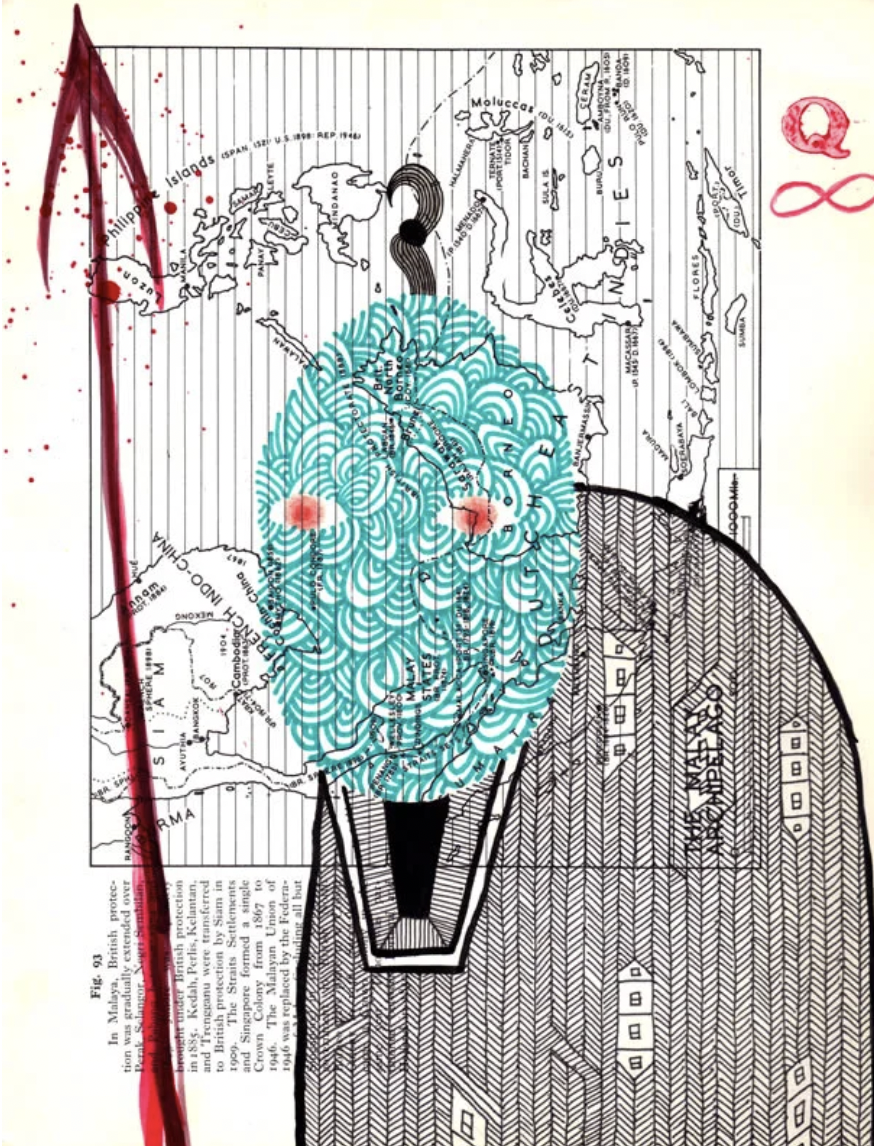
Illustration by Matt Kish
Recap
The text proper begins when our narrator, Ishmael, states his desire to go to sea. He then goes to some length to show that such longings are universal to man in general. He talks of his preference for being a paid crewman to paying as a passenger and his reasons for choosing to go on a whaling ship for the first time.
Leaving Manhattan, Ishmael arrives at New Bedford late on a Saturday only to discover that the next packet ship to Nantucket will not leave until Monday. After some wandering he finds a suitably inexpensive lodging house only to discover all the rooms are taken. He has to share a bed with a “savage” harpooner, Queequeg, who very quickly forms a bond with Ishmael that goes well beyond mere friendship.
The next day, Sunday, Ishmael wanders the town and notes the mix of humanity from all over the globe. He attends a church service conducted by the famous Father Mapple, who gives a sermon on Jonah and the whale. Queequeg also attends this sermon.
When Ishmael returns to the Spouter-Inn he finds Queequeg already there, and makes observations regarding the nature of so-called savage and civilized people, concluding that Queequeg is as noble as any Christian. Queequeg performs a ceremony whereby the two are “married”: Queequeg would gladly die for Ishmael, and will share all his possessions with him.
We learn Queequeg’s story. He was born the son of a king on an island “far away to the west and south”. A youth wanting to see the world, Queequeg manages to get aboard a whaling vessel that visits his island. Initially Queeqeeg is motivated to learn from the white people ways to improve the lives of his native people, but he soon discovers that Christians are miserable and wicked. He now feels he can not return to claim the throne because the time he has spent among the white people has made him too impure to rule his country.
Monday morning, the two walk together to the boat for Nantucket. While the people on the street are used to seeing the likes of Queequeg, seeing him in the company of a white man causes many incredulous stares. On the boat a bumpkin who makes fun of Queequeg is swept overboard and then is saved by Queequeg. The captain, who was threatening to have Queequeg arrested for his previous man-handling of the bumpkin, now apologizes.
Arriving at Nantucket, the pair settle into new lodgings at the Try Pots; an inn whose devotion to chowder is astonishing. This seems a good spot to take our leave of them for now, for they will be well fed until we meet them again.
Reflections
While we all have our personal reactions to the book, it is also good to think about what a general reader, be they reading in 1851 or 2026 might think and feel. This will help us figure out why it flopped on publication nearly a decade before the American Civil War, made such a strong connection to readers immediately after the First World War, and persists today.
The book you are reading from may or may not contain the Etymology (Supplied by a Late Consumptive Usher to a Grammar School) and Extracts (supplied by a Sub-Sub-Librarian), in which we are presented much information, some of it contradictory and some of it from fictional sources, concerning just about anything even tangentially touching upon whales. These sections seem designed to establish the authority of the following text, but, to me, the scatter-shot nature of these extracts casts some doubt on the academic credentials of our author (or at least of the sub-sub-librarian who collected them). This is the first of many ambiguities to come.
“Call me Ishmael”. Has ever a narrator who said so much (and Ishmael does seem to luxuriate in language, doesn’t he?) offered so few facts about himself? Call you Ishmael? Is that your name or not? The notes in the edition I am reading inform us that it was once common to refer to any exile as an Ismael. So the narrator sees himself as an exile?
What to make of Ishmael’s declarations concerning the pull of the sea upon the soul? To me, this section reveals a lot about the character of our narrator, who for romantic reasons, will go out of his way to sail out of Nantucket rather than the convenient port of New Bedford. Of all the arguments put forth by Ishmael in Chapter 1, the most compelling to me is the idea that the image that tormented Narcissus is the same image we see in rivers and oceans; that this “ungraspable phantom of life” is a reflection of ourselves.
And speaking of narcissism, I love how Ishmael in jest imagines himself in terms of worldly importance, worthy of a newspaper headline.
While Ishmael is looking for lodging in New Bedford, he stumbles into a Negro church, and views the congregation in detestible terms; “It seemed the great Black Parliament sitting in Tophet” (Tophet being a biblical city where child sacrifice was performed), and the preacher is described as “A black Angel of Doom”. This, our first mention of race in the novel, makes it pretty clear that Ishmael has internalized racist views.
When Ishmael looks about the Spouter-Inn his gaze is captured by a “boggy, soggy, squitchy” painting of indeterminate subject matter. Even when Ishmael decides that in fact it is a painting of a ship in a Cape Horn Squall with a whale leaping over it, this conclusion is merely his final theory as supported by the opinions of the other denizens of the inn. What a rich image! How sure to provoke discussion in study groups!
The sermon of Father Mapple is presented in such a way that the reader is guided to pay attention to it. So much detail is given about the chapel; the many marble tablets in memory of those who perished while whaling, the pulpit being the prow of a boat which Father Mapple must ascend to in a rope ladder. This is a wonderfully visual scene. Although the book is always better than the movie, Orson Welles gave an amazing performance as Mapple: https://www.youtube.com/watch?v=9DAQ8Az5Gpc. There is much to unpack in the sermon, but there is one passage that should particularly resonate with someone who has also read Infinite Jest: “And if we obey God, we must disobey ourselves; and it is in this disobeying ourselves, wherein the hardness of obeying God consists.”
Back at the Spouter-Inn after the sermon that Ishmael experiences a conversion of sorts. He considers Queequeg and, declaring “you cannot hide the soul” is convinced his new friend is possessed of a noble spirit; “I’ll try a pagan friend, thought I, since Christian kindness has proved but hollow courtesy”. When Ishmael says “I felt a melting in me”, is it the internalized racism we glimpsed earlier that he feels leaving him? The chapter ends with Ishmael bowing before the idol Yojo before the two friends climb into bed; “then, in our hearts’ honeymoon, lay I and Queequeg – a cosy, loving pair”. Is this conversion that makes the narrator view himself as an exile?
Of Queequeg’s home island of Kokovoko we read; “It is not down on any map; true places never are.” What a great sentence! How sure to provoke discussion in book study groups!
What are the takeaways from these first few chapters?
For me, (and not everyone will agree with me) the takeaways are:
Promotion of racial equality.
Ismael spends a lot of ink examining the question of race, and seems to conclude that the difference between civilized and savage people is only skin deep. He frequently inverts view points; if Queequeg seems comical for carrying a wheelbarrow, then a ships’ captain is comical for mistaking soup for a fingerbowl. If we approve of Queequeg attending church service, then why should we not approve of Ishmael kneeling to Yojo? Typical adventure stories follow a white man to the wild parts of the world, acting the hero. Here we see Queequeg saving the undeserving white man. To someone reading Moby-Dick without any foreknowledge of its contents, it almost seems like Queequeg is the book’s protagonist.
It is not surprising race would be on Melville’s mind – it was a fundamental issue of his time. Ten years after Moby-Dick was published, the Civil War would erupt. It is interesting that Moby-Dick flopped sales-wise in 1851, and then a year later the best selling American novel of the 19th Century, Uncle Tom’s Cabin, was published. Certainly Moby-Dick is a much more complex and challenging book, so it is not surprising that the simple melodrama of Uncle Tom was more popular. I also think that Moby-Dick is a far more politically radical book than Uncle Tom’s Cabin, for while Harriet Beecher Stowe was calling for an end to slavery, Melville questions the idea of white superiority that made slavery possible. (This view is mine and not everyone shares it).
An examination of the role of religion.
If Melville is not directly challenging religion, he certainly points out that many if not most Christians are pious on the outside, but act in self-serving ways. In Chapter one we read that although “on no account can a monied man enter heaven. Ah! how cheerfully consign ourselves to perdition!” This marriage of religion and commerce will be explored further in the coming weeks.
When Ishmael experiences something like a conversion in his heart in Chapter 10, it is the “civilized hypocrisies and bland deceits”, the “hollow courtesy” of Christian kindness that he is rejecting.
This seems to be a good place to mention Melville’s friendship with Nathaniel Hawthorn, to whom Moby-Dick is dedicated. Examining civilized hypocrisies was Hawthorn’s bread and butter. If you get a chance to read his short stories, you may come to the conclusion that the Puritans were a bunch of assholes who used the guise of religious piety to cover their very sinful ways. I think Melville has adopted this viewpoint.
Examinations of power structures and gender roles.
Early on Ishmael hints that it is the crew, not the captain and officers, who make the ship function. As we have not even made it to the ship we are going to sail on yet, this is only a seed of an idea, yet the seed is planted in Chapter 1: “…the Commodore on the quarter-deck gets his atmosphere at second hand from the sailors on the forecastle. He thinks he breathes it first; but not so. In much the same way do the commonality lead their leaders in many other things, at the same time that the leaders little suspect it.”
As for gender roles, Melville leaves much for the individual reader to decide. Melville could not have written about an openly homosexual relationship, the times he lived in would not have allowed it, but could he be hinting that such a relationship might exist? Does it matter?
Ah, shipmates, I have rambled on.
Thank you Tyler! I’m looking forward to delving into this novel with other readers. It’s my third time reading it and it gives me something new each time, which is why it’s one of my favourite books. Some of the passages come through like a fever dream. See you Tuesday!
Thanks Jen! I am also amazed at how much more I discover with each read. I am eager to see which parts you and others are connecting with.
Fantastic recap Tyler! I have Tuesday commitments so can’t attend tonight, and I’m very grateful for you sharing your thoughts here. There is a certain timelessness to the book, certainly not being mistaken for today (although there is some contemporary resonance to the part in Chapter 1 with the imagined excerpt of Fate’s playbill reading “‘Grand Contested Election for the Presidency of the United States’ ‘Whaling Voyage By One Ishmael’ ‘Bloody Battle in Affghanistan’”) but touching on aspects of human experience like contending with ennui and inner turmoil, the meditative pull of water and nature, the challenge and thrill of facing unknowns through human connections. I really loved the start of Chapter 3 and the description of Ishmael’s experience taking in the oil painting. The articulation of experiencing art felt like an encouragement at the beginning of a journey to trust the process of reading: possible initial confusion or initial assumptions, the wondering, the questioning, the landing on a personal impression. Sad to miss the first meeting, but will be at the next one I’m able to attend!
I agree, Laura. There are many visual scenes throughout the book that play out on our inner movie screens, and I think you nailed it on the painting.