Moby-Dick Week Two
Before we begin examining chapters 16 through 30, I wanted to say how great the first in-person discussion was. So many interesting ideas and different takes! One idea that really hit home for me personally was that commerce and culture are intertwined; I have always held a more simplistic view that they are somehow two opposing forces, but this intertwining makes much more sense. If anyone else has a takeaway from the meeting to share with our on-line shipmates, please comment below.
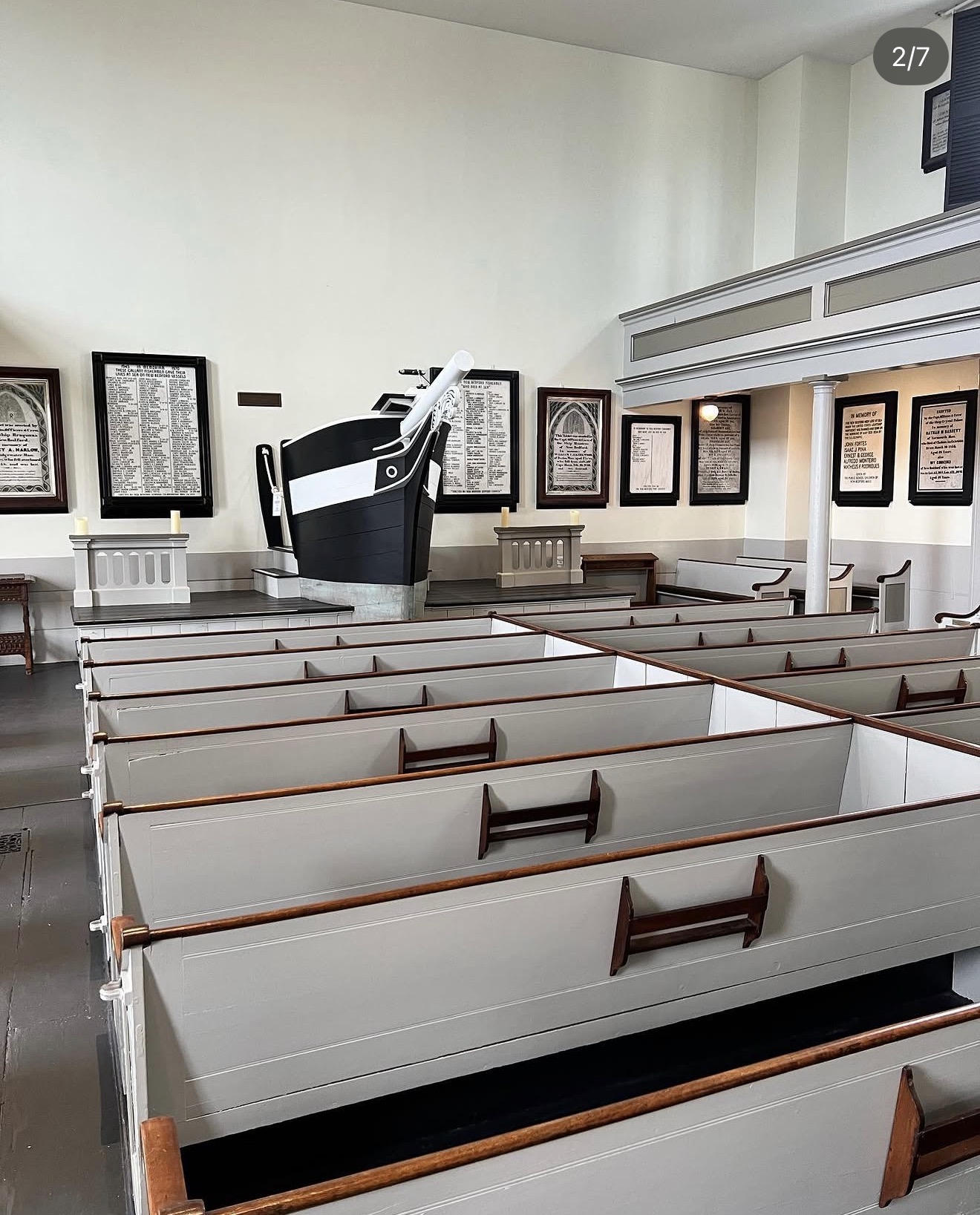
I would also like to share this picture Bradley took when he visited the Seaman’s Bethel in New Bedford. This chapel was built in 1832 and is the model for Father Mapple’s church. Although the bow-shaped pulpit was Melville’s invention, just such a pulpit was added to the bethel in 1961.
Recap
Last we left Ishmael and Queequeg they were chowing down chowder at the Try Pots. The Reader may be excused at this point for feeling a touch impatient; fifteen chapters in and we haven’t even set sail yet! Patience, shipmates. This week we will sign aboard our ship, meet and say good-bye to all three female characters in the book, be introduced to the captain’s mates’ (knights) and their harpooneers (squires) and depart for a journey around the world. We will even meet Ahab!
Off we go.
In bed at the Try Pots, Queequeg reveals that Yojo has decided that Ishmael should go out by himself to choose the boat the two will sail on. Ishmael expresses doubts about the wisdom of this plan, but Queequeg reveals that Yojo already knows which ship Ismael will choose, and that Queequeg must stay behind to begin a religious fast.
After rejecting whaling ships named Devil-dam and Tit-bit, Ishmael decides the Pequod looks like the ship he wants and goes aboard. He meets two of the principal owners; the blustery Peleg and the sober Bildad, and signs on.
Returning to the Try Pots, Ishmael finds Queequeg’s fast is still in progress. After waiting for some time, Ishmael finds that Queequeg has locked himself in their room. Hilarity ensues when Ishmael, convinced Queequeg has suffered a stroke, runs for help. It is at this point that Moby-Dick comes as close as it will get to passing the Bechdel test when the inn-keepers’ wife and the chamber maid join Ishmael in trying to gain access to the room. Once the door is forced, Queequeg is found to be safe but still in his trance-like state, and remains so until morning. Ishmael tries to remonstrate with Queequeg, but is shrugged off.
Ishmeal and Queequeg go to the Pequod where Peleg and Bildad state that only Christian sailors are allowed in the crew, but they change their minds rather quickly after Queequeg demonstrates his skill with a harpoon and he is signed on. Leaving the Pequod, the two are accosted by one Elijah, a dockside prophet of doom who casts all sorts of dark portents about.
We see many details concerning all the work done preparing the ship. We catch a glimpse of Bildad’s sister, Aunt Charity, who brings many of the items that will bring comfort to various crew members. As the time to sail draws near, Ishmeal and Queequeg go to board the Pequod and through the morning fog they see four or five men ahead of them boarding the ship, but before they can investigate Elijah once again accosts them and hints men they had seen may not be found when they go aboard. Indeed, the only person they find on the Pequod is a single sailor fast asleep, but soon the rest of the crew arrives.
It is Christmas day when the Pequod sets sail. Bildad performs the role of pilot, steering the ship out of harbour. Peleg shouts orders to the crew and gives Ishmael his first kick in the bum. Once open seas are reached Peleg and Bildad take leave of the Pequod and return to Nantucket in their side-boat.
In the following chapters Ishmael slips back into his pseudo-intellectual mode, giving many examples to support his claim that those who participate in the whaling fisheries are as grand as any members of the nobility.
In two chapters (both named Knights and Squires) we are introduced to the three officers and their harpooneers. Starbuck, the chief mate, is a serious Nantucket Quaker who seems to be the personification of calm professionalism. The second mate, Stubb, is also a brave whale-killer but a much more jovial one than sober Starback. Last in both authoritative and physical stature comes young third mate Flask, whose bravery is described as a kind of ignorance, as if he is not quite smart enough to be afraid of whales.
When its time to kill whales, these three will each lead an attack boat. Starbuck has chosen Queequeg as his harpooner. Stubb’s harpooneer is Tashtego, an “un-mixed Indian” from the Gay-Head promontory of Martha’s Vineyard. Flask’s harpooneer is Daggoo, a giant African who, like Queequeg, left his native land in his youth.
After many more days of sailing, one fine morning Ahab is at last seen on deck. Ismael describes Ahab as a powerful, grim figure who seems “made of solid bronze” and is so imposing that one does not even notice his whale-bone leg right away. His gaze is fixed, fearless, and of the firmest fortitude. He is obviously not a man to be trifled with, as Stubb soon discovers when he tells Ahab that the report of the wooden leg upon the deck as he walks is disturbing the men trying to sleep below and sparks Ahab’s anger.
Before we get into the reflections, let’s look at some biblical names . We have already talked about Ishmael, but in this weeks’ reading we meet:
Bildad – In the Book of Job, Bildad is a so-called friend of Job’s who, after Job loses his wealth and his children and is covered in painful boils, tells Job that he must somehow be to blame for his own misfortunes.
Peleg – I am not sure that the biblical character of Peleg is significant for anything other than living to the age of 239, which was not that remarkable for those early Old Testament characters.
Ahab – A bad guy in the Book of Kings. Ahab, King of Israel, worships the Canaanite god Baal.
Elijah – A prophet during the reign of Ahab. Elijah defends the worshipers of the Hebrew god, and opposes Ahab.
Reflections
The bond between Ishmeal and Queequeg is so well established in our minds at this point, that we may not even notice the peculiarity of their continuing to share a bed in Nantucket, when it is no longer necessary for them to do so. Not that it is any of my business.
We talked a bit about humour in our first meeting, and some of the scenes we read this week are, to me, the funniest in the book. They say humour does not always translate well, and I think this is true when the joke is travelling across a distance of time as well as across languages. Some of the obviously intentionally funny lines still land; “I cherish the greatest respect towards everyone’s religious obligations, never mind how comical,” sounds like something out of a Mel Brooks movie,The good-cop / bad-cop routine that Peleg and Bildad put on to get Ishmael to sign on for poor wages and Mrs.Hussey reaction when she thinks thinks Queequeg has killed himself are both very funny, but to me the funniest character is Elijah the wharf-side prophet, who in my mind’s movie version of Moby-Dick is played by Marty Feldman. Elijah gives me the giggles. My personal feeling is that Melville meant the Elijah scenes to be funny, and that by making them so he prevents gravitas from overwhelming the book. But I am interested to hear if you disagree.
We also talked about our mixed feelings towards our narrator in week one. How he is a bit of a poser, but also a genuine romantic. Those traits are expanded upon in these chapters with his long diatribe on the nobility of killing whales, mixed in with a rather touching reflection on the life of one of the minor characters, Bulkington, who we first met at the Spouter Inn having just gotten in from a four year voyage only to sail on the Pequod after only a few days on land.
My takeaways. Again, the following thoughts are my own. You may think I am a humbug.
The focus on race continues.
Back in Chapter 14 we read the creation story of Nantucket: how it is quite literally built on the bones of the Native Americans. Now, in Chapter 16, we find our whaling ship of choice is named after the Pequods. Known today as the Pequot, this tribe was destroyed in a war with early New England settlers, with many of them killed in the Mystic Massacre in 1637, with the survivors being sold into slavery in the Caribbean. I think the impulse that in later years would see numerous sports teams being named after indigenous peoples is the same impulse that lead to naming the ship the Pequod. I look forward to discussion on this!
The focus on fate and free will continues.
At Yojo’s urging, Ismael chooses a ship “for all the world as though it turned out by chance.” when in fact Yojo knows Ishmaels’ choice beforehand. We revisit this theme in the character of Elijah, the crazed “prophet” who hints that the Pequod is doomed. Elijah also states that Ahab lost his leg “according to the prophecy.”
Religion and Money.
Way back in chapter one Ishmael, while talking of his preference to being paid to having to pay, says; “The urbane activity with which a man receives money is really marvelous, considering that we so earnestly believe money to be the root of all earthly ills, and that on no account can a monied man enter heaven. Ah! How cheerfully we assign ourselves to perdition!” This theme is revisited with a vengeance in the character of Bildad, forever reading a bible and counting pennies.
And here we close the book again.
I am going to admit that Chapter 25: Postscript almost sunk me this week. I read the opening paragraph over and over trying to untangle the double negatives and the rhetoric and alas, I still have no idea what he is saying.
But I loved the humour in this section – the Innkeeper deciding to get a sign painted “No suicides permitted here,” that the name “Tit-Bit” is “obvious,” and even the re-phrasing of all the statements in The Advocate going on and on and on. Maybe that last one wasn’t supposed to be funny but the airs he takes when pontificating make me giggle.
Certainly Ishmael’s hyperbole can be both frustrating and amusing!
Before beginning this reread, I saw someone mention somewhere that reading Moby Dick is very much like a whale hunt in that there’s a lot of time spent waiting. Going in with this mindset has made the experience much more enjoyable and helped me to really absorb myself into Ishmael’s world.
Also, I have made it my goal to work the line “art thou the man to pitch a harpoon down a live whale’s throat, and jump in after it” into a work meeting as soon as the opportunity presents itself.
Yes, Cary! It’s the best job interview question ever.