Moby-Dick Week Three
Welcome back! This week’s reading covered a lot of ground (water?), so I hope everyone made it through with all your limbs still attached.
Recap – Chapters 31-45
When we last left the Pequod, Ahab had just given Stubb a severe tongue lashing. Now we see Stubb relating to Flask a curious dream he had in the wake of the incident.
Which brings us to the dreaded Chapter 32, Cetology. This is the coral reef against which many a reader’s ship has broken up on. Twelve pages of the classification of whales into categories and sub-categories.
We then learn much about the chain of command; about how in some foreign whaling fleets command of a ship was divided between Captain and Chief Harpooneer. On American ships however, the chain of command is rigid and linear, as evidenced by the rituals of dinner on the Pequod. We see that the harpooneers have a much more enjoyable time at their meals than the officers do. Queequeg seems to pack away more in a meal than poor Flask eats in a week.
Ismael after a long digression on the history of people climbing up tall things in order to see far away, describes in romantic terms what it is like to man the mast-head.
In Chapter 36, The Quarter-Deck, Ahab gathers the crew and reveals his intention to kill the white whale. Ahab infects all the crew, save Starbuck, with the force of his will..
In the next three chapters, the reader is granted access to the inner thoughts of Ahab, Starbuck and Stubb. Ahab is aware of his mania; “I am madness maddened” and he seems to have been quite calculating in his attempts to win over the crew, likening himself to match to light their small piles of powder. Starbuck is distraught. Stubb is lighthearted. We do not see Flask’s thoughts – perhaps he has none.
The crew celebrate their new sworn purpose and we see sailors from around the globe with various ideas on the best way to party. A Spanish sailor tries to pick a fight with Daggoo, but all is interrupted by a storm, which is too bad because I think we all wanted to see Deggoo kick the guy’s butt.
Chapter 41, Moby Dick, is a big infodump where we get the low down on the legend of the white whale and Ahab’s involvement with him. We also get a summation of how Ahab kept his true vengeful intent hidden until in command of the Pequod and far from the authority of Nantucket.
In The Whiteness of the Whale, Ishmael goes on a long discourse about why the whiteness of Moby Dick is, for Ishmael, his most terrifying aspect.
After a brief interlude in which sailors Archy and Cabaco discuss the possibility of there being men below deck we have not yet seen (those shadowy figures spied by Ishmael and Queequeg back in Chapter 21?)
Ishmael addresses the question of how likely it could be for a ship to find one particular whale it is looking for. If it were just random chance that the Pequod were to come across Moby Dick, then “slim to none” would be a fair description of the odds, but Ishmael assures us that recent advances in tracking the migration routes of whales can give some highly educated guesses as to where to look. Ishmael goes further in defending the plausibility of the story in Chapter 45, The Affidavit, by telling other stories that he can personally attest to of the same whales being encountered by the same individual sailors on occasions of several years apart.
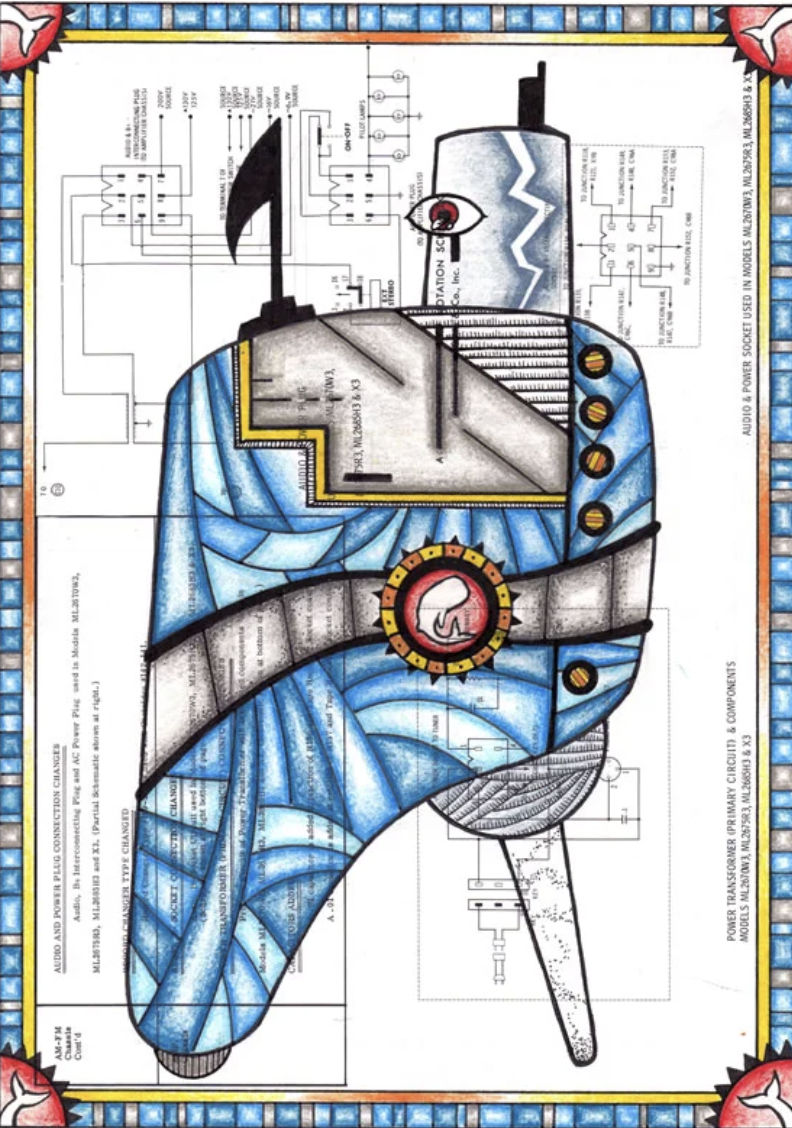
Illustration by Matt Kish
Reflections
The chapter in which Stubb relates his dream is titled “Queen Mab” – a reference to the scene in Romeo and Juliet in which Mercutio tells of the nature of dreams as “the children of an idle brain, begot of nothing but vain fantasy.” To me, this suggests that dreams, which we often see as coming from some external source to give us guidance, are actually the products of our own desires; in this case Stubb’s desire to accept his mistreatment at the hands of Ahab while still keeping his dignity intact. To an outsider like Flask, the dream does not make any sense; “I don’t know; it seems a sort of foolish to me tho’.” Similarly Romeo says to Mercutio; “Peace, peace, Mercutio, peace! Thou talk’st of nothing.” (Act I, Scene 4).
Cetology, while seemingly a long dry chapter, is actually quite interesting for the themes it raises, such as the limits of scientific knowledge. Ishmael, our supposed whale expert, seems unaware of the size of blue whales, but I do not know if blue whales were widely known back then. I really like how Ishmael bases his classification on different sizes of books. Much food for thought here. It is regrettable that Darwin’s On the Origin of Species would not be published until eight years after Moby-Dick, because I think Melville would have made a great evolutionary biologist, but you may disagree. Near the end of the chapter we are given another Shakespeare reference when Ishmael disregards the whale lore that doesn’t fit his system as “mere sounds, full of Leviathanism, but signifying nothing”, echoing Macbeth.
In one of the most descriptive passages, Ismael literally puts us in the mast-head; “There you stand, a hundred feet above the silent decks, striding along the deep …” For me the picture Melville paints for us is not unlike the photo Michael Collins took of the Earth rising above the surface of the Moon. I also love how this chapter ends with Ishmael, a self-confessed daydreamer, giving a warning about losing yourself in daydreams.
In The Quarter-Deck, Ahab’s mania is revealed. There is so much to discuss about how Ahab wins the crew over to his purpose! The infectious nature of passion; how Ahab appeals to the emotional sense of glory over dull commercial commitments.
And the language! Ahab’s speeches are very Shakespearian. Ahab uses ceremony to bond the officers and crew; they all drink (the crew from a passed bottles, the knights and squires from the sockets of the harpoon heads) as they swear allegiance to Ahab’s cause.
As mentioned in our in-person meeting, our first glimpse of the characters commanding the Pequod came in summary form; we were told, not shown, who they were. Now Melville moves to the other extreme, giving us access to the thoughts of Ahab, Starbuck and Stubb. I find these sudden shifts in perspective keep me a little off-balance as a reader, and not knowing what to expect next is kind of exhilarating. We are “at sea” in more ways than one. The soliloquies reveal much about the different attitudes the characters have concerning fate. Ahab is convinced that he can create his own fate; “ I now prophesy that I will dismember my dismemberer. Now, then, be the prophet and the fulfiller one.” Starbuck is conflicted, both amazed that he has been overmatched by a madman, and unsure what step to take next. Ultimately, he decides upon a course of inaction for the present, trusting that the heavens will keep them from ever finding Moby-Dick. Stubb does not see himself as having any choice at all in how things play out; “and come what will, one comfort’s always left, that unfailing comfort is, it’s all predestinated.” He is determined to meet fate with a laugh.
The scene with the sailors in their cups before the mast has some cringe worthy moments ( a Chinese sailor speaking of pagodas, a little black boy made to shake a tambourine and dance) but it seems to me these are not racial stereotypes shared by Melville, but that he is showing how we act out the roles assigned to us; hence the setting as a play. I do like Tashtego’s disdain for all the merrymaking; “That’s a white man; he calls that fun: humph! I save my sweat.
So why does Ishmael find the whiteness of the whale so terrifying? Ishmael leaves no stone unturned as he attempts to find the reason that whiteness causes him such horror. He gives several reasons; that white, a colour associated with purity, seems horrific for creatures that bring death such as polar bears and white sharks. Ishmael also seems to hold the white albatross in reverence, so it is not merely the whiteness that is terrifying – it is the whiteness associated with destruction. Maybe it’s just Ishmael’s quirk. I’ve never found albinos to be repulsive, but he sure does.
Takeaways
Well one big takeaway: How is it that crazy people seem to keep getting in positions of authority?
Reading Moby-Dick in 2026, a reader is sensitive to anything that smells of authoritarianism. What does this book have to say about dictatorial personalities and how they are enabled? Melville seems to have some knowledge of how groups of rational individuals can be whipped up into one irrational mob. In Chapter 41, Ishmael states that he too joined his voice to the others calling for death to Moby Dick. Ishmael? Our erudite and learned Ishmael a mindless member of that mindless rabble? This chapter also speaks to the contagious nature of monomania; how one individual who has evidently figured everything out becomes very attractive to the baffled and confused masses. Perhaps most interesting of all is how the attitudes of the officers also enable Ahab to impose his will. In Chapter 41, Ismael points to “the incompetence of mere unaided virtue or right-mindedness in Starbuck, the invulnerable jollity of indifference and recklessness in Stubb, and the pervading mediocrity in Flask. Such a crew, so officered, seemed specially picked and packed by some infernal fatality to help him to his monomaniac revenge.”
I would like to leave you all with the icebreaker at our next in-person meeting (Monday) and for those who can’t attend, feel free to leave a comment here. When I immerse myself in a book I often find myself thinking about what kind of music would match the images of the book in my head. Do you have any pieces of music that would be your Moby Dick soundtrack? I think a somber, moody piece like Grieg’s The Death of Aase, from the Peer Gynt Suite captures the moments of quiet tension that fill the book, but I also like The Mariner’s Revenge Song by The Decemberists,
Nerd alert: I found public domain online copies of a couple of the texts referenced in these chapters. Links below in case this is interesting to anyone else! I did not have the patience to read in full, but they’re wild to skim through (and I can completely understand how Meville was inspired to dream up this book)…
Thomas Beale’s “The Natural History of the Sperm Whale”: https://archive.org/details/naturalhistoryof00beal/page/n15/mode/1up
Owen Chase’s “Narrative of the […] shipwreck”: https://digitalcommons.unl.edu/etas/98/
Amazing! I randomly scanned to a page in Beale’s book that was all about whale vaginas!
For the icebreaker, one of my fave local artists creates music that always seems perfect for television or movie soundtracks and I think would be fitting for reading this as well!
Astral Swans’ “Controls”
https://youtu.be/WtK9WXXSTMU?si=qniLWNDRqKUf0nOF
I am about 5 chapters behind but this section has been wild. From Cetology, to the musical/play numbers, and some of Ishmael’s thoughts in general, its been a wild week.
The songy bits gave me flashbacks to when ive watched dramas in the past that randomly decide to break out into musical numbers (season 2 of American Horror Story and the final season of House M.D.). Yet this time around, instead of going “wtf?” it seems to fit in naturally with all the other wackiness going on in Ishmael’s head.
Some of my favorite bits from the week’s reading:
“But as these pig-fish [Lamatins and Dugongs] are a noisy, contemptible set, mostly lurking in the mouths of rivers, and feeding on wet hay, and especially as they do not spout, I deny their credentials as whales; and have presented them with their passports to quit the Kingdom of Cetology.”
“Flask, alas! was a butterless man!”
I also had a good laugh about denying their credentials! Ha!