Moby-Dick Week Four
“To read a great book for the first time in one’s maturity is an extraordinary pleasure, different from (although one cannot say greater or less than) the pleasure of having read it in one’s youth. Youth brings to reading, as to any other experience, a particular flavor and a particular sense of importance, whereas in maturity one appreciates (or ought to appreciate) many more details and levels and meanings” – Italo Calvino, Why Read the Classics?
I hope Moby Dick is an extraordinary pleasure for those of you discovering it for the first time. My icebreaker question is; Is there a book you discovered in your maturity that was an extraordinary pleasure for you?
There are many such books for me, but one that leaps to mind is The Black Sheep (La Rabouilleuse), by Balzac, which I read a few years ago. I was not sure what I expected, but it was not the action packed joy ride I got! So much fun!
Recap – Chapters 46-60
Chapter 46 – Surmises
We begin this week’s reading with another glimpse into Ahab’s shrewd nature. Aware that his hold over the crew can only last so long, he gives orders that the ship is to continue to hunt whales, thus keeping the crew focused on their routine duties rather than mulling over the sanity (and legality) of his quest.
Chapter 47 – The Mat Maker
In a wonderfully visual scene, Ishmael and Queequeg are weaving a mat, which Ishmael imagines is the Loom of Time, and himself (free will) the shuttle weaving away at the Fates; warp is destiny; the woof is chance. His dreamy dreams are interrupted by Tastego singing out for a whale. As the boat crews prepare to lower in pursuit, everyone is stunned to see Ahab with five men whom no one had seen before.
Chapter 48 – The First Lowering
Yes! Ahab had smuggled a crew aboard to man his own boat – four men from Manilla and the thin, tall mysterious harpooneer Fedallah. Four boats lower for the whale just as a squall comes upon them. Starbuck’s boat is overturned while attempting to harpoon the whale, and the men must cling to the boat until the morning, when they are rescued by the ship.
Chapter 49 – The Hyena
Ishmael, one of the crew in Starbuck’s boat, is rather dismayed to find that this sort of thing is commonplace in whaling. He goes below to write his will.
Chapter 50 – Ahab’s Boat and Crew. Fedallah
The mystery of the phantom figures is revealed. Ahab, knowing the ship owners would not approve of him risking his life in a whale boat, smuggled his own boat crew aboard. These men now blend in with the general crew, save for the harpooneer Fedallah, who with one protruding tooth and a turban woven with his own white hair, seems more than a touch sinister. How Ahab met Fedallah and what their relationship is remains a mystery.
Chapter 51 – The Spirit-Spout
The Pequod is now in the southern Atlantic, near Argentina. Fedallah sings out for a spout and all boats lower for it, but the spout disappears. In the following nights the phantom spout reappears, always disappearing again before the ship can reach it. The Pequod sets course for the Cape of Good Hope.
Chapter 52 – The Albatross
Just off the Cape of Good Hope, the Pequod encounters another Nantucket whaling vessel, the Goney, on its way home after a four year voyage. The Goney is a desolate craft, its crew, who look like castaways, stare blankly and say nothing. Ahab asks if they have encountered the white whale, but when the captain raises his speaking horn to reply it slips and falls into the sea. A squall prevents Ahab from visiting the Goney. The two ships go their opposite ways.
Chapter 53 – The Gam
Chapter 54 -The Town-Ho’s Story
We learn of the tradition of whaleships when meeting on the ocean of having a social meeting, or “gam”, between the captains and first mates. As a result of just such a gam with a ship called the Town-Ho, we hear a story of mutiny; how a sailor’s beef with an officer leads to rebellion. When the mutineers are punished, the sailor (Steelkilt) plots his revenge against the officer (Radney) but in a moment of divine justice Radney is killed by none other than Moby Dick.
Chapter 55 – Of the Monstrous Pictures of Whales
Chapter 56 – Of the less Erroneous Pictures of Whales, and the True Pictures of Whaling Scenes
Chapter 57 – Of Whales in Paint; in Teeth; in Wood; in Sheet-Iron; in Stone; in Mountains; in Stars.
Ishmael now lectures about how most artistic representations of whales are not very accurate – the reason being that most are drawn from stranded or dead whales, which are about as accurate as drawing ships from their wrecks. Of the good drawings of whales he gives credit to the French. He goes on in his encyclopedic way to talk of whales in folk art, scrimshaw, signs and even the stars.
Chapter 58 – Brit
The Pequod now comes across brit; the yellow substance that Right Whales feed on. Numerous Right Whales are seen, mowing through the brit, but as the Pequod is hunting the Sperm Whale, they leave the Right Whales alone.
Chapter 59 – Squid
Now approaching Java, Daggoo sees a white mass and sings out; “The White Whale!” When the boats reach the spot, however, they find a giant squid. Starbuck declares this a bad omen; “The great live squid, which, they say, few whale-ships beheld, and returned to their ports to tell of it.”
Chapter 60 – The Line
A technical examination of the line attached to the harpoon; what it is made of and how it is coiled. Like the chapter on brit, Ishmael descends into a meditation: “All men live enveloped in whale-lines. All are born with halters around their necks.”
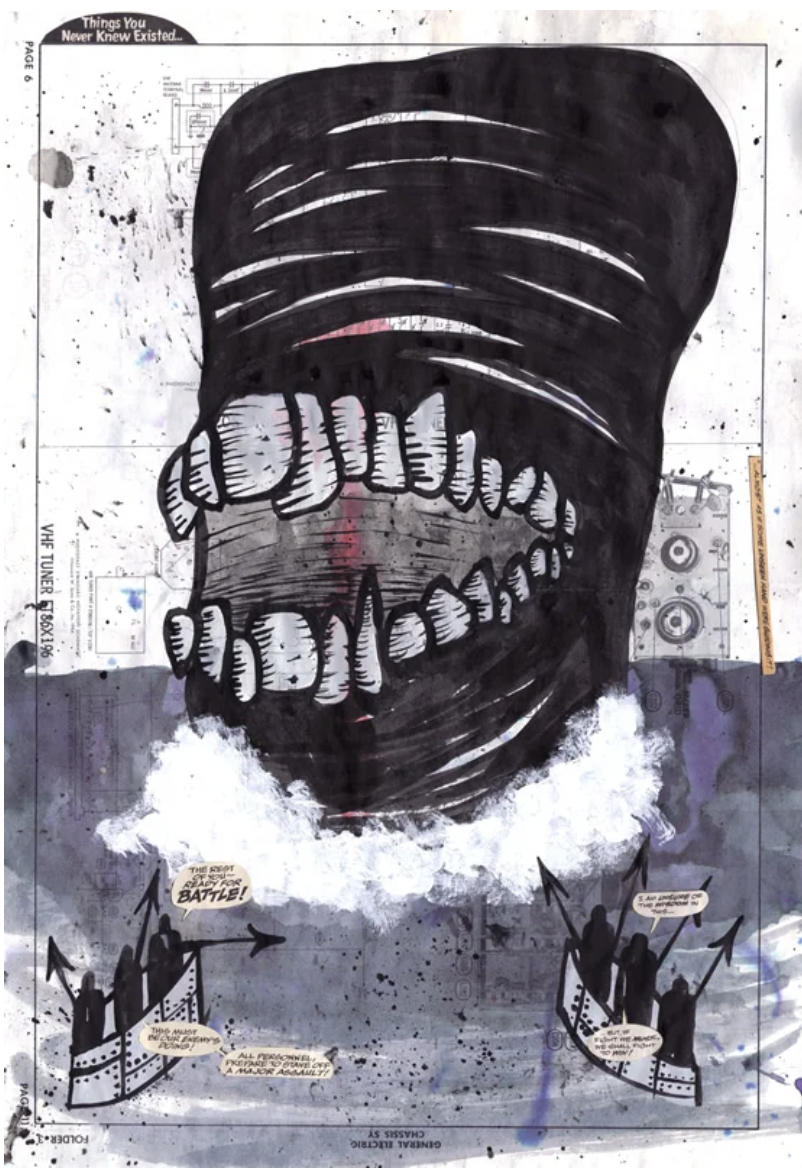
Illustration by Matt Kish
Reflections
Surmises: Once again we see Ahab’s feline cunning in manipulating the crew; “To accomplish his object Ahab must use tools; and of all tools used in the shadow of the moon, men are the most apt to get out of order.”
The Mat-Maker. So much of this book is about fate and free will, and perhaps this chapter is the best example of how in Ishmael’s mind those forces work together to make the mat of our lives. I like how the chapter is structured; Ishmael’s philosophising is cut short by sudden action and the surprise appearance of Ahab’s boat crew.
In The First Lowering we get our first look at boats in pursuit of a whale. The personalities of Starbuck and Stubb are reflected in the way they motivated their men to row. Of Stubb: “He would say the most terrific things to his crew, in a tone so strangely compounded of fun and fury, and the fury seemed so calculated merely as a spice to the fun, that no oarsman could hear such queer invocations without pulling for dear life, and yet pulling for the mere joke of the thing.” Whereas Starbuck’s earnest whispers to his crew are written in parentheses: (Strong, strong, boys!). The book has much to say about leadership styles.
The Hyena
A very funny chapter, but the humour is dark. Ishmael is joking about dying. Kinda makes you think about humour as a defense mechanism against terror.
The Albatross.
Back in The Whiteness of the Whale, we learn that Ishmael is in awe of the albatross, which sailors call the goney. Ishmael refers to Coleridge’s poem, The RIme of the Ancient Mariner. In that poem a sailor kills an albatross that had led his ship out of an icepack. The remaining crew blame this sailor for their subsequent bad luck and make him wear the dead albatross around his neck. Now we encounter this broken down looking ship and crew named for the albatross. Are we supposed to be reminded of the crime committed by the Mariner against nature and see it as a warning to Ahab not to commit a similar crime? Does the Goney present to the Pequod a vision of its own future? I particularly like how the fish that have been following the Pequod all abandon it to follow the Goney, like rats leaving a sinking ship.
The Town-Ho’s Story
In yet another structural transition, Melville embeds the story of the Town-Ho within the novel, and takes us one step further away from the main story by having the tale related by Ishmael many years later in a cafe in Lima. Then all this narrative distance is quickly closed when Moby Dick makes a sudden appearance. It appears that this future Ishmael has done well for himself; holding court with fine Peruvian gentlemen.
Aside from the appearance of Moby Dick, the story of the Town-Ho is interesting because it brings up the subject of mutiny. The reader’s sympathies are with Steelkilt and the mutineers, so the story may be laying the groundwork for future plot developments on the Pequod. At what point is mutiny justified?
Brit; The chapter that begins with a description of Right Whales feeding on brit takes a dark turn as Ishmael talks of the vast destructive nature of the sea; “Consider once more, the universal cannibalism of the sea; all whose creatures prey upon each other, carrying on eternal war since the world began.” Ishmael says that if we were smart we’d just stay on our little green islands and not venture on a sea bent on our destruction. What a reversal from the first chapter in which he says all men are drawn to the sea! What does this say about human nature?
I’m going through chapter 55 with this website which adds the reference pictures he’s referring to! https://bygosh.com/novels/moby-dick/of-the-monstrous-pictures-of-whales/
This is great! I found this one, which is also has some visuals/context for chapters 56-57 (you need a free account to see the whole thing): https://archive.org/details/hermanmelvillesp0000fran
It’s a little crazy that Melville spends THREE CHAPTERS literally just describing drawings, paintings and other visuals… but I did find the descriptions (and Ishmael’s many, many opinions) hilariously compelling. So.
Awesome! Thanks for posting. I kept Googling images in this chapter. Ill have to go through it again or maybe we can explore on Monday.
This section reminded me of some familial trauma my daughter and I shared. When she was 10, we went to the NYC Museum of Natural History and far in the back corner of the diorama room with the giant blue whale in it was a dark enclosure.
We couldn’t really see what was in there so we got up close (too close!) and the Squid and the Whale was revealed. It loomed – LOOMED! – into view and scared the crap out of us. For years we only had to say the words “Squid and the whale” and we would both get the howling fantods – that sensation of fear that feels like someone poking you deep in the belly button… ugh.
Years later we went back, and conquered our trauma by returning to the scene and giving that whale and squid the finger!
And yes I’ve seen the movie, and no it didn’t help.
https://www.amnh.org/exhibitions/permanent/ocean-life/sperm-whale-and-giant-squid
Ohmigod, Johanna, I had basically the same childhood trauma at the Royal Saskatchewan Museum in Regina. I was around 7 years old and I was alone, running ahead of my parents. I didn’t know better to recognize a sense of foreboding as, in the winding corridor of the small, dim museum, prehistoric footprints appeared on the carpeted floor. I galloped along and then, as designed, I rounded a corner to come face to face with a life-size meters-long “mosasaurus” prehistoric reptile, mounted on the CEILING as the water’s surface while I stood on the seabed. Definitely was instantly brought to tears and ran away back to my mom, never to forget this terrible gaping creature and the sudden realization that I was drowning at the bottom of the sea.
https://i.redd.it/scary-museum-mosasaurus-v0-o9nwsus2vfnc1.jpg?width=600&format=pjpg&auto=webp&s=fdec4c9d4cd73ec203a4b59048fb4e318e39881b
Oh Emily that is truly terrifying! He is so aggressive! “As designed” indeed – no warnings!
One more scary ocean sculpture to add to this (which I have never seen and NEVER will – mostly because I don’t dive). Does everyone know about the terrifying Ogopogo scuplture at the bottom of Okanagan Lake?
Also now I know there is a “submechanophobia” thread on Reddit.
https://www.reddit.com/r/submechanophobia/comments/rspygt/ogopogo_statue_in_kelowna_bc_30_feet_bellow_lake/
hi All,
Thanks again for yesterday’s conversation — I’m having such a wonderful time re-reading ‘Dick with you all!
As promised, here is the relevant portion of Chief Justice Lemuel Shaw’s decision in “Commonwealth of Massachusetts v. Rogers” (March 1844), the case in which “monomania” was used as the grounds for the first-ever successful claim of Not Guilty By Reason of Insanity
“In order to constitute a crime a person must have intelligence and capacity enough to have a criminal intent and purpose; and if his reason and mental powers are either so deficient that he has no will, no conscience or controlling mental power, or if, through the overwhelming violence of mental disease, his intellectual power is for the time obliterated, he is not a responsible moral agent, and is not punishable for criminal acts. But these are extremes easily distinguished and not to be mistaken. The difficulty lies between these extremes, in the cases of partial insanity, where the mind may be clouded and weakened, but not incapable of remembering, reasoning, and judging; or so perverted by insane delusions, as to act under false impressions and influences. … The character of the mental disease, relied upon to excuse the accused in this case, is partial insanity, consisting of melancholy, accompanied by delusion. The conduct may be in many respects regular, the mind acute, and the conduct apparently governed by rules of propriety, and at the same time there may be insane delusion, by which the mind is perverted. The most common of these cases is that of monomania, when the mind broods over one idea and cannot be reasoned out of it. This may operate as an excuse for a criminal act in one of two modes.
1. Either the delusion is such that the person under its influence has a real and firm belief of some fact, not true in itself, but which, if it were true, would excuse his act: As where the belief is, that the party killed had an immediate design upon his life, and under that belief the insane man kills in supposed self defence. A common instance is where he fully believes that the act he is doing is done by the immediate command of God, and he acts under the delusive but sincere belief that what he is doing is by the command of a superior power, which supersedes all human laws, and the laws of nature. 2. Or this state of delusion indicates, to an experienced person, that the mind is in a diseased state; that the known tendency of that diseased state of the mind is to break out into sudden paroxysms of violence, venting itself in homicide or other violent acts towards friend or foe indiscriminately; so that although there were no previous indications of violence, yet the subsequent act, connecting itself with the previous symptoms and indication, will enable an experienced person to say that the outbreak was of such a character, that for the time being it must have overborne memory and reason; that the act was the result of the disease and not of a mind capable of choosing; in short, that it was the result of uncontrollable impulse, and not of a person acted upon by motives, and governed by the will.”
—Chief Justice Lemuel Shaw (Melville’s father-in-law),“Commonwealth v. Rogers” (March 1844)
Absolutely loved the brutal art reviews in this reading, thank you for sharing the link to the images!
I am also finding myself continually impressed with Melville’s ability to turn a phrase. The line, “I myself am a savage, owing no allegiance but to the King of the Cannibals, and ready at any moment to rebel against him” so perfectly illustrated the anarchy at the heart of the ship, just waiting to boil over