Moby-Dick Week Five
If the only part of Moby-Dick to survive centuries from now were Chapters 61 through 75, then one would not blame those future readers for concluding that Stubb is the book’s protagonist. For the coming meeting’s icebreaker, I’d like you to say something about your impressions of Stubb. Does he remind you of anyone real or fictional? If he were alive today, what would he be doing? Would you want to go for a beer with him? Cross the street to avoid him? Any and all comments on Stubb are welcome.
Recap – Chapters 61-75
Chapter 61 – Stubb Kills a Whale
Chapter 62 – The Dart
Chapter 63 – The Crotch
In a scene of intense action and graphic detail, Stubb kills a Sperm Whale. This is followed by a chapter in which Ishmael asserts that the harpooning of whales would be much more successful if the harpooneer were not tired out by rowing and could put all his strength into the throw. Further technical details of the hunt are revealed; how all the weapons are kept in near the bow, in easy reach of harpooneer and headsman, and how the second harpoon is attached to the same line as the first, so it must either be thrown at the whale or tossed overboard before it is dangerously yanked about. This ends with Ishmael hinting that the danger of becoming entangled in the line will play a role in events to come.
Chapter 64 – Stubb’s Supper
Chapter 65 – The Whale as a Dish
When the action returns to the Pequod, the whale is fixed to the ship. Sharks descend on the carcass, as does Stubb. Stubb complains to the cook, Fleece, about his whale steak (over cooked) and the sharks (too loud), and makes Fleece tell the sharks to keep the noise down. Ishmael then reveals the history of people eating whales, and concludes that all meat eating involves a certain amount of cruelty.
Chapter 66 – The Shark Massacre
In a rather nightmarish scene we witness the killing of sharks feasting upon the dead whale. The crew’s killing of sharks only drives the sharks to greater frenzy.
Chapter 67 – Cutting In
Chapter 68 – The Blanket
Chapter 69 – The Funeral
A very visual description of blubber being cut away from the whale like peeling an orange in one big spiral. Ishmael reflects on the blubber as the whale’s blanket. After the whale has been stripped of his blubber, the body is set adrift while the head remains attached to the ship.
Chapter 70 – The Sphynx
Chapter 71 – The Jeroboam’s Story
While the crew all go to supper, Ahab addresses the head of the Sperm Whale, beckoning it to tell all the secrets of the wonders it has seen. He is interrupted by the cry that a ship has been spotted. A boat from this ship, the Jeroboam, communicates at a distance from the Pequod. In the boat with the Jeroboam’s captain is a sailor with a “deep, settled, fanatic delirium” in his eyes, who believes himself to be archangel Gabriel. We learn how Gabriel has come to be held in fear and awe by the ship’s crew and that the Captain dares not to move against him. We hear from Mayhew (Captain of the Jeroboam) of how his first mate Macey went after Moby-Dick in spite of Gabriel’s dire warnings, only to be killed by a swat from Moby-Dick’s tail.
Chapter 72 – The Monkey-Rope
We flash-back to the securing of the whale to the side of the Pequod, and learn of the necessity of one sailor (the Monkey) having to stand upon the body of the whale while the blubber-hook is attached. In this case it is Queequeg who performs this dangerous task, while Ishmael is fixed fast to him by the monkey-rope, which he uses to jerk Queequeg away from danger. While this is going on, Tashtego and Daggoo are killing sharks near Queequeg, coming perilously close to him with their blades. Once his task is done Queequeg is hauled up and offered a cup of ginger and water by Dough-Boy, as per Aunt Charity’s instructions. Stubb gets Queequeg some strong spirits and pitches the ginger water into the ocean.
Chapter 73 – Stubb and Flask Kill a Whale; and Then Have a Talk over Him
While the Pequod did not hunt Right Whales before, now Ahab gives the order that one should be killed given the chance. This is accomplished in short order by Stubb and Flask. Flask says that he had overheard Fedallah saying that if the Pequod had a Sperm Whale head on one side and a Right Whale head on the other, then it would never capsize. Stubb opines that Fedallah is the devil and brags of the whooping he will give him.
Chapter 74 – The Sperm Whale’s Head – Contrasted View
Chapter 75 – The Right Whale’s Head – Contrasted View
Ishmael compares the head of the Sperm Whale to that of the Right Whale. The differences are quite great; jaws and teeth as opposed to lips; baleen, head shape, tongues and spouts all differ. Not surprisingly, Ishmael favours the noble Sperm Whale.
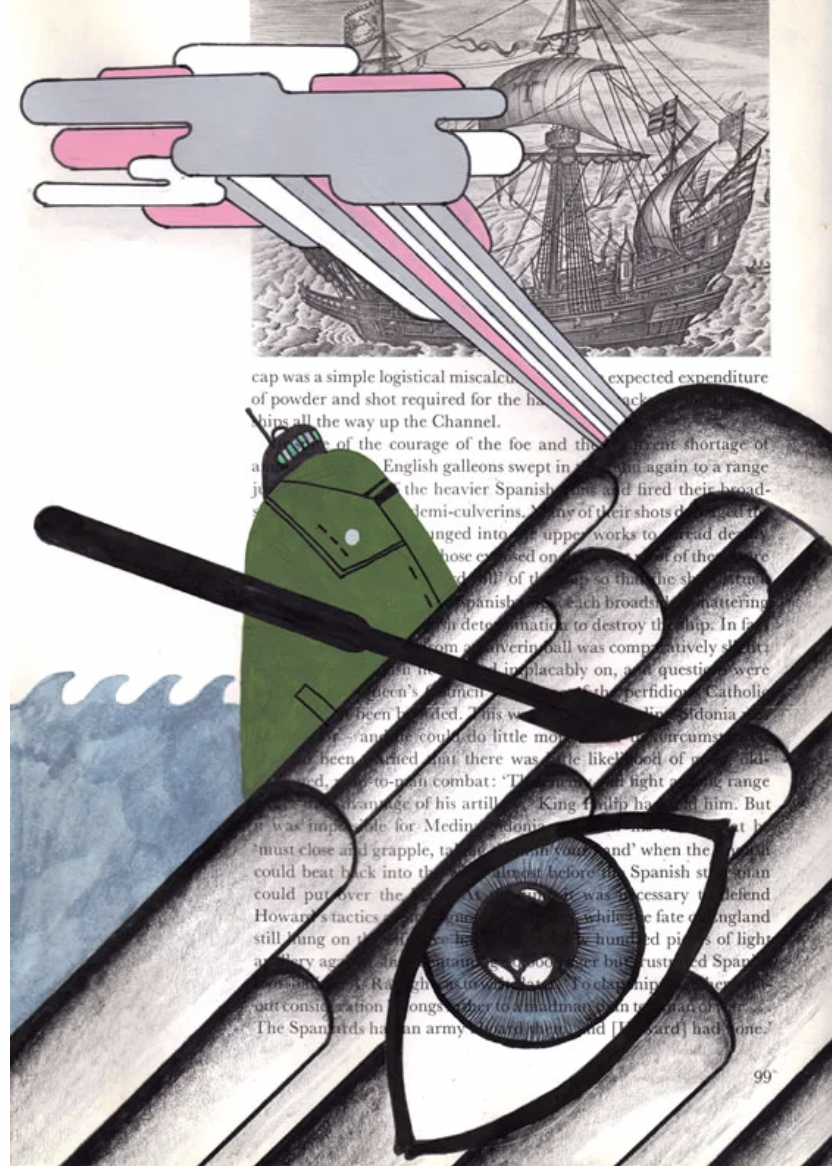
Illustration by Matt Kish
Reflections
The killing of the whale is very detailed in its description of violence; how the sun reflecting off the bloody sea casts everything in a red glow; the horrific death-throws of the whale bathed in its own gore. The violence of the scene is startling. It is almost as though Melville wanted to obliterate any romantic notions of whaling with this gruesome reality.
The scene in which Stubb makes Fleece tell the sharks to be quiet is, to a reader in 2026, very
cringy. On the face of it, it looks like an attempt at humour at the expense of the old black cook, but I think (and you may disagree) it is more of a dig at the arrogance of Stubb, who is punching down. Fleece gets the last laugh; “Wish, by gor! Whale eat him, ‘stead of him eat whale.”
Ishmael’s examples of the cruelty of eating animals in general echoes many arguments that animal rights activists would cite over a century later, such as the practice of force feeding geese to make foie gras. Just as Ismael reminds his readers that the whale oil they use so unthinkingly comes at the cost of human lives, he now admonishes us to be conscious of where our meat comes from.
With the words of Fleece about Stubb being more shark “dan Massa Shark hisself,” still ringing in our ears, we see sharks killing each other and even eating themselves in a frenzy of mindless violence. Given Stubb’s own declaration against thinking (“Think not, is my eleventh commandment,” he declares in Chapter 29) and his proven ability to kill, he does seem quite shark-like. Not surprisingly, it is Stubb who is an expert at beheading a whale.
When Queequeg is nearly bitten by a shark, he says “de god wat made the shark must be one dam Ingin.” That a racist remark like this is uttered by Queequeg seems startling since he is such an admirable character. Commentators have noted that “Injin” meant simply “trouble maker,” but regardless it is jarring. I read it as an example of the insidious nature of the casual use of racist language.
The comparison of the markings on the skin of a whale to old Indian characters chiselled into the banks of the Mississippi is interesting, as is the comparison of blubber to a blanket keeping the whale warm.
Chapter 69, The Funeral, ends with an interesting comment on superstition. Ishmael notes how the mass of sharks and flocks of sea birds continue to feed on the carcass of the whale long after it is cut adrift, and how other whaling ships who spy this feeding frenzy conclude that the roiling waters and feeding birds are token of shoals, and how these spots are then avoided.
The Chapter 71 ends with Ahab remembering he had a letter for an officer of the Jeroboam. The letter turns out to be for the dead Macey, and as Starbuck tries to deliver it to the boat, Gabriel impales it on the spade-pole Starbuck is holding, so it is returned to the Pequod. Gabriel says that the Pequod should keep the letter, as they are on their way to meet Macey. There is just so much in here about how authority is granted, and how a seemingly crazy person can hold sway over others; as Ishmael says; “Nor is the history of fanatics half so striking in respect to the measureless self-deception of the fanatic himself, as his measureless power of deceiving and bedevilling so many others.”
Jeroboam, like Ahab, was a wicked king in the Old Testament.
With the death of Macey, we have now heard two stories of Moby Dick killing individuals who had already been marked for destruction in some way. Despite Ishmael’s protests, I am having a hard time not thinking of this whale as an allegory.
Chapter 73 ends with Fedallah staring at the wrinkles in the Right Whales’ head and comparing them to the lines in his own hand, as though predicting the future. So many instances of attempts to read the unreadable throughout the novel.
The final two chapters in this week’s reading have us considering the heads of the two different types of whale. Ishmael uses these differences to represent different philosophies; the Right Whale a Stoic, the Sperm Whale a Platonian. My knowledge of philosophy is rather weak, so I welcome any enlightenment any of you can provide. I do know that Stoics focus on self-discipline (governing our shark natures) while Platonists believe in the existence of things beyond the visible world (striking through the mask). I hope this section sparks lively conversation.
Since I won’t be there today I wanted to add a few things. The visual of the two giant whale heads hanging off the boat was incredible and I definitely looked up some whale anatomy – what amazing creatures.
I really disliked the throwaway line about how it was “proved by experiment” that the polar whale’s blood is warmer than someone from Borneo.
We have both the angel Gabriel and the devil (as Fadallah) making themselves known.
I loved the image of the small boat with Gabriel aboard being pushed back out away from the Pequod every time the captain was yelling at Gabriel.
And Stubb reminds me of two tv characters – Mr Howell from Gilligan’s Island and Jimmy James from NewsRadio. They are both blustery people with unrealistic expectations and who would make what they perceived as “improvements” with disregard for others – like Stubb’s monkey-rope.
There were a few others in the in-person meeting who brought up the comic elements of the whole scene with Gabriel. Melville had a great way of adding these comic touches that seem almost slapstick.
One other thing about the Jeroboam’s story brought about much mirthful discussion at the in-person meeting was that Ishmael should say of the death of Macey (coming at the flick of Moby Dick’s tail which launched him in a long arc of some fifty yards without disturbing a chip on his boat) as a type of fatal accident “as frequent as any” in the Sperm Whale fishery.