Moby-Dick Week Seven
I find chapters we read this week to be among the most absorbing in the entire novel. So much happens. So many scenes have an epic, cinematic, quality to them. The philosophical digressions are profound and there are some great comic moments.
For this week’s icebreaker, imagine you have been chosen to direct a new film version of Moby-Dick. Which of the scenes in this week’s reading would you be most excited to include? Casting suggestions are always welcome!
Recap – Chapters 91-105
Chapter 91 – The Pequod Meets the Rose-Bud
Chapter 92 – Ambergris
The Pequod encounters another whaling ship, the Rose-Bud, which has two whales fastened to her, both which appear to be corpses found by the Rose-Bud, and both smell something awful. Stubb, thinking one of the whales may possess the valuable substance ambergris, tricks the French captain of the Rose-Bud into cutting the whales loose and manages to get some of the ambergris before Ahab demands he return to the Pequod. The next chapter then relates the uses of ambergris and ends with the refutation of the idea that whales are smelly.
Chapter 93 – The Castaway
We hear the story of how Pip is made to row in Stubb’s boat. In his second lowering, Pip becomes frightened by the bumping of a fast whale against the boat and leaps overboard where he becomes entangled in the harpoon line. Stubb, rather reluctantly, orders the line cut to save Pip and lose the whale. When, on another lowering, Pip leaps from the boat again, Stubb leaves him behind in the belief a trailing boat will pick him up. Unfortunately, the other boats change course in pursuit of whales and Pip is left adrift. By chance, Pip is rescued by the Pequod, but his mind has been altered.
Chapter 94 – A Squeeze of the Hand
Ishmael describes in almost sensual detail the job of breaking up the globules of spermacetti by hand. He then informs us of other by-products of the whale; white-horse, plum-pudding, slobgollion, gurry and nippers. He then takes us into the blubber-room, where many toes go missing.
Chapter 95 – The Cassock
If you thought Ishmael was going to leave any part of the Sperm Whale undescribed, then you would be wrong. What is this “enigmatic object”, this “unaccountable cone”, this “grandissimus”? It is the whale’s penis. We see the skin removed, stretched, dried, and made into a cassock for the blubber slicing “mincer” to wear.
Chapter 96 – The Try-Works
The process of rendering the blubber into oil is done on deck, using the massive brick furnace known as the try-works. The description of the flames burning through the night seems like a vision of hell. Ishmael, at the ship’s helm, becomes lost in thoughts of inferno and drifts off to sleep and nearly capsizes the ship.
Chapter 97 – The Lamp
Ishmael notes that the whaleman, unlike the merchant sailor, always has access to oil and does not have to stumble in the dark.
Chapter 98 – Stowing Down and Clearing Up
The final stage in the processing of the whale is described; the oil is poured into casks which are lowered into the hold of the ship. The ship, now covered in blood and soot, is then made clean using the oil and lye made from burnt whale scrapes, so that the whale provides the soap to clean away its own blood. The chapter ends on a meditation of this cycle of contamination and purification – suggesting that this is the human condition.
Chapter 99 – The Doubloon
Several of those aboard the Pequod approach the doubloon Ahab nailed to the mainmast as the reward to first one to spot Moby-Dick. Ahab, Starbuck, Stubb, Flask, the Manxman, Queequeg, Fedallah, and Pip all examine the doubloon and either comment on it or are themselves commented upon.
Chapter 100 – Leg and Arm – The Pequod, of Nantucket, meets the Samuel Enderby, of London
The Pequod encounters another ship that has not only seen the white whale, but whose Captain Boomer has lost an arm in battle with Moby-Dick. In the gam, Captain Boomer, with the assistance of one Dr.Bunger, tells the story of his encounter and his subsequent resolve never to mess with Moby-Dick again. Ahab goes into a fury and leaves Boomer and Bunger befuddled.
Chapter 101 – The Decanter
Ishmael recites the history of Enderby & Sons, whose founder is the namesake of the ship encountered in Chapter 100. This English company opened the Pacific Ocean to whaling. Ishmael recalls a visit to this same ship some years after the events of Chapter 100, in which much libations were consumed – a practice that the English whalers copied from the Dutch.
Chapter 102 – A Bower in the Arsacides
Chapter 103 – Measurement of the Whale’s Skeleton
We now turn our attention to the skeleton of the Sperm Whale, a (something) of which Ishmael had the opportunity to examine in detail as his friend, King Tranquo, had one. Short on paper and pen, Ishmael tattoos the skeleton measurements on his arm. He then relates those measurements, only to conclude that they do not give a proper idea of the whale’s size, and that it is “vain and foolish” to try to understand the whale by studying the skeleton.
Chapter 104 – The Fossil Whale
Chapter 105 – Does the Whale’s Magnitude Diminish? – Will he Perish?
We zoom out and consider the whale from an archaeological perspective, noting that as the fossil remains of whales have been found hundreds of miles inland they have frequently been mistaken for dinosaurs. The fossil record (at least that available to Ishmael) also indicates that the modern whales are larger than their ancestors. Ishmael also concludes that the whale, unlike the buffalo, they will not be hunted to extinction,
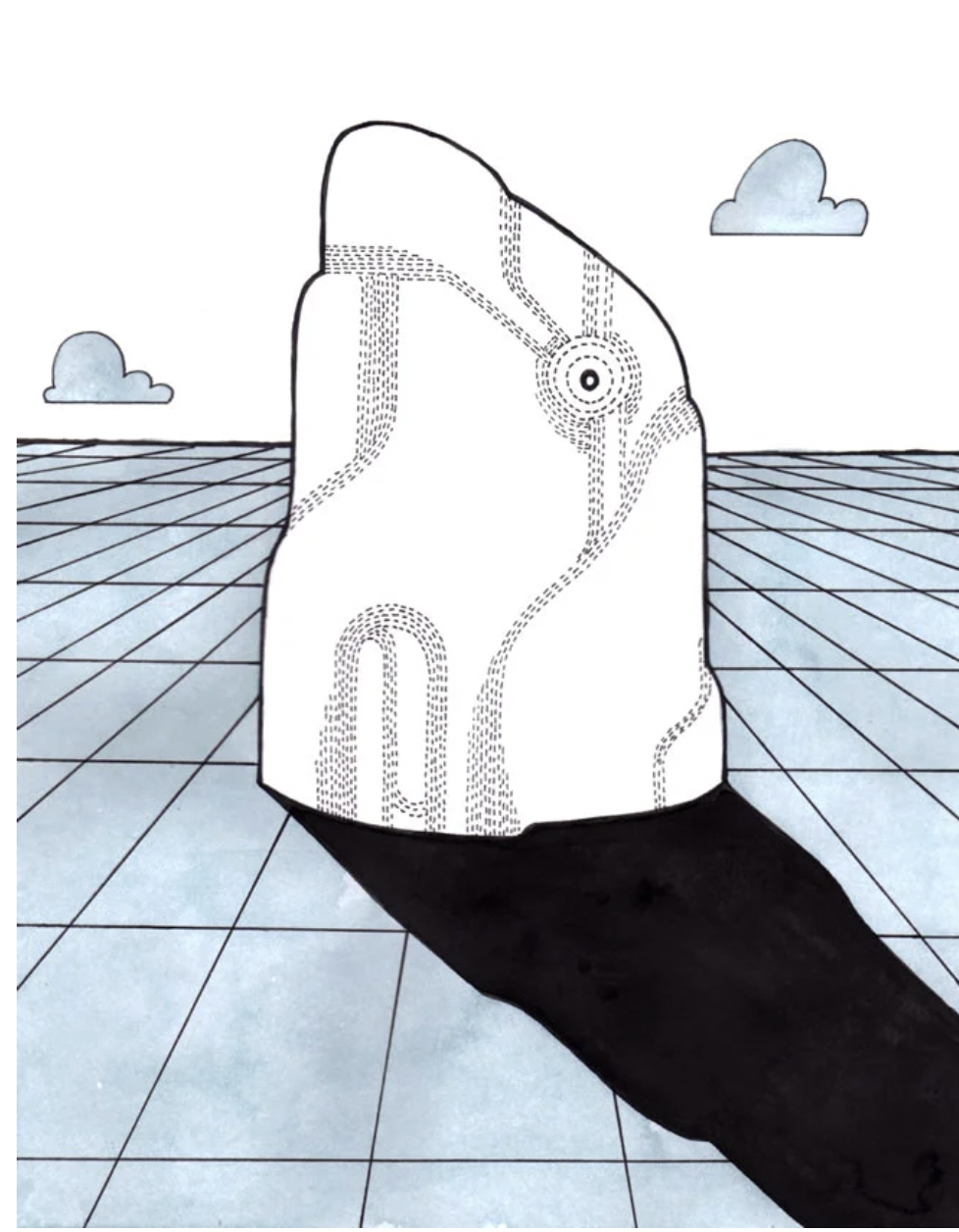
Illustration by Matt Kish
Reflections
It is quite curious that the captain of the Rose-Bud, who we are told is a former cologne manufacturer, should be unaware of the source of ambergris. And why do the Americans like to make fun of the French so much?
In Chapter 92 (Ambergris), Ishmael ponders the irony that this substance used to enhance the attraction of people should come out of decay; the diseased bowels of a whale. Does this idea simply mirror the larger narrative that out of the death of whales comes the stuff that enriches our lives? I feel, somehow, he is hinting at more than that.
Oh, Poor Pip! Whose bright idea was it to put Pip in a whale boat? Was there no better candidate among the ship-keepers to choose from? Why not Doughboy, who is “dull and torpid in his intellects” and less likely to be excitable? In the last sentence of Chapter 40 (Midnight, Forecastle) Pip says, “Oh, thou big white God aloft there somewhere in yon darkness, have mercy on this small black boy down here; preserve him from all men who have no bowels to feel fear!” Alas, this prayer seems not to have been heard.
Ishmael leaves plenty of space for us to see Pip’s madness as possessing a divine quality; “He saw God’s foot upon the treadle of the loom, and spoke it; and therefore his shipmates called him mad.”
I am very interested to hear what people have to say about Chapter 94 (A Squeeze of the Hand) and Chapter 95 (The Cassock). The mix of sacred and profane in the Cassock is amazing!
Chapter 96 (The Try-Works) concludes with one of the most examined passages in the novel:
“There is a wisdom that is woe; but there is a woe that is madness. And there is a Catskill eagle in some souls that can alike dive down into the blackest gorges, and soar out of them again and become invisible in the sunny spaces. And even if he for ever flies within the gorge, that gorge is in the mountains; so that even in his lowest swoop the mountain eagle is still higher than other birds upon the plain, even though they soar.”
I have my ideas about the meaning of the above passage, but I’d love to hear yours.
Those that try to interpret the meaning of the symbols on the doubloon (chapter 99) reveal more about themselves than they do about the coin. Pip’s comments, which at first seem merely simple-minded descriptions, also contain some dire prophecy concerning Ahab and the Pequod.
I love Chapter 100 (Leg and Arm). The visual of the two captains crossing their ivories gives me the giggles. Boomer and Bunger are like a comedy act, and Boomer’s complete lack of any thoughts of revenge toward Moby-Dick shows Samuel Enderby to be the complete opposite of the Pequod.
In Chapter 102 (A Bower in the Arsacides) Ishmael describes the glen in which the skeleton has been placed in terms of the loom; the floor of the glen a “living carpet” with ground vines forming the warp and woof and the sun a shuttle moving above it. This recalls Chapter 47, The Mat-Maker, as well as the comment about Pip’s transformation; “He saw God’s foot upon the treadle of the loom, and spoke it; and therefore his shipmates called him mad.”
I would recommend the Moby Dick Big Read audio version of Chapter 105, which is read by Sir David Attenborough. It is wonderful.