Moby-Dick Week Six
I sometimes feel overwhelmed. By the news. By my job. By my garden. This week I was even a little overwhelmed by Moby-Dick, and by the realization that I am not a giant salamander. So for this week’s icebreaker, we are going to do an emotional check in. How are you all doing? Is this reading experience emotionally difficult at times? Is anybody strongly tempted to step into the street and start methodically knocking people’s hats off? To just look at pictures of puppies for a while? Consider this a safe space. You can even bring your teddy bear to the meeting if you like.
Recap – Chapters 76-90
Chapter 76 – The Battering-Ram
Chapter 77 – The Great Heidelburgh Tun
We return once again to considering the Sperm Whale’s head; this time as a battering ram. Ishmael foreshadows that this will play a role in “one of the most appalling, but not the less true events, perhaps anywhere to be found in all recorded history.” In the Sperm Whale’s head we also find the “case” – a large area containing the valuable spermaceti, which Ishmael compares to a giant wine cask.
Chapter 78 – Cistern and Buckets
In one of the strangest action sequences ever written, Tashtego slips while atop the head in the spermacetti extraction process, and ends up upside down inside the Sperm Whale’s head, which then breaks free of the Pequod and begins to slowly sink. Queequeg comes to the rescue; diving overboard with a sword to cut into the head from below and pull Tashtego out.
Chapter 79 – The Prairie
Chapter 80 – The Nut
Over two chapters, Ishmael applies physiognomy and phrenology (the study of facial features and skull shape) to the Sperm Whale, and (surprise!) concludes it bears the marks of genius and nobility.
Chapter 81 – The Pequod meets the Virgin
The Pequod meets the German whaling vessel Jungfrau (Virgin) which has been so unsuccessful that its captain begs for oil for his reading lamp. As the Jungfrau’s captain returns to his ship, both the Jungfrau and the Pequod spot whales. With their boat already in the water, the Jungfrau has a considerable head start, but thanks to both luck and pluck, the Pequod manages to reach the whale first. What follows is a horrifying killing of an aged, blind, crippled whale in a cruel manner. Once the whale is attached to the Pequod, it immediately begins to sink and very nearly pulls the ship down with it. Only the quick actions of Queequeq saves the Pequod. The chapter ends with Ishmael mocking the Jungfrau as it is observed chasing an uncatchable Fin-Back whale.
Chapter 82 – The Honor and Glory of Whaling
Chapter 83 – Jonah Historically Regarded
Ishmael creates a roll-call of the great whalemen of history, and comes up with some very creative interpretations of mythology in order to do so: “Perseus, St. George, Hercules, Jonah, and Vishnoo! there’s a member-roll for you!” Ishmael then presents very far-fetched arguments to try to verify the truth of the story of Jonah and the whale.
Chapter 84 – Pitchpoling
Another whale is killed, yet again by Stubb, who this time shows his mastery of hurling lance in the method known as pitchpoling.
Chapter 85 – The Fountain
Chapter 86 – The Tail
We return to an anatomical study of the whale, this time focusing on his respiratory system. The question of whether it is water or vapour that is expelled through the spout is given close examination. The chapter ends with Ishmael concluding it must be steam, as all great thinkers produce this almost invisible steam from the workings of their heads. Then our examination shifts to the tail; its structure and motions.
Chapter 87 – The Grand Armada
In chasing a pod of many whales the boats end up in the inner-sactum of the pod where curious baby whales come alongside the boats and are petted. Mothers suckle the young and other whales are observed in their love-making. This idyllic moment is then destroyed by the horrific violence of a whale dragging spears and lances which kill many other whales.
Chapter 88 – Schools and Schoolmasters
The social structure of Sperm-Whales is examined.
Chapter 89 – Fast-Fish and Loose-Fish
Chapter 90 – Heads or Tails
Ownership of whales is examined from a legal standpoint, with an example of the disputes that may arise when a whale is killed but abandoned. This question of ownership is then extended to the historical instance of the English nobility “owning” all whales captured on the coast of England.
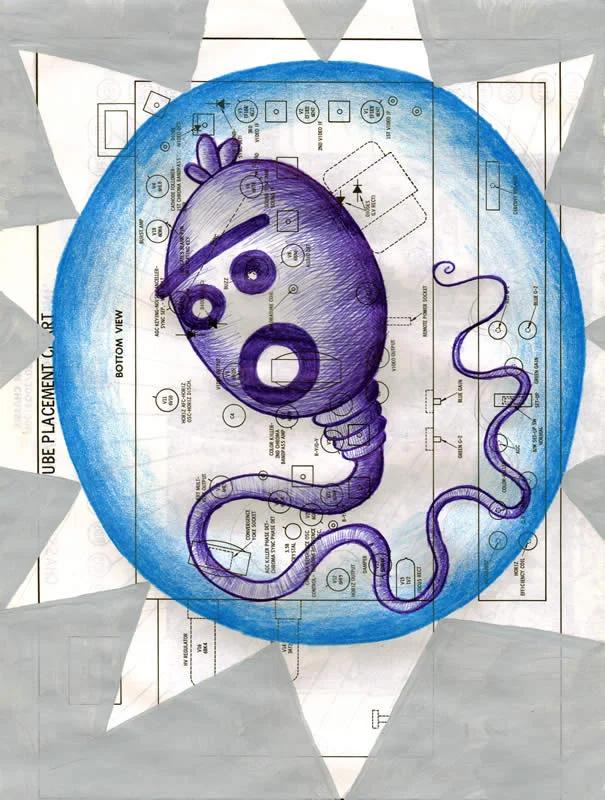
Illustration by Matt Kish
Reflections
Boy did I ever struggle with this section of Moby-Dick. I don’t mean I had trouble understanding the concepts, but quite the opposite; by beginning to understand the concepts I felt tossed about; a very small boat on a very big sea. I think that this struggle is one of the things Moby-Dick is about.
Can I tell you something that might sound a little crazy? This week I have become convinced that Moby-Dick is a warning about the dangers of Artificial Intelligence, which obviously could not have been Melville’s intention. Or could it? Humans have not really changed in the last 175 years after all, and Melville is, I think, simply trying to warn us about the dangers of turning off our brains, or our souls, or both.
Yeah the struggle is hard, but if we forgo the struggle and just go with the flow, we run the risk of becoming like Stubb; unfeeling. The section that nearly broke me was when Stubb killed that old blind whale that only had one fin; he crossed a line between doing his job and revelling in the cruelty. I see a lot of people reveling in cruelty these days.
Anyway, that is my state of mind reading this section. I think what set all this off in me was the end of Chapter 76 (Battering-Ram) when Ishmael makes the statement; “But clear Truth is a thing for salamander giants only to encounter; how small the chances for the provincials then? What befel the weakling youth lifting the dread goddess’s veil at Sais?” This is a reference to the Friedrich Schiller poem The Veiled Statue at Sais, wherein a young man transgresses sacred boundaries in pursuit of absolute knowledge by lifting the veil of Isis, only to have his mind and spirit broken and be driven to an early grave. You can find an English translation of the poem here:
https://allpoetry.com/The-Veiled-Statue-At-Sais
Is looking under the veil like punching through it? Are both equally bad ideas? The last two lines of Shiller’s poem are:
“Woe to that man who wins the truth by guilt,
For truth so gained will ne’er reward its owner.”
– which pretty neatly sums up my feelings about artificial intelligence.
Oh boy have I blathered on. Anyway here are a few more reflections:
The rescue of Tashtego in Chapter 78 is a scene of thrilling action which Ishmael describes in terms of obstetrics. Talk about a scene pregnant with meaning! The description of the “horrible oily gurgling” sound of Tashtego’s headfirst fall is a wonderful touch. What to make of Ishmael’s concluding the chapter by telling of the “delicious death” of the Ohio honey farmer drowned in honey? His question regarding how many have similarly perished in Plato’s honeyed head reminds me of his warnings to dreamers on the masthead getting lost in thought and falling into the sea.
The scene at the end of Chapter 81 (The Pequod meets the Virgin) where the sinking whale nearly destroys the Pequod is so cinematic and meaningful (I’m thinking “monkey rope” here). Yet again, it is Queequeg who saves the day. The role Queequeg plays in Moby-Dick may require a re-examination at this point.
The Grand Armada (Chapter 87), with its contrast of calm peace and chaotic death provokes a visceral reaction in me. The image of blood and mother’s milk co-mingling is overpowering. That Ismael can follow this with an examination of the social structure of whales is wrenching. Our sympathies are definitely shifting from the whalers to the whales if they were not there already.
And there is SO much more to talk about in this section, however I need to go watch some puppy videos now.
The Grand Armada and Schools&SchoolMasters were a rough go for me this week. No wonder we need an emotional check-in! I like being challenged as it brought up questions for me about humans as part of the food chain and why I dislike animal violence even amongst animals.
I hear you Jon. I too struggled with this section. However the eagle in my soul soared upward in the following section – I hope yours will too!