Gravity’s Rainbow Week Seven
This week’s reading broke from our typical cadence of reading from either around the hundreds to the fifties or from around the fifties to the next hundreds, so, if you are anything like me, you may be a bit mixed up as to where we’re meant to be. In any case, this week’s reading was an enlightening adventure.
– Ben
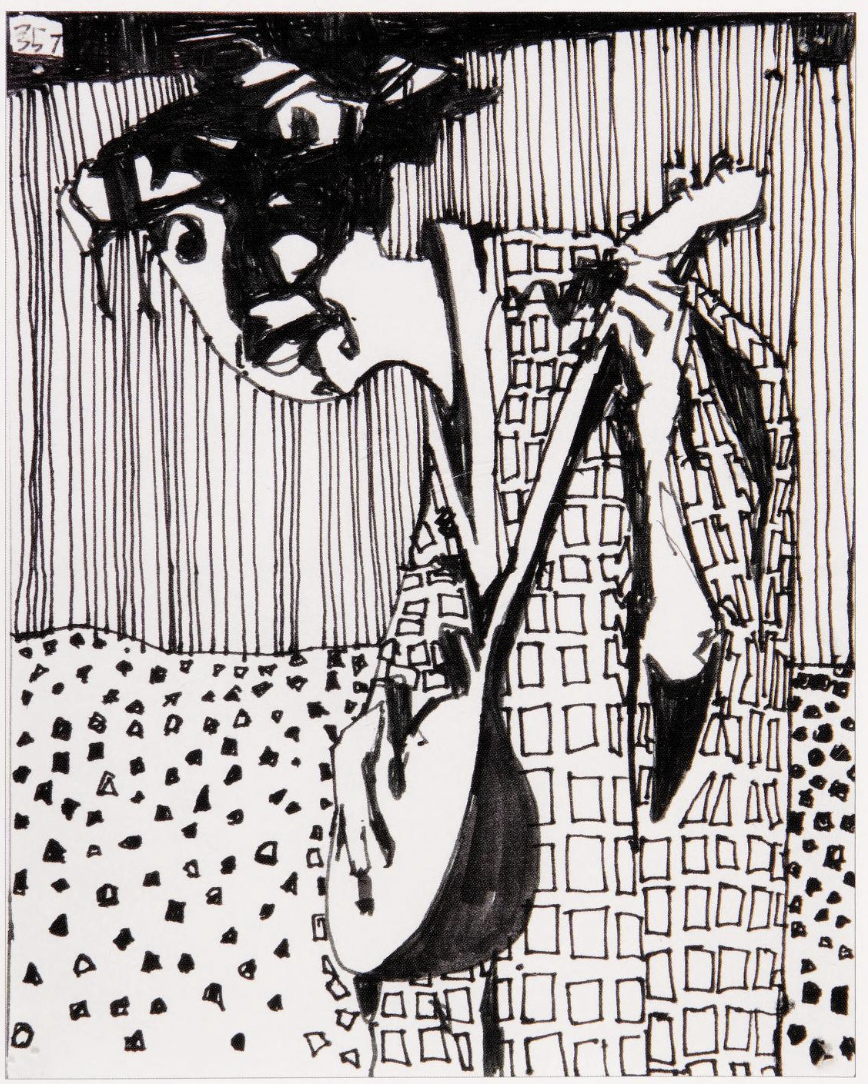
Illustration by Zak Smith – borrowed from the Internet Archive
Recap & Reflections
□ □ □ □ □ □ □
We begin this week on a new chapter (book?) (3. In the Zone), with a familiar quotation “Toto, I have a feeling we’re not in Kansas any more….” Fair, enough, we’re not in Kansas anymore, but it’s hard to say that the Zone is any stranger (or less strange) than the previous settings of Gravity’s Rainbow. We are in Nordhausen, which is more or less in the geometric centre of Germany (or Mitteldeutschland). In the early 1900s, Nordhausen became the centre for the engineering and arms industries, and, relevant to our reading, hosted (nearby at least) the Mittlebau-Dora concentration camp, where 60,000 people were forced to work in the arms industry. Conditions in this camp were, predictably, awful for the people who were forced to work there, and ultimately the rockets produced at Mittlewerk suffered from production flaws that yielded launchpad and mid-flight explosions. The familiar Wernher Von Braun visited the Mittlewerk amidst these production issues. Quoting Wikipedia “More people famously died constructing these weapons [V-2s and V-1s] under horrific conditions than were killed by their actual detonations.” As an aside, the excellent Michael Chabon book Moonglow features scenes of the main character (Chabon’s grandpa)’s exploration of the horrors of the Mittlewerk tunnels and manhunt for Von Braun.
Slothrop has been relieved of his shoes “by some DP with fingers lighter than dreams” on his way from Switzerland across Bavaria. In return, they’ve left a tulip between his toes, a perceived sign of Katje. Major Duane Marvy has departed (not much discussed here, but important later). Slothrop’s rambling through the Zone, trading a doll’s lapis lazuli eyes for a ride and half a boiled potato and being confronted with signs of Katje. He (improbably) feeds a horrible-smelling fire with the human (Russian Jewess) hair from the doll’s head as toys roll towards the fire. Slothrop chats with the (ghost of?) the doll’s owner.
He now has the chance to dig a bit deeper into the files bootlegged for him by Mario Schweitar back in Zürich. Imipolex G was ordered by one Franz Pökler and was to be delivered to Nordhausen and the Mittlewerke, where the rockets were supposed to be produced en masse, but which has since (back in Feb/March) been evacuated. So Slothrop, as ace reporter Ian Scuffling, decides to do some boots-on-the-ground journalism at the Mittlewerke. Slothrop gets on a train (I think) to the Mittelwerke with “thirty other cold and tattered souls [mostly kids], eyes all pupil, lips cratered with sores” who are singing a Displaced Persons song.
We learn more about what is in the dossier on Laszlo Jamf. Jamf is one of those characters who seems to be connected in some way with nearly all other characters, organizations, and events in the novel. An incomplete list: Grössli Chemical Corp – ultimately IG Farben, (Uncle) Lyle Bland (of Boston, Mass), Stinnes, Walter Rathenau, Krupp and Thyssen (took me a bit to realize why these names are familiar: ThyssenKrupp manufactured the elevator that I ride up to my office every day), Weimar Republic, and, invariably, the Slothrop Paper Company. Notable line from this segment “Those were the days when you carried marks around in wheelbarrows to your daily shopping and used them for toilet paper, assuming you had anything to shit.” Jamf was, evidently, an all-too-familiar from our modern times, shyster who profits off of sketchy dealings in which fake (crypto?) currency is, invented, bought, and sold to help profit from the purchase of the instruments of war. Slothrop gets inexplicably aroused and is enveloped by a soft and chemical, threatening, haunting smell from before his conscious memory begins – the breath of the Forbidden Wing. In fact, the smell if Imipolex G. Jamf paid $5000 for Slothrop’s education at Harvard, and Slothrop realizes he’s been sold to IG Farben like a side of beef. Slothrop realizes that he may have been under observation by the IG since he was born.
Slothrop’s freaking out, so decides to climb a ladder up to the top of the freight car that he is riding in (towards Nordhuasen and the Mittelwerke), where he meets Major Marvy, who is, surprisingly, “really fat” and whose pants are “bloused” (great verb) into his shiny combat boots and whose eyes are “like safety valves that pop out at you whenever the pressure gets too high.” In addition to being confused by this version of Marvy, Slothrop’s feet are cold, because he is still not wearing any shoes. Racist conversation with Marvy ensues, and we are then introduced to Oberst Enzian, “a tall African with a full imperial beard” and member of the Schwarzkommando, as he throws the Major from the roof. Enzian doesn’t believe Slothrop’s war correspondent ploy, but they do finally get to Nordhausen.
We meet the “thin, awkward, very young” Geli Tripping, singing a song and playing a balalaika, which belongs to the Soviet intelligence officer Tchitcherine. They hook up, she (irritatingly to Slothrop) fantasizing about her boyfriend Tchitcherine. Later, her owl, Wehrner stops by for a Baby Ruth candy bar. She also calls out Slothrop’s war correspondent bluff, to which he offers his War Correspondent badge and his Hemingway-esque ‘stache.
Geli offers up some info about the Imipolex G device, the S-Gerat, and Rocket Number 00000, which she has gleaned from reading Vaslav (Tchitcherine’s?) mail. They hook up again, and the owl reappears.
□ □ □ □ □ □ □
Slothrop departs against the “Sunday-funnies dawn”, wearing Thicherine’s giant shoes with bits of an old chemise stuffed in them to fit his feet. We’re presented with rambling speculation about the Mittlewerke and neighboring Dora prison camp. Enzian evidently had an Illumination, in the course of a wet dream where he coupled with a slender white rocket and you can still view (a replica of) the result. There is discussion of “The Promise of Space Travel” (remember Von Braun was crucial to the development of the Saturn V rocket, which propelled the Apollo missions to their success). The 1.5 pg long paragraph ends with a return to the polymerized indoles of Imipolex G.
Slothrop gets to the Mittlewerke tunnel entrance, which is shaped like a parabola, where he is shrugged through after presenting his SHAEF (Supreme Headquarters Allied Expeditionary Force) pass, signed by Ike himself. The shape of the Mittlewerke is an elongated SS, with cross-tunnels linking the main ones. These were dug by the forced labor of the prisoners. The SS is a double integral sign, ∬, (which I personally will never be able to see without thinking of the ancient meme tacked up on the wall of the break area of my grad school institution where some renaissance-looking gents are saying “We put integrals into our integrals so we can derive while we derive”). Pynchon gives us another lay-explanation of calculus (meters per second integrates to meters; if we’re talking double integrals, we would integrate acceleration over time – meters per second per second (e.g. gravitational acceleration = 9.8 m/s2) to get velocity (meters per second), on the way to getting to distance (meters). In other words, rockets need to accelerate to overcome gravity (i.e. pulling gs) and go the distance. We are berated with various, further discussion of integrals and rockets (with reference to Pointsman and Katje), before ending with ∬ as a motif for spooning lovers, and Katje, of course, comes to mind.
We then gain a visual description of the Mittelwerke and its tunnels and cross-tunnels, with the apt quote “It is hard down here in the Mittelwerke to live in the present for very long. The nostalgia you feel is not your own, but it’s potent.” In Stollen 20 and up, where the traffic grows heavier, we are exposed to rocket parts, and, eventually Americans and Russians gathered around a massive barrel of beer. The Americans are singing Rocket Limericks. Slothrop is hungry and thirsty so takes a harrowing cable ride down to Stollen 41 to get some lunch. Lots of singing and drinking, Russian and American alike, Slothrop is granted a foaming, ice cold shell-case (of beer, what else?). Slothrop, holding another beer, finds that it is the going-away party of Major Marvy’s ,who appears presently with bruises to show he did indeed rapidly descend from the top of a freight car in the recent past. A sergeant dozing with a gun in his hands wakes up and blows apart the beer barrel. So much for that.
Slothrop decides to get while the gettin’s good and finds an old man, Glimpf, Professor of Mathematics at the TH Darmstadt and Science Adviser to the Allied Military Government, to whisk him away. They duck into a metal storage area, Slothrop hops into some coveralls, combs his pompadour forward, and cuts his stache at both sides and ends up looking a bit like Hitler. Slothrop is scared shitless, partially because Glimpf is turning out to be a raving maniac. He shouts provocatives back at the drunk soldiers and they begin pursuit. Slothrop and Glimpf fire up a tractor/train and start on their way. Slothrop uncouples cars to pick up speed. They encounter Major Marvy himself, invariably wearing a giant white John B. Stetson, armed with a .45 automatic for each hand, who opens fire as Slothrop ducks behind a – you guessed it – giant warhead. He shoves it onto the rails, and Glimpf and Slothrop make haste back to the parabolic entrance.
They hijack a Mercedes and head to Glimpf’s colleague Zwitter’s lab and we conclude with a wartime jingle.
□ □ □ □ □ □ □
We start with an excerpt from Tales of the Schwarzkommando about the battle between theoretical predictions of the most desirable working pressure and empirical measurements of the same. Enzian told them to stick with the empirical constraints.
We learn a bit more about the Schwarzkommando, which is no longer a military title but rather a class of people, Zone-Hereros, in exile from SW Africa for two generations. Erdschwein (ardvaark) presents some sort of joke, harkening back to Africa and their current life in the tunnels. Back in Africa, Erdwchwieinhöhle was a powerful symbol of fertility and life, but it’s not so clear now in the Zone.
Enzian is known behind his back as Otyikondo, the Halfbreed, because his dad was a European. As the Rocket grows toward its working shape and fullness, so does Enzian evolve into a new configuration. Enzian and colleagues discuss the Final Zero, which embraces all the
Deviations (think pedophilia, homosexuality, and so on) in one single act.
We proceed to learn, in a rambling way, about Enzian and the Hereros and their traditions. Weissmann (literally, white man) comes into the discussion as well. We end with them receiving a radio transmission, and, finally learn that Enzian and Tchitcherine are half-brothers (although Enzian’s never seen the man). Enzian evidently wants a chance at Tchictcherine.
□ □ □ □ □ □ □
Lots to unpack here, and I look forward to doing so with you all!
0 Comments