Moby-Dick Week Eight
Moby-Dick Week Eight
We are in the wondrous Pacific now Shipmates. One senses the curtain is rising on the final act. We have voyaged far. With the end of the journey nearing, I would like to make this week’s icebreaker to be about the first stage in planning our next voyage. Where should we go next? Do we stick to fiction? Do we read something in translation? A book that has more than three women in it, possibly even written by a woman? Do we continue to hunt Folio Whales (yes, please)? I know we are not choosing the next book until week 10, but it is not too early to start thinking about such things. Besides, there is nothing more delicious than choosing a book to read!
Recap – Chapters 106-120
Chapter 106 – Ahab’s Leg
Chapter 107 – The Carpenter
Chapter 108 – Ahab and the Carpenter
Ahab finds his ivory leg has been damaged and he orders the ship’s carpenter to make a new one from the Sperm Whale’s jawbone. We learn that not long before the present voyage Ahab’s ivory leg splintered beneath him, stabbing him in the groin. In a scene presented in the form of a play, the carpenter measures Ahab for his new prosthetic. Ahab gives voice to grand philosophical musings while the confused carpenter just tries to do his job.
Chapter 109 – Ahab and Starbuck in the Cabin
Starbuck goes to the captain’s cabin to inform Ahab that the oil casks are leaking and need to be brought up and repaired. Ahab refuses to do so, not wishing to lose time in the pursuit of Moby-Dick. The two men argue, and Ahab is angered to the point that he points a loaded musket at Starbuck. Later, after cooling off, Ahab changes his mind and orders the casks to be brought up to be fixed.
Chapter 110 – Queequeg in his Coffin
In the process of bringing up the casks, Queequeg, working in the musty depths of the hold, catches a chill which quickly worsens. Wasting away, Queequeg asks the carpenter to make his coffin which, when finished, Queequeg tests and approves of. Just when it appears that Queequeg is ready to depart this life, he makes a remarkable recovery, which he explains by saying that he remembered he had an unfinished task to do onshore and so decided not to die.
Chapter 111 – The Pacific
Passing the Bashee isles (today’s Batanes in the northern Philippines) the Pequod passes into the Pacific Ocean. Ishmael immediately feels a deep connection to this immense body of water. To Ahab, this only seems to signify that he is getting closer to the end of his quest.
Chapter 112 – The Blacksmith
We are introduced to Perth, the Blacksmith, and are told his story of woe: a once prosperous husband and father who lost his home and family to drink. Wishing to leave his broken life behind, but not being of a suicidal nature, he goes to sea on a whaling ship.
Chapter 113 – The Forge
Ahab has Perth make him a harpoon, using the nail stubs of horseshoes and his own razors for materials, Ahab uses the blood of the harpooneers to temper the barbs of the harpoon head.
Chapter 114 – The Gilder
In the literary equivalent of a montage scene, Ishmael describes days passing wherein the crew spend countless hours chasing whales with little success. Then, in a peaceful moment, the sun gilds all in its golden glow. Ishmael imagines the calm sea to be like the western prairie. He then reflects that humans do not progress through life (in terms of their inner-states of being) in a straight line, but in cycles. The chapter concludes with comments from Starbuck and Stubb, who also seem moved to introspection.
Chapter 115 – The Bachelor
The Pequod now encounters the Bachelor of Nantucket, a whaling ship so successful that casks of oil have filled her hold and stored in every available space.
Chapter 116 – Dying Whale
Chapter 117 – The Whale Watch
Ahab kills a whale and, noting that the whale turns its head to the sun as it dies, calls the whale a fire-worshipper. He meditates on the sun as a life-giving force, and that the dark-force of death seems to be located deep in the sea itself. Three other whales are killed by the Pequod’s boats, and while these are brought alongside the ship, Ahab is left beside his whale through the night. Ahab and Fedallah speak of prophecies concerning Ahab: he will have neither hearse nor coffin, yet he must see two hearses (one not made by human hands, one made with wood grown in America) before he can die; that Ahab cannot die before Fedallah, and that only hemp can kill Ahab. Ahab thinks these things cannot come to pass, and declares himself “Immortal on land and on sea!” Obviously he has not read Macbeth.
Chapter 118 – The Quadrant
The crew waits upon Ahab who trains his quadrant upon the sun to know the precise moment to change course towards the equator, having determined that this will bring them upon Moby Dick. Ahab curses the Sun because it can only tell him where he is, not where Moby-Dick is. He destroys the quadrant, and gives orders for the course change. Starbuck laments that Ahab’s fiery life will end in ashes, to which Stubb (the laughing fatalist) replies that Ahab is only playing the cards he has been dealt.
Chapter 119 – The Candles
A typhoon hits the Pequod headlong, shredding the sails and destroying Ahab’s boat. Starbuck sees this as an obvious sign that the Pequod should turn around and let the typhoon blow them home. Corpusants – balls of electrical light – sit atop the three masts, making them appear like candles before an altar. Ahab addresses the fire as something to be worshipped not through reverence but defiance. In the destroyed boat Ahab’s harpoon begins to glow, causing Starbuck to cry out for Ahab to abandon his quest. The crew seem ready to back Starbuck, but Ahab grabs the glowing harpoon and threatens to kill the first man who moves against him. Then, in a spectacularly dramatic moment, he reminds them that they are bound by their oaths and then blows out flames of the harpoon.
Chapter 120 – The Deck towards the End of the First Night Watch
Starbuck approaches Ahab about the prudence of taking down the damaged parts of the ship for repair and is rebuffed by Ahab. Ahab mocks the wind, saying it is sick with colic and should take medicine.
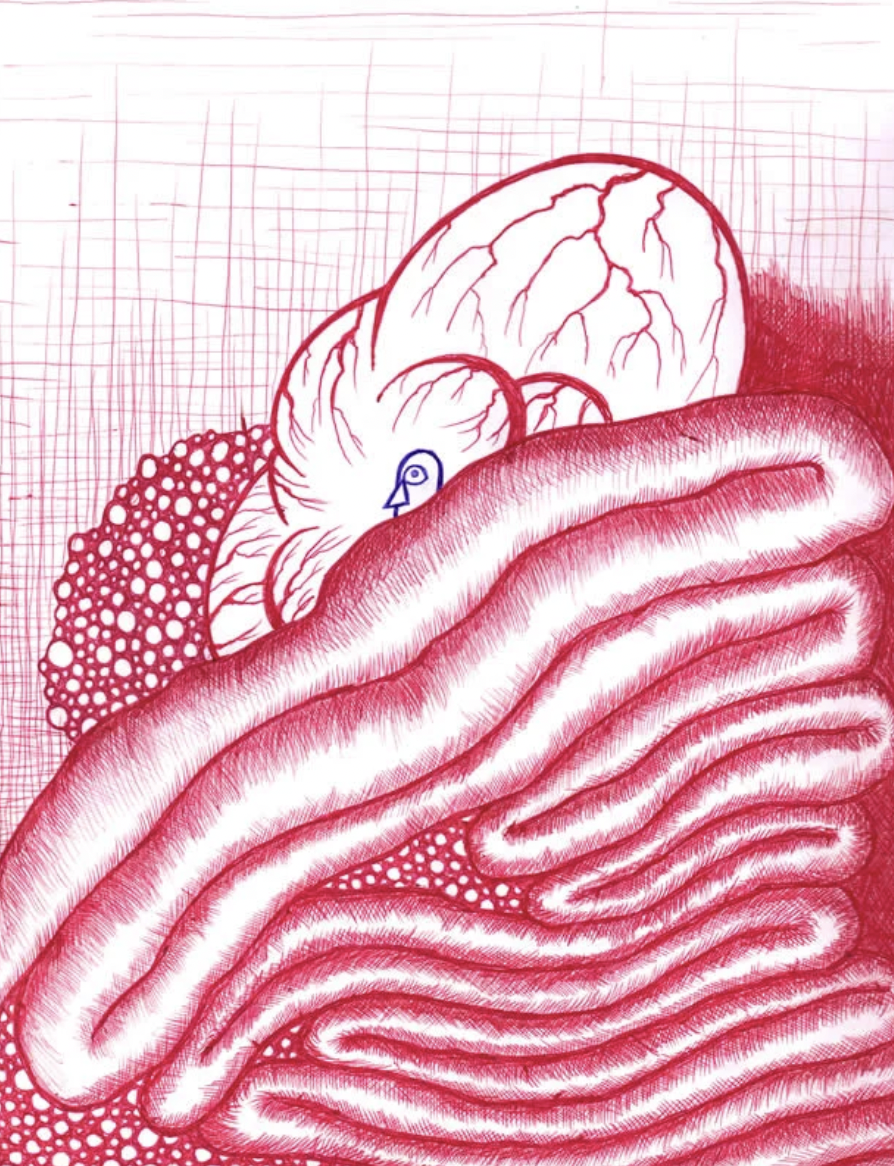
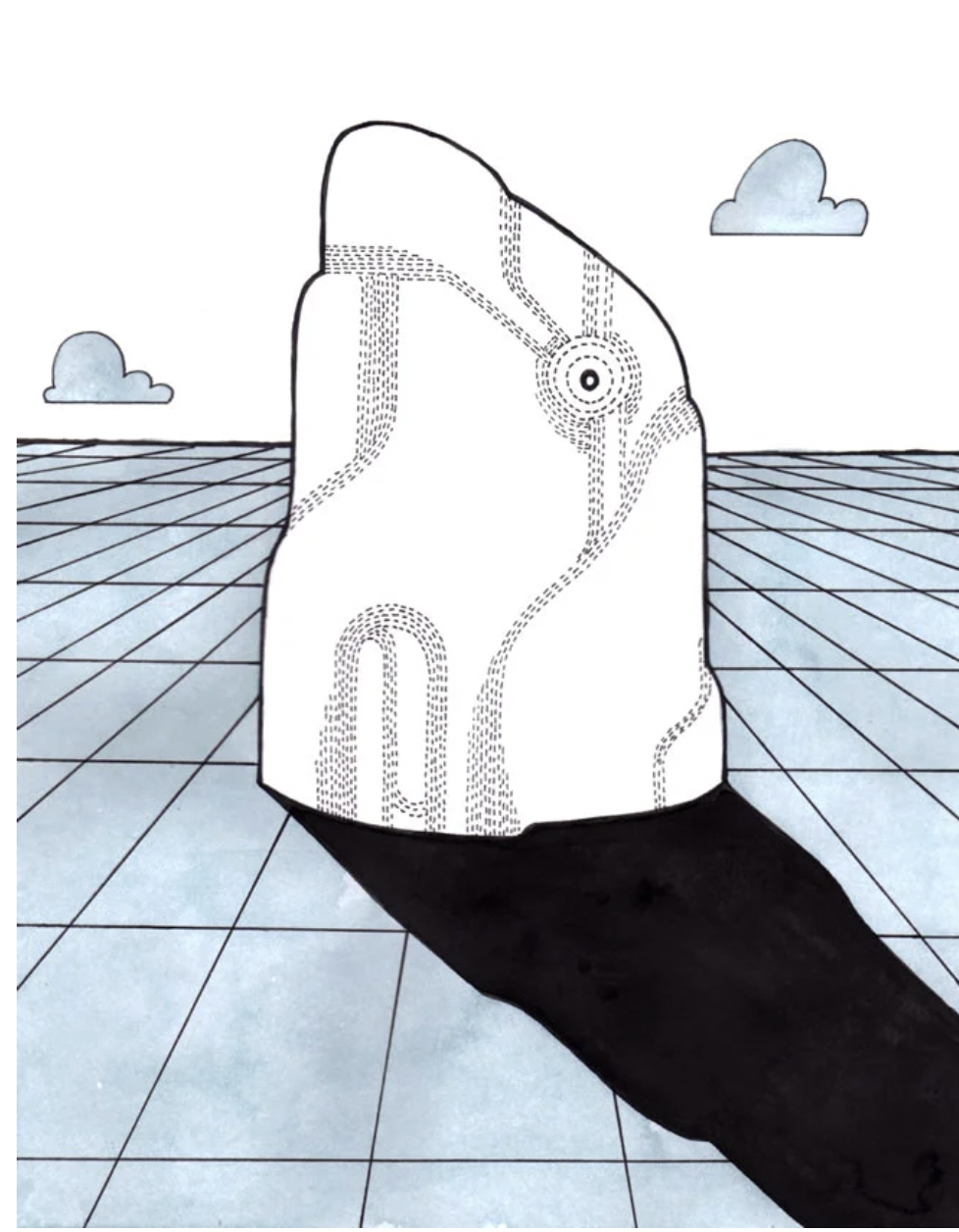
Illustration by Matt Kish
Reflections
In Ahab and the Carpenter (Chapter 108), Ahab complains of feeling sensation in his “phantom leg” and concludes that if a non-existent leg should feel pain – then could not a whole phantom being? This seems another manifestation of his belief in the existence of things beyond the perceived world.
Ishmael, writing of Queequeg being “close to the sill of the very door of death”, tells of Queequeg being able to see those dark mysteries that elude mortal man: “For whatever is truly wondrous and fearful in man, never yet was put into words or books.” This failure of the written word to capture the truly wondrous is inverted later when we are told that in fact there is some writing that purports to be “a mystical treatise on the art of attaining truth” on the very tattoos on Queequeg’s body; the only catch is no one can read them.
Ishmael’s rhapsodic feelings for the Pacific Ocean make us feel that a significant barrier has been crossed.
Why are we introduced to Perth and told his story so late in the booK? His reason for going to sea is presented as substitute for suicide, which seems to me the opposite motivation that drove Ishmael who is seeking a new experience.
In Chapter 113 (The Forge) Ahab’s incantation over the blood-tempered harpoon,“Ego non baptizo te in nomine patris, sed in nomine diaboli” means ”I do not baptize you in the name of the Father, but in the name of the Devil.” Has Ahab renounced God, or is he just recognizing that his obsession is unholy?
I found Pip’s laughter at the sight of Ahab and his newly forged harpoon very unsettling.
The comparison of the whaling ship to the progress of pioneers on the American prairie (114 – The Gilder) is illuminating, and very discussion worthy. The concept of Manifest Destiny – the obvious truth that westward expansion is America’s divine right is brought up and, perhaps, questioned.
The captain of the Bachelor (115) is shown to be the opposite of Ahab, and does not even believe in the existence of Moby Dick. Lucky man! “How wondrous familiar is a fool!” mutters Ahab.
Science and religion mix in Chapter 118 (The Quadrant). Ahab uses his quadrant while Fedallah uses his sun-worshipping mystical mojo to determine when to change course. Ahab rejects science and destroys the compass.
Chapter 119 (The Candles) seems to be the climax of the slow revelation of Ahab’s character, for here he confronts the most powerful force of nature – a typhoon – and directly defies it. Any hope that he might be deflected from his chosen course is extinguished as completely as the fire around the harpoon. At least that’s how I read it.