Gravity’s Rainbow Week Nine

Gravity’s Rainbow Week Nine

Gravity’s Rainbow Week Nine
These are my thoughts and notes from this week’s reading. Looking forward to unpacking some of the themes and filling the gaps with the gang!
– James
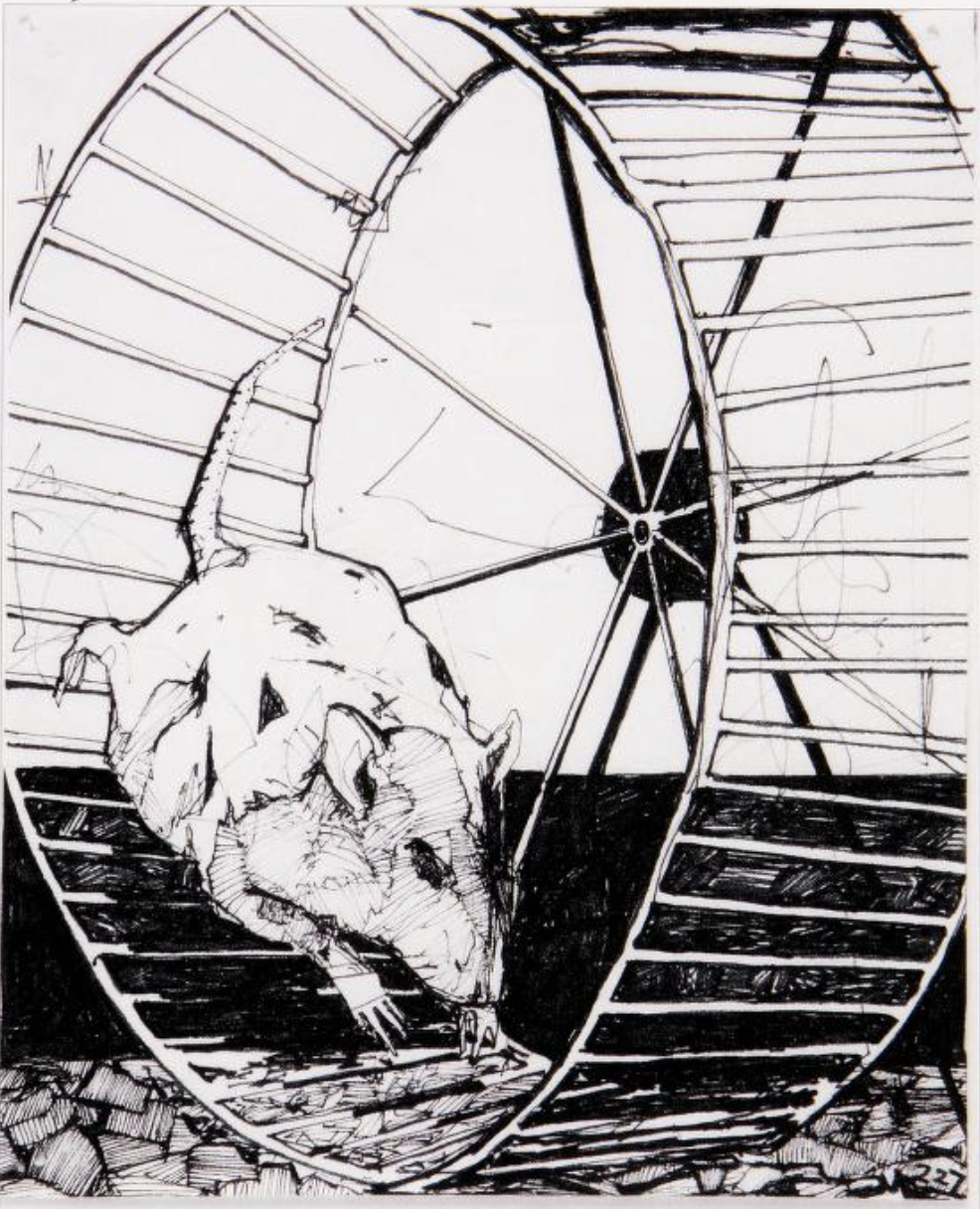
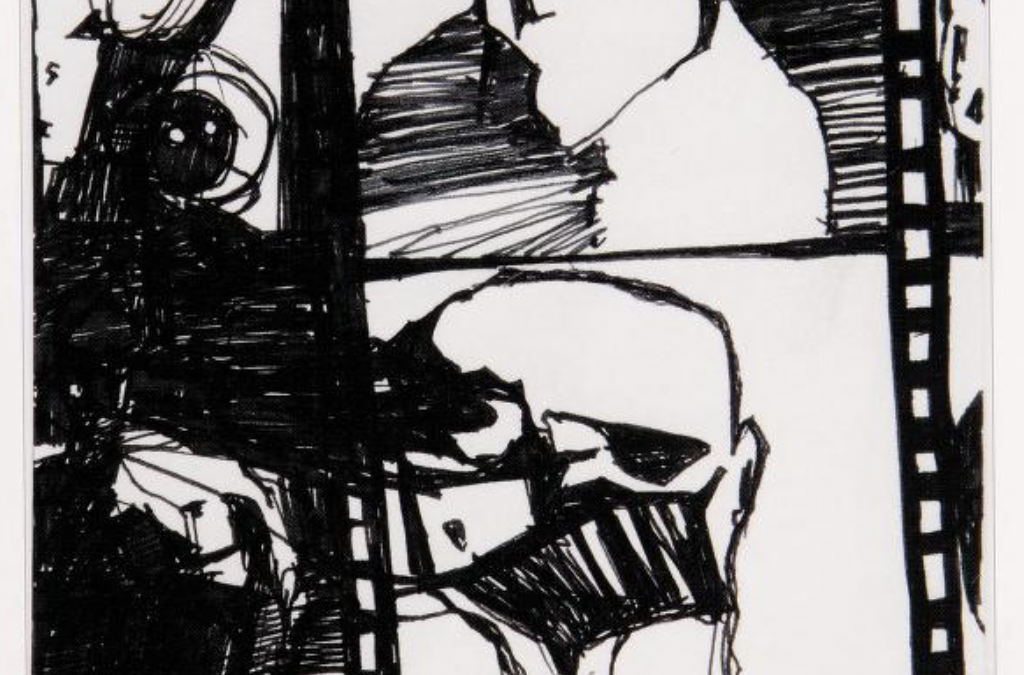
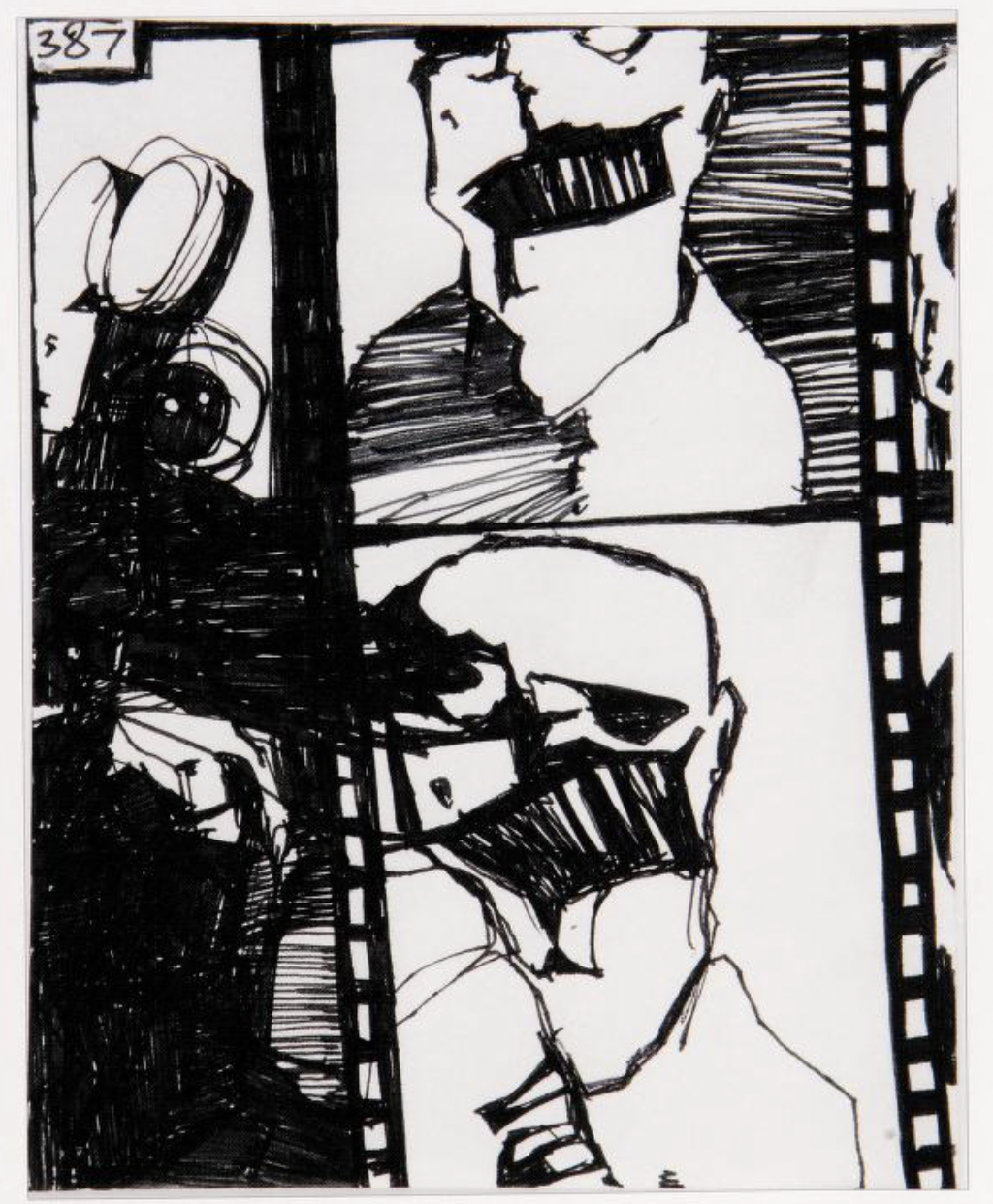
Image by Zak Smith

Reflections

We begin this week’s reading zeroed in on the Argentinian anarchist revolutionaries (Squalidozzi, their leader, was previously seen in Part II with Slothrop, recruiting our hero for a covert message delivery). The Argetntine Anarchists have commandeered a U-boat and are plotting their own revolution in post WW2 Europe. The overarching themes of ideological chaos in the post-war landscape are peppered throughout Part III of the novel, and I noticed at this point that some parallels between the Argentine Anarchists and the Hereros. Both parties are disenfranchised, mobile, zig-zagging across the map, and using the Allied/Axis power characters to advance their own political and cultural agenda.

The Argentine Anarchists are an eclectic, passionate bunch including El Nato who cosplays as a 19th-century Gaucho. I discovered in my research that Gauchos are a symbol of national resistance across South America, a revolutionary cowboy of sorts.

Squalidozzi relays to his team his experience in Bavaria, where he encountered a film being screened in a run-down harmonica factory. The audience is clad in zoot suits (they are back!) and Caligari gloves (a reference to the Mickey Mouse style gloves worn by Dr. Caligari in The Cabinet of Dr. Caligari and apparently in vogue in the Zone. I love this reference and Caligari would make for excellent Halloween watching for any movie fans in the group!). Squalidozzi is introduced to….Gerhardt von Goll! The filmmaker who made the Schwarzcommando/Hereros films! Von Goll goes by the pseudonym “Der Springer” (a reference to the Knight chess piece?) and immediately hits it off with Squazodolli. Von Goll agrees to adapt the Gaucho revolutionary poem Martin Fierro for the Anarchists. We then get a taste of the film, with descriptions reminiscent of our favourite spaghetti westerns.

One of my favourite prose moments in the book so far is Von Goll espousing his filmmaking mission to Squalidozzi:

“It is my mission,” he announces to Squalidozzi, with the profound humility that only a German movie director can summon, “to sow in the Zone the seeds of reality. The historical moment demands this, and I can only be its servant. My images, somehow, have been chose for incarnation. What I can do for the Schwarzkommando I can do for your dream of pampas and sky….I can take down your fences and your labyrinth walls, I can lead back to the Garden you hardly remember….”

Despite Von Goll being a maniac, the idea that films can be vehicles for transmuting realities (in ways that even novels cannot) resonates. The Argentine Anarchists feel the same way with Squalidozzi taking this back to the group, with the normally gruff Belaustegui stating “What if we’ve really come back, back to the way it was before the continents drifted apart?” Can film be a vehicle for inter-continental revolution? This reader says yes.

The Argentine Anarchists are then intercepted by another returning character, the U.S.S. John E. Badass whose crew has been drugged by spiked coffee grounds (with Lazlo Jamf’s intoxicant, another returning character). This causes the John E. Badass to fire their torpedo wildly, missing the U-boat and hitting a floating corpse instead.

Pynchon does something particularly interesting at the end of this chapter, switching to second person perspective (“Now what sea is this you have crossed… pg. 396). From my memory, this is one of the rare instances in the novel that the author/narrator/Greek chorus addresses characters in the novel.

□ □ □ □ □ □ □

In this brief episode, Tchitcherine returns with his driver and sidekick Dzabajev. They have captured Slothrop with a tip from Geli and are contemplating what to do with our hero. Tchitcherine muses that he and Slothrop would have been friends in another life with their shared love of costuming and women. The quick flashback to Tchitcherine’s childhood, putting on a wolf mask for a school play (“I am the Wolf… pg.397) was bang-on to the feeling of being a child and putting on a costume for Halloween or a school event and feeling like a superhero, a witch, another person…

Tchitcherine refers to the folks scavenging the Zone (Slothrop, Enzian, etc) as the “Faithful” “Pilgrims along the roads of miracle”. This deification of the Rockets (which fully arises in the final episode of our reading) is a constant throughout the novel as we have much discussed and I believe Slothrop, Enzian, and Tchitcherine are at the heart of that. Tchitcherine and his sidekick return to smoking hash under a tree, cackling insanely.

□ □ □ □ □ □ □

Slothrop awakes on a cot still dressed as Rocketman. The heisted hash is gone (thanks Tchitcherine) and he appears to be in a movie studio. Slothrop encounters Margherita Erdmann, a former B-movie star, in search of her daughter Bianca across post-war Europe. She is wandering through the movie studio, reminiscing of her time in the films of Von Goll (Der Springer from the above. The threads are connecting…). Von Goll’s films were transgressive art films in line with his ethos outlined in the above episode. It is revealed that one of Margherita’s co-stars is “Max Schlepzig”, an apparently common pseudonym as this is the exact name that Slothrop received for his falsified identity papers! Slothrop clocks this immediately, with Margherita even revealing the signature on the falsified ID is indeed Max’s.

Slothrop and Margherita fall into a re-enactment of a Schelpzig/Erdmann film Alpdrucken , with Margherita going so far as calling Slothrop “Max”. Margherita speculates that her daughter, Bianca, was conceived in the Alpdrucken scene. Once again, as with Geli, Slothrop becomes another man, in costume and performance. Shifting identities bleed into each other into the next episode…. (fade out cinematically)

□ □ □ □ □ □ □

(fade in cinematically) The episode fades into the original Alpdrucken Schelpzig/Erdmann scene being played out on a film screen, excitedly witnessed by Franz Pokler. Pokler conceives his child, Ilse, with his estranged wife Leni the night of viewing Alpdrucken. Leni was introduced as the paramour of Peter Sascha in the novel.

This episode is complex, shedding insight into Pokler’s relationship with his child Ilse and its connection to the German rocket program led by Weissman( Blicero). Pokler meets his daughter every year at the same location, Zwolfkinder, a resort/theme park of sorts. This episode’s POV shifts into Pokler’s history within the rocket program and Leni’s pacifist objections to the program (“They’re using it to kill people,” Pokler: “We’ll all use it, someday, to leave the earth. To Transcend”). The occult, spiritual, and scientific collide in the development of the German Rocket. The team members’ descriptions range from the occult, to the Zen, to Mondaugen described as the bodhisattva (a Buddha to be). Enzian re-appears as the protege of Weissman, described as “Weissmann’s Monster” “less out of racism than at the picture the two of the made” (pg. 410).

Weissman permits a once-a-year visit with his “daughter”, who he is told is being housed at re-education camps (concentration camps) ran by the SS. The “daughter” is presented as a different child each time to Pokler’s memory (or is it the effects of the concentration camp and memory…), with the clothes and looks of Leni. One heartbreaking passage (pg.416), Pokler and “Leni” are permitted to view a rocket launch together: “It was a message to him, but he didn’t understand till later what it meant. It meant that there was no violation of security: there was no she could tell who mattered”. Pokler knows that he cannot question what’s in front of him and his anger turns to the shame of acceptance, and loathing for Weissman/Blicero.

A chemist, Kekule, is introduced to the rocket program on pg. 418 and delivers what feels like a substantial passage (almost thesis statement) on his dream of the Great Serpent holding its own tail in its mouth surrounding the World. The cyclical descriptions of the World and the System, in which the System takes from the World stripping it of resources and demanding that productivity and earnings keep on increasing with time, very much resonated with me in the spirit of 1960s/1970s counter culture writing. The Great Serpent dream is aligned with the discovery of six carbon atoms of benzene that are formed in a closed ring. The Rocket Program leadership view this a premonition (“but who, who sent, the Dream?” pg.420) and Kekule is exalted, further compounding the mysticism of the Rocket Program.

Pokler appears to be descending into madness, dreaming of sabotaging the Rocket Program and fleeing to England. He is certain now that “Ilse” is an imposter and is permitted an out of town vacation to Zwolfkinder, a resort town run by children, with “Ilse”. This begins a yearly affair in Zwolfkinder with the false “Ilse”, a new person each time, a disturbing arrangement orchestrated by Wiessman as a means of control. Pokler returns every year in shame, waiting for a rocket to destroy him.

The episode ends with the war nearing its end and Pokler being transferred to an underground factory at Nordhausen. The Schwarzcommando have grown away from the SS and have abandoned Weissman. Pokler leaves Nordhausen after the war and sees the devastation of the Dora concentration camp where the real Ilse was likely being held. This is the close-up of the Holocaust that Pynchon has thus far skirted and it is zoomed in on in terrible fashion. The realities of the Holocaust hit Pokler, as well as the reader as we trapezed through WW2 with Slothrop in a mad-cap manner, and Pokler is given a final letter and permit to go back to Zwolfkinder to see “Ilse”. We leave Pokler in the devastation of Dora. He sees a woman lying in the liberated camp and gives her his wedding ring, in the hopes that if she lives that it will buy her food, a ride, or shelter.

□ □ □ □ □ □ □

That’s a wrap for pages 389-440! I am looking forward to discussing with the group as this was a particularly heady portion of the novel with lots of background, exposition, humour (I found the Gaucho descriptions fun) and darkness (Pokler’s story), connections to sections and characters past. I, for one, am feeling the bigger picture is coming together in true Pynchonian fashion. I particularly connected with the film theory parts of the reading and the book mirroring cinematic devices throughout. See you all soon!
Gravity’s Rainbow Week Eight

Gravity’s Rainbow Week Eight

Gravity’s Rainbow Week Eight

I’m going to buck the trend and allow someone else to summarize given
there’s the below fantastic breakdown already.

It looks like page 334-389 of the Penguin Classic Delux Edition correspond
to his summaries “Chapter 4” through the end of “Chapter 7” of the LibGuy’s reading site

The 2020 publication jumped at me. What a beautiful lockdown gift, so many years after the fact.

– Nikki

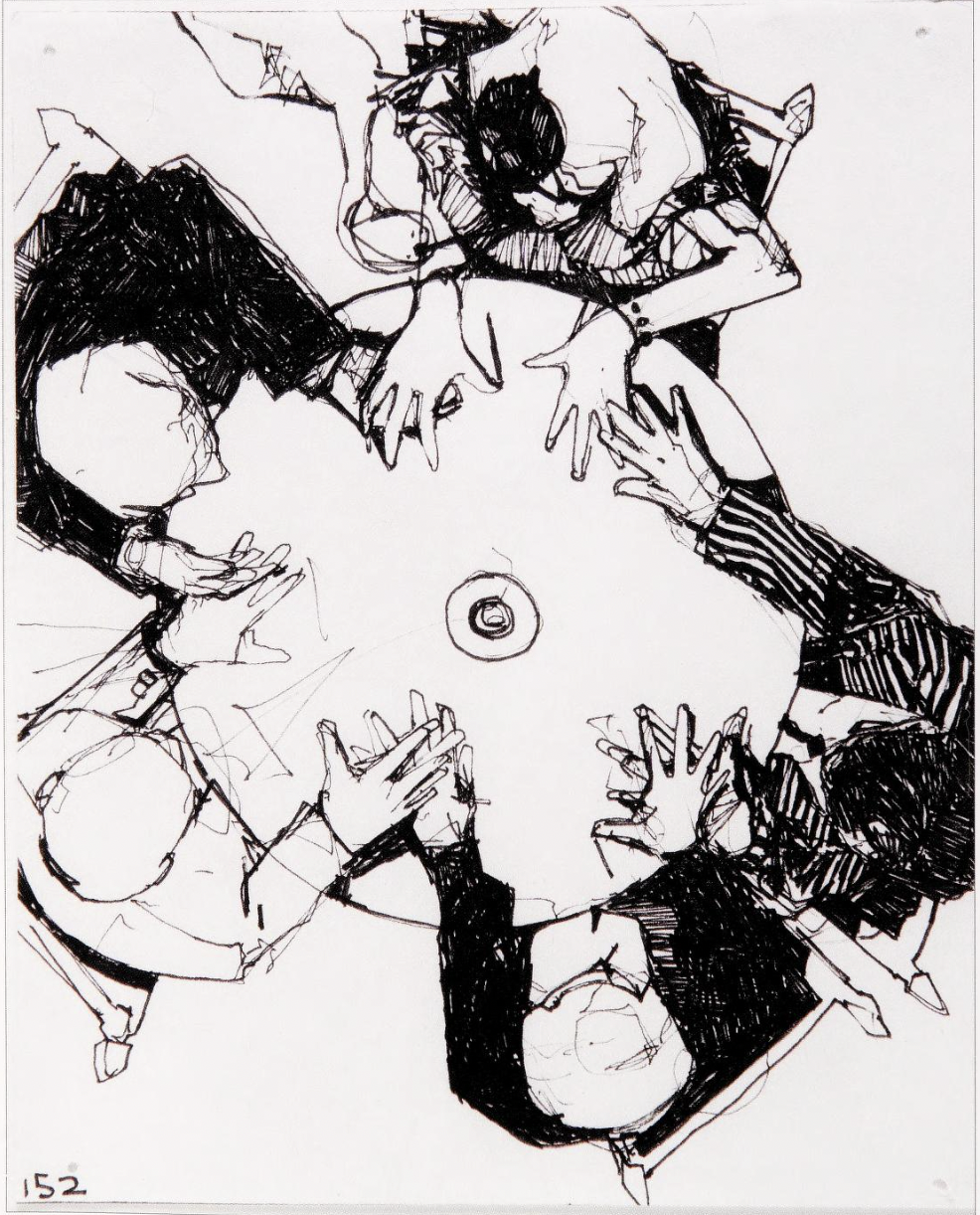
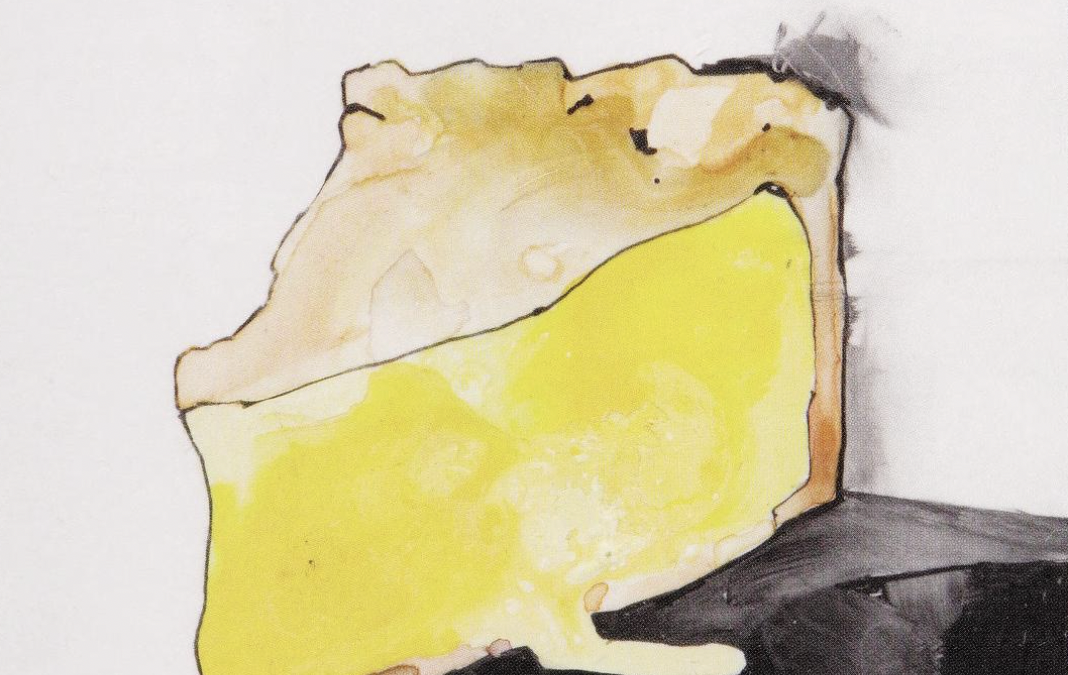
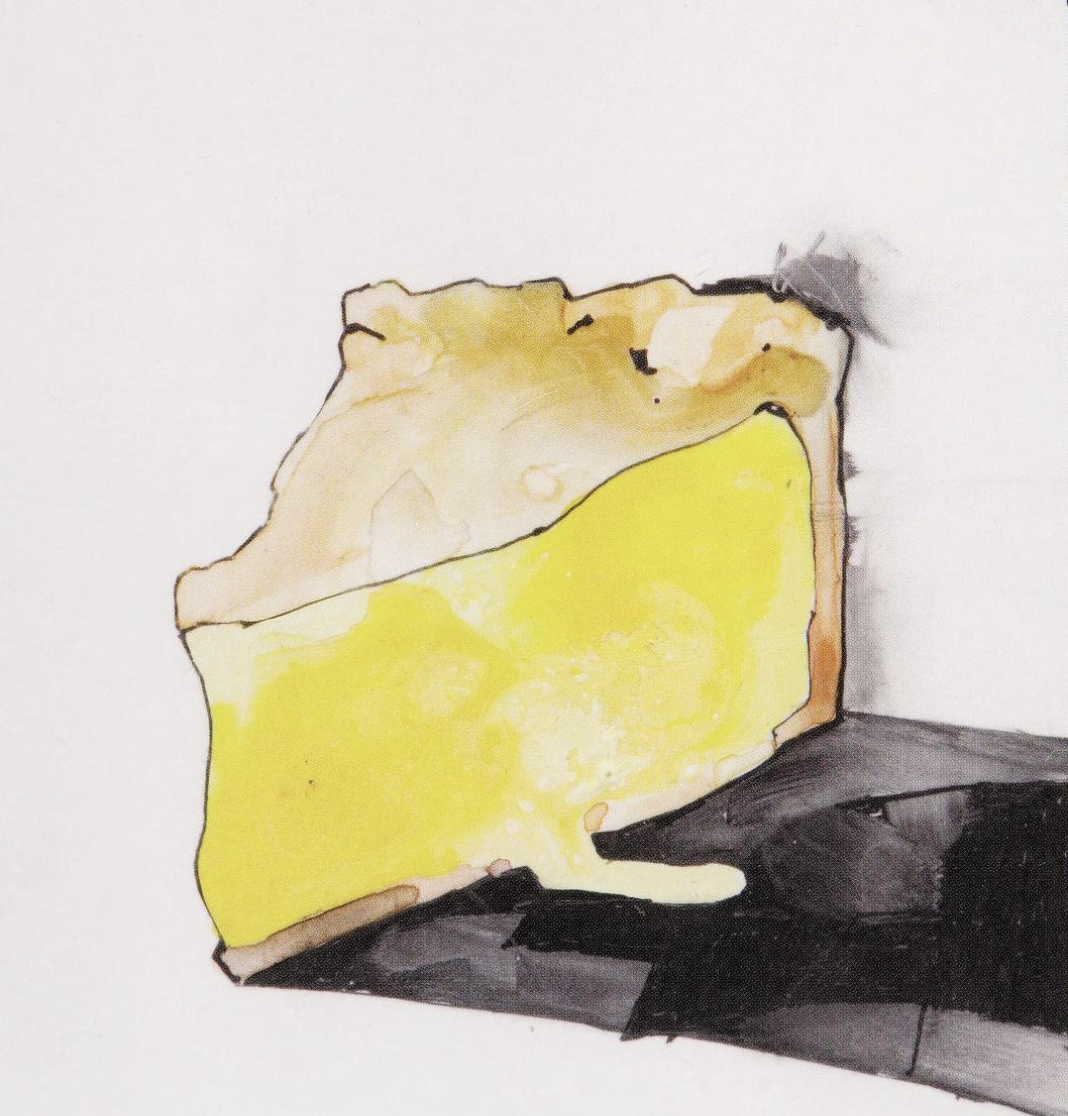
Image by Zak Smith

Reflections

I also ended up on a Pynchon reddit deep dive and the opinions on Gravity’s Rainbow are quite divisive. However, there’s a general trend that people seem to find it more enjoyable on the reread. I kept thinking that this guy’s style goes head to head with all the research I’ve read on working memory. I wonder if that first read gives a mental pathway through it, making the reread itself more enjoyable than the meandering madhouse wander through the first time. Even reading the above summary before the book itself this week led to a significant increase in my enjoyment of this section. Also, a hankering for pie. I may just end up assuaging that with a Big Ass Tart tomorrow (no targets other than my stomach, I promise!). Anyone else?

For anyone else who’s been struggling with this book, I’m curious what strategies you’re using to keep at it. For those who aren’t. I’m curious how, and if you have something in common. Looking forward to hearing from
you all tomorrow!

Gravity’s Rainbow Week Seven

Gravity’s Rainbow Week Seven

Gravity’s Rainbow Week Seven

This week’s reading broke from our typical cadence of reading from either around the hundreds to the fifties or from around the fifties to the next hundreds, so, if you are anything like me, you may be a bit mixed up as to where we’re meant to be. In any case, this week’s reading was an enlightening adventure.

– Ben

Image by Zak Smith

Recap & Reflections

□ □ □ □ □ □ □

We begin this week on a new chapter (book?) (3. In the Zone), with a familiar quotation “Toto, I have a feeling we’re not in Kansas any more….” Fair, enough, we’re not in Kansas anymore, but it’s hard to say that the Zone is any stranger (or less strange) than the previous settings of Gravity’s Rainbow. We are in Nordhausen, which is more or less in the geometric centre of Germany (or Mitteldeutschland). In the early 1900s, Nordhausen became the centre for the engineering and arms industries, and, relevant to our reading, hosted (nearby at least) the Mittlebau-Dora concentration camp, where 60,000 people were forced to work in the arms industry. Conditions in this camp were, predictably, awful for the people who were forced to work there, and ultimately the rockets produced at Mittlewerk suffered from production flaws that yielded launchpad and mid-flight explosions. The familiar Wernher Von Braun visited the Mittlewerk amidst these production issues. Quoting Wikipedia “More people famously died constructing these weapons [V-2s and V-1s] under horrific conditions than were killed by their actual detonations.” As an aside, the excellent Michael Chabon book Moonglow features scenes of the main character (Chabon’s grandpa)’s exploration of the horrors of the Mittlewerk tunnels and manhunt for Von Braun.

Slothrop has been relieved of his shoes “by some DP with fingers lighter than dreams” on his way from Switzerland across Bavaria. In return, they’ve left a tulip between his toes, a perceived sign of Katje. Major Duane Marvy has departed (not much discussed here, but important later). Slothrop’s rambling through the Zone, trading a doll’s lapis lazuli eyes for a ride and half a boiled potato and being confronted with signs of Katje. He (improbably) feeds a horrible-smelling fire with the human (Russian Jewess) hair from the doll’s head as toys roll towards the fire. Slothrop chats with the (ghost of?) the doll’s owner.

He now has the chance to dig a bit deeper into the files bootlegged for him by Mario Schweitar back in Zürich. Imipolex G was ordered by one Franz Pökler and was to be delivered to Nordhausen and the Mittlewerke, where the rockets were supposed to be produced en masse, but which has since (back in Feb/March) been evacuated. So Slothrop, as ace reporter Ian Scuffling, decides to do some boots-on-the-ground journalism at the Mittlewerke. Slothrop gets on a train (I think) to the Mittelwerke with “thirty other cold and tattered souls [mostly kids], eyes all pupil, lips cratered with sores” who are singing a Displaced Persons song.

We learn more about what is in the dossier on Laszlo Jamf. Jamf is one of those characters who seems to be connected in some way with nearly all other characters, organizations, and events in the novel. An incomplete list: Grössli Chemical Corp – ultimately IG Farben, (Uncle) Lyle Bland (of Boston, Mass), Stinnes, Walter Rathenau, Krupp and Thyssen (took me a bit to realize why these names are familiar: ThyssenKrupp manufactured the elevator that I ride up to my office every day), Weimar Republic, and, invariably, the Slothrop Paper Company. Notable line from this segment “Those were the days when you carried marks around in wheelbarrows to your daily shopping and used them for toilet paper, assuming you had anything to shit.” Jamf was, evidently, an all-too-familiar from our modern times, shyster who profits off of sketchy dealings in which fake (crypto?) currency is, invented, bought, and sold to help profit from the purchase of the instruments of war. Slothrop gets inexplicably aroused and is enveloped by a soft and chemical, threatening, haunting smell from before his conscious memory begins – the breath of the Forbidden Wing. In fact, the smell if Imipolex G. Jamf paid $5000 for Slothrop’s education at Harvard, and Slothrop realizes he’s been sold to IG Farben like a side of beef. Slothrop realizes that he may have been under observation by the IG since he was born.

Slothrop’s freaking out, so decides to climb a ladder up to the top of the freight car that he is riding in (towards Nordhuasen and the Mittelwerke), where he meets Major Marvy, who is, surprisingly, “really fat” and whose pants are “bloused” (great verb) into his shiny combat boots and whose eyes are “like safety valves that pop out at you whenever the pressure gets too high.” In addition to being confused by this version of Marvy, Slothrop’s feet are cold, because he is still not wearing any shoes. Racist conversation with Marvy ensues, and we are then introduced to Oberst Enzian, “a tall African with a full imperial beard” and member of the Schwarzkommando, as he throws the Major from the roof. Enzian doesn’t believe Slothrop’s war correspondent ploy, but they do finally get to Nordhausen.

We meet the “thin, awkward, very young” Geli Tripping, singing a song and playing a balalaika, which belongs to the Soviet intelligence officer Tchitcherine. They hook up, she (irritatingly to Slothrop) fantasizing about her boyfriend Tchitcherine. Later, her owl, Wehrner stops by for a Baby Ruth candy bar. She also calls out Slothrop’s war correspondent bluff, to which he offers his War Correspondent badge and his Hemingway-esque ‘stache.

Geli offers up some info about the Imipolex G device, the S-Gerat, and Rocket Number 00000, which she has gleaned from reading Vaslav (Tchitcherine’s?) mail. They hook up again, and the owl reappears.

□ □ □ □ □ □ □

Slothrop departs against the “Sunday-funnies dawn”, wearing Thicherine’s giant shoes with bits of an old chemise stuffed in them to fit his feet. We’re presented with rambling speculation about the Mittlewerke and neighboring Dora prison camp. Enzian evidently had an Illumination, in the course of a wet dream where he coupled with a slender white rocket and you can still view (a replica of) the result. There is discussion of “The Promise of Space Travel” (remember Von Braun was crucial to the development of the Saturn V rocket, which propelled the Apollo missions to their success). The 1.5 pg long paragraph ends with a return to the polymerized indoles of Imipolex G.
Slothrop gets to the Mittlewerke tunnel entrance, which is shaped like a parabola, where he is shrugged through after presenting his SHAEF (Supreme Headquarters Allied Expeditionary Force) pass, signed by Ike himself. The shape of the Mittlewerke is an elongated SS, with cross-tunnels linking the main ones. These were dug by the forced labor of the prisoners. The SS is a double integral sign, ∬, (which I personally will never be able to see without thinking of the ancient meme tacked up on the wall of the break area of my grad school institution where some renaissance-looking gents are saying “We put integrals into our integrals so we can derive while we derive”). Pynchon gives us another lay-explanation of calculus (meters per second integrates to meters; if we’re talking double integrals, we would integrate acceleration over time – meters per second per second (e.g. gravitational acceleration = 9.8 m/s2) to get velocity (meters per second), on the way to getting to distance (meters). In other words, rockets need to accelerate to overcome gravity (i.e. pulling gs) and go the distance. We are berated with various, further discussion of integrals and rockets (with reference to Pointsman and Katje), before ending with ∬ as a motif for spooning lovers, and Katje, of course, comes to mind.

We then gain a visual description of the Mittelwerke and its tunnels and cross-tunnels, with the apt quote “It is hard down here in the Mittelwerke to live in the present for very long. The nostalgia you feel is not your own, but it’s potent.” In Stollen 20 and up, where the traffic grows heavier, we are exposed to rocket parts, and, eventually Americans and Russians gathered around a massive barrel of beer. The Americans are singing Rocket Limericks. Slothrop is hungry and thirsty so takes a harrowing cable ride down to Stollen 41 to get some lunch. Lots of singing and drinking, Russian and American alike, Slothrop is granted a foaming, ice cold shell-case (of beer, what else?). Slothrop, holding another beer, finds that it is the going-away party of Major Marvy’s ,who appears presently with bruises to show he did indeed rapidly descend from the top of a freight car in the recent past. A sergeant dozing with a gun in his hands wakes up and blows apart the beer barrel. So much for that.

Slothrop decides to get while the gettin’s good and finds an old man, Glimpf, Professor of Mathematics at the TH Darmstadt and Science Adviser to the Allied Military Government, to whisk him away. They duck into a metal storage area, Slothrop hops into some coveralls, combs his pompadour forward, and cuts his stache at both sides and ends up looking a bit like Hitler. Slothrop is scared shitless, partially because Glimpf is turning out to be a raving maniac. He shouts provocatives back at the drunk soldiers and they begin pursuit. Slothrop and Glimpf fire up a tractor/train and start on their way. Slothrop uncouples cars to pick up speed. They encounter Major Marvy himself, invariably wearing a giant white John B. Stetson, armed with a .45 automatic for each hand, who opens fire as Slothrop ducks behind a – you guessed it – giant warhead. He shoves it onto the rails, and Glimpf and Slothrop make haste back to the parabolic entrance.

They hijack a Mercedes and head to Glimpf’s colleague Zwitter’s lab and we conclude with a wartime jingle.

□ □ □ □ □ □ □

We start with an excerpt from Tales of the Schwarzkommando about the battle between theoretical predictions of the most desirable working pressure and empirical measurements of the same. Enzian told them to stick with the empirical constraints.

We learn a bit more about the Schwarzkommando, which is no longer a military title but rather a class of people, Zone-Hereros, in exile from SW Africa for two generations. Erdschwein (ardvaark) presents some sort of joke, harkening back to Africa and their current life in the tunnels. Back in Africa, Erdwchwieinhöhle was a powerful symbol of fertility and life, but it’s not so clear now in the Zone.

Enzian is known behind his back as Otyikondo, the Halfbreed, because his dad was a European. As the Rocket grows toward its working shape and fullness, so does Enzian evolve into a new configuration. Enzian and colleagues discuss the Final Zero, which embraces all the
Deviations (think pedophilia, homosexuality, and so on) in one single act.

We proceed to learn, in a rambling way, about Enzian and the Hereros and their traditions. Weissmann (literally, white man) comes into the discussion as well. We end with them receiving a radio transmission, and, finally learn that Enzian and Tchitcherine are half-brothers (although Enzian’s never seen the man). Enzian evidently wants a chance at Tchictcherine.

□ □ □ □ □ □ □

Lots to unpack here, and I look forward to doing so with you all!

Gravity’s Rainbow Week Six

Gravity’s Rainbow Week Six

Gravity’s Rainbow Week Six

This section was full o’ hijinks and I enjoyed taking a closer look. As always, there’s layers-upon-layers of symbolism and meaning in Pynchon’s writing but I’ve tried to stick to the surface details that my li’l brain can handle. Enjoy!

– Kris

Image by Zak Smith

Recap & Reflections

□ □ □ □ □ □ □

“It is necessary to thread one’s way among bodies to get to where anything’s happening. What’s happening is not clear.”

We open at Raoul’s party where things are firmly in disarray. The punch (Hollandaise) has been spiked (hashed?) and seems to have given people the munchies for broccoli of all things. The place is full of characters. “An emaciated crooner with wavy hair and very red eyes” sings one of my favourite, dumbest rhymes so far “Jool-yaaahh, no one else could love you tru-lier.” Raoul de la Perlimpinpin wanders about dressed like a no-foolin’ cowpoke complete with giant Percheron horse shitting on the floor and on some of the guests. The “mean customer” is, we soon learn, Blodgett Waxwing, military prison escapee, Western film aficionado, and forger extraordinaire. He must have some real special stationery to forge papers with fingers the size of corncobs. And of course that rascal of a white slaver, Jean-Claude Gongue, is busy white-slaving in the eucalyptus grove. Slothrop holds on to some important mystery documents from Waxwing and later manages to score not only a version of Waxwing’s zoot suit with reet pleats (fun rhyming again) but a sweet keychain as well.

The ensuing chaos stemming from a convolutedly looping series of borrowings and dealings between Tamara, Italo, Waxwing, Theophile and Raoul is wonderfully ridiculous. I especially like that the summary of said dealings ends with the sentence “Something like that.” which sums up my sense of it perfectly. Tamara bursts onto the scene in the very tank Theophile had put up as collateral and attempts to blast the whole gang of debtors and creditors to kingdom come. I especially loved the visual of Raoul trying to flee by horse only to miss and fall into a tub of Jell-o. (“Aw, no…”) The tank shell turns out to be a dud which only manages to put holes in a few walls and wreck a painting of Virtue and Vice, the symbolism of which could’ve been milked to oblivion in my grade 12 English class. Slothrop gets to play the hero once more (for real this time) and manages to have a physical altercation with a female without getting a boner. After Tamara is taken away Slothrop returns the envelope to Waxwing and is given not only the coveted suit and keychain but also a special business card and instructions to head to Nice.

The scene at the end of this section recounting how Ricky Gutiérrez’s suit ended up in Europe was touching and sad. The Anglo vigilantes beating him up while police look on (and give advice to the chuds) before intervening and arresting the non-white victim is all too familiar. I’ll leave it to you to read more about the Zoot Suit Riots if you’re in the mood for learning about another depressing chapter in history. Ricky hocking his suit is something that will resurface later when Slothrop is forced to pawn it for a bit of baloney money.

□ □ □ □ □ □ □

“We are obsessed with building labyrinths… To draw ever more complex patterns on the blank sheet.”

I found this doozy of a section simultaneously long and breezy. We get a lot more detail on the origins and chemical composition of Imipolex G, the substance developed by Laszlo Jamf and used to manipulate baby Tyrone’s brain and body. Someone with the right knowledge could likely speak to the coherence or incoherence of the chemistry-speak being used here. Either way, I enjoyed the passage. Some standouts for me were the bit about nylon being “an announcement of Plasticity’s central canon: that chemists were no longer to be at the mercy of Nature” and “Plasticity’s virtuous triad of Strength, Stability and Whiteness” being often “taken for Nazi graffiti”. Albert Hoffman, father of LSD (as every schoolchild knows), also gets a nod.

Slothrop’s fantasy raid on Shell Mex House with Waxwing in tow (acting as the Zoot-suit Zanies, lol) is pure, gleeful comic book violence. (Side thought: maybe Slothrop reading a *Plastic* Man comic earlier on was a bit too on-the-nose?). From the parts list, he gets a clue pointing towards that elusive Document SG-1. “S-Gerät, 11/00000”. At the Casino restaurant, last Tuesday’s London Times has been conspicuously left at the table where Slothrop happens to sit. He learns of Tantivy’s purported death, with a obit stinking of feigned glory signed by none other than that false friend, Theodore Bloat. Before heading off to Nice, he has a few last words with Hilary Bounce who’s evidently had a nice night with Michele. I can’t help but wonder if she made off with his IG Farben trinket after all.

And off we go! Down through shifty, duplicitous dealings in backrooms, corridors and cafés in the classic espionage style. Slothrop manages to shake the big-t Them off his tail by disguising his pal Claude in his own “pseudo-Tahitian bathing trunks”. I think the Citroën with the keys left in was intentionally planted for our hero, but I like to believe he has a shady past as a car thief and just had a sixth sense… The image of Tyrone rolling into town in his white zoot suit, sunglasses, and Panama hat (think straw fedora) is goofy as hell and seems to be as far from camouflaged as he can get. When he reaches his hotel I love the line about the drunks lying in the hallways with “eyelids like tiny loaves brushed with a last glaze of setting sun”. It’s really evocative and made me crave a good brioche.

At the hotel, he encounters various comrades-in-arms who respond effusively to the sight of Waxwing’s card. He gets a fake id, some money, and a warning to stay away from the girls who work in the hotel (“Aw…”). He has a miserable sleep, interrupted by bugs (real or imagined?) and drunks with great names like Dumpster Villard and Murray Smile. He either dreams or willfully hallucinates a conversation with Jenny, one of his former conquests. What he really wants is to talk to Katje and Tantivy but he can’t seem to muster their voices. “What he wants lies too deep…”

He’s nearly nabbed by some American Military Police who are acting “as demoralizing as a close-up of John Wayne screaming ‘BANZAI!'” but is saved by a Hopper Ex Machina. He sets off as Ian Scuffling, English war correspondent, thanks to Waxwing’s cohorts.

Onto Zürich where he meets with his next contact, a Russian named Semyavin. Semyavin waxes nostalgic for a simpler time when people just wanted drugs, sex and luxury items. “Is it any wonder the world’s gone insane, with information come to be the only real medium of exchange?” (too real, too real). Slothrop spends his next stretch of time split between the three cafés he found under “Espionage, Industrial” in Semyavin’s list. A great descriptive paragraph follows detailing some of the types of people he encounters while on stakeout. And then we’re thrust into either Slothrop or Pynchon’s fever daydream of a musical, LOONIES ON LEAVE!, in which nuthouse Keepers and Nuts, respectively, are nearly indistinguishable from one another. This bit satirizes capitalist hucksters and the dopes that they fleece. By design, it’s all a bit much and I found myself agreeing with Tyrone “Think I’ll go take my nap now…”

One day, he finally manages to meet a new operative, Mario Schweitar, who offers him some L.S.D. (I’ll admit I thought the “pounds, shillings, pence” (Librae, solidi, denarii) retort was Pynchon’s own witticism and not a separate and potentially centuries-old abbreviation). Slothrop is excited to learn of Mario’s Sandoz connection and begs for any info on Imipolex G and L. Jamf. Schweitar says it’ll cost him and suggests trading in his beloved zoot suit for some quick cash. Slothrop, I mean… Ian Scuffling’s paranoia is running hot and he avoids returning to his hotel or latest haunts and ends up at the Odeon, a café with a supposedly illustrious history of influential patrons. There he makes the acquaintance of “a swarthy, curly-headed alien in a green suit”, Francisco Squalidozzi, an exiled Argentine anarchist living in Switzerland who wants to make it to Germany (the German Zone), a country whose collapse he perceives as an ideal plot from which anarchism can flourish.

Slothrop takes a job as messenger for Francisco in exchange for enough money to pay off Schweitar for his information and then some. He gets half the money up front and we next see him aboard a DC-3 plane whose description I find aspirational: “chosen for its affinity for moonlight, the kind expression on its windowed face, its darkness inside and outside.” Joke only… On the flight to Geneva, the spectral voice of real-life vanished explorer Richard Halliburton tells Slothrop, “There’s nowhere to go, Slothrop, nowhere”. Slothrop meets his Argentine contact and they make the handoff in a splaying out of all manner of paper products on a café table in which Squalidozzi’s message can be shrouded and passed along.

Back to Zürich where he finds Schweitar once more and pays him half his fee, then gets the location of Jamf’s grave, the site where they agree to finish up their dealings. Squalidozzi is nowhere to be found. After days camping out in Jamf’s crypt without so much as a measly haunting he receives a big fat envelope from Mario’s delivery boy and goes back to the crypt to light a fire and start poring over the Information: “not as much as he wanted but more than he hoped”.

□ □ □ □ □ □ □

“When everything has been taken care of, when nothing can go wrong, or even surprise us… something will.”

It’s Whitsun, or Pentecost, May 20th, 1945 (Easter having fallen on April 1st that year). The Nazis signed their unconditional surrender less than two weeks before. Pointsman, feeling “a certain obligation to go relax”, takes a seaside holiday with some of his White Visitation besties Roger, Jessica, and Katje as well as a Shell Mex House rep, Dennis Joint, whose prerogative is to take PISCES under the umbrella of SPOG (Special Projectiles Operations Group). Doesn’t quite have the same ring to it, does it? Slothrop has been out of Pointsman’s sight for almost a month after he made the mistake of letting the Secret Service take over the surveillance work in place of PISCES for the purpose of balancing the budget, the surveillance bill being “the most excruciating thorn in the crown of funding problems” Pointsman has to bear.

We learn that, with some funds freed up, Pointsman assembled SEZ WHO (Slothropian Episodic Zone, Weekly Historical Observations) the Anglo-American crack team of Harvey Speed and Floyd Perdoo who investigate some of Slothrop’s supposed sexcapades (“Don Giovanni’s map of Europe”) 2,065 of them to be precise. After a cute li’l canteloupe (sp?) diversion it’s revealed that Harvey and Floyd have come up short: “No Jenny. No Sally W. No Cybele. No Angela. No Catherine. No Lucy. No Gretchen.” They even tracked down dear old Mrs. Quoad, pusher of candied horrors, who has no recollection of the nurse Darlene. Pointsman fears Slothrop’s starred map may have referred to “sexual fantasies instead of real events” but reasons that PISCES is concerned only with a “clinical version of truth” and, fantasy or not, the correlation still holds water.

Shell Mex House is losing its collective mind now that Slothrop is running wild knowing “everything it’s possible to know” about the A4/V-2 as well as everything Great Britain knows about it. There’s serious concern that he’s fallen into Soviet hands, especially now that the uneasy alliance between the USSR and Europe has lost its use. More about PISCES’ disintegration is revealed, notably Brigadier Pudding (name conjuring what he’s been munching on, yech) seems to have lapsed on his penicillin intake. I think it’s sweet that mama bird Katje seems worried about him.

Then we get the vignette of Pointsman and co. near a seaside fair of sorts. The details are pointed and unique as ever. I especially laughed at “The donkeys hee-haw and shit, the children walk in it and their parents scream.” Dennis Joint is making goo-goo eyes at Katje, Roger and Jessica do the opposite, and Pointsman, initially trying to play it cool and “wait for the others to betray themselves” seems to be losing touch with reality. There’s a callback to Part 2’s opening quote from Merian C. Cooper in the bit about Mitchell Prettyplace and his 18-volume study of King Kong for which he even interviewed the King Kong Kultists (womp, womp) whose members have seen the movie at least 100 times and passed an 8-hour entrance exam. Maybe a bit of a poke at people who read into media a bit too much? There’s a connection being made between the fictional “black scapeape” and its mutant offspring, the Schwarzkommando. It seems some version of the Schwarzkommando was not just a fabrication of Operation Black Wing’s psy-op but a living, breathing group of Herero rocket troops sweeping across the Zone. News of this has melted ax-wielding Edwin Treacle’s mind who we find chasing a blue-skinned Gavin Trefoil through some decorative trees while screaming “Giant ape? I’ll show you a giant ape all right!”

Meanwhile Pointsman’s insane mutterings continue to freak out his pals who “begin to edge away, in definite alarm”. The voice he hears tells him that Roger Mexico is key to his operation and that Jessica is the only thing standing in the way. SPOG, by way of Dennis Joint, could be called upon to dispatch Jessica once and for all and then Roger, in his despair, would find work is “the best ointment for the burns.” The voice tries to convince him that he can be both hero and villain in this situation, Nayland Smith and Fu Manchu, Yang and Yin…

“Oh ha, ha,” he sez instead “Talking to myself here.”

Gravity’s Rainbow Week Five

Gravity’s Rainbow Week Five

Gravity’s Rainbow Week Five

It’s been a very long time since I last read this book any my memory was fuzzy, but this week I remembered. Oh boy did I remember. And then, with decades of maturity behind of me, I was all like, huh. 

– Johanna

Image by Zak Smith

Recap & Reflections

□ □ □ □ □ □ □

As Part 2 began last week, the great “fuck with Slothrop” routine was just getting started, and the aftermath of his tangle with Grigor the Octopus is reverberating through the Casino. Like so many in Pointsman’s path, Grigor’s handler Porkyevitch is fretting about his usefulness (can anyone remind me what the Bukharin conspiracy is? p. 192)

Slothrop and Tantivy are carousing, and Slothrop is wearing a really killer Hawaiian tie with naked hula dancers on it. Katje is playing cool and Slothrop decides to ratchet up the carouse, to better get her attention. Can you imagine having a personalized drinking song that everyone knows? I’m a little jealous.

But Slothrop can’t shake the weirdness of the octopus battle, and Tantivy gives him a little bit of assurance that he’s not batty – he notes that Teddy Bloat has been acting a little weird, and that he warned Tantivy about Katje. Armed with this info, Slothrop decides to still meet Katje up in her room – a “keep your enemies closer” sort of thing, I imagine. Plus, she’s so hot.

Katje’s wardrobe is just amazing. I love the descriptions of her clothes. And Slothrop is impressed too, until he gets a whiff of something operative about the whole thing.  From here, Slothrop is experiencing everything from (some would say and they might be wrong) a paranoiac’s view of things. They, capital “T” are messing with everything, and he’s seeing planted and adulterated situations everywhere. He just doesn’t know why. Why would They plant a seltzer bottle in the room just so Katje could spray him with it like some Catskills comedy trope? And has he been lured here to participate in the world’s best pillow fight just so his pants (and papers) can be stolen? (p. 201). I love how he just rolls with everything, chasing (a gremlin?) up a tree, wrapped in a sheet, only to tumble into a croquet game, where (coincidentally?) Bloat is there, and ready to help him into a spare British uniform, which he will stay in for the duration of this section.

The dissonance Slothrop is feeling is best articulated, and foreshadowed, in this passage “Shortly, unpleasantly so, it will come to him that everything in this room is really being used for something different. Meaning things to Them it has never meant to us. Never. Two orders of being, looking identical…but…but…(p. 205).”

Slothrop is feeling the “rainbow edges of what is almost on him” – the Forbidden Wing (p.205, 212). He is adrift, alone, the promised help long gone, with his papers.  He is bereft, and returns to Katje.

□ □ □ □ □ □ □

Sir Stephen Dodson-Truck “just materialized one day, out on the beach in a black suit” (p.209) which reminds me a lot of how the octopus arrived.  D-T and Katje have a relationship, that much is clear.  I love how Slothrop considers They may have chosen Dodson-Truck to “seduce his brain” while he reads Plasticman comics. (p. 210).

Slothrop knows Katje is doing her job as seductress, and we get a memory of them playing roulette, which leads Slothrop to consider that the game of chance is something They have control over.  We are briefly given allowed a glimpse of Slothrop’s hazy memory of the abuse he suffered as a baby (“Back in a room, early in Slothrop’s life, a room forbidden to him now, is something very bad” p. 211) and he sees kinship in Katje.

There’s something important in Katje’s declaration of their positions within the rocket’s trajectory/parabola/Rainbow (p. 212) – let’s remember that!

Slothrop is “raising” a moustache. He knows he is being observed. He’s feeling out Dodson-Truck, and conceives of a drinking game to get him sloshed and talking.  Under the gaze of the Angels, D-T drunkenly spills it. He’s spying on Slothrop and Katje, and has some of his own stuff going on. Poor guy.

We transition to Eventyr & Sascha, grilled by Sammy Hilbert-Spaess on the content of Caroll’s conversations with Peter. Eventyr wonders about the connection he has with Peter vis a vis the connection Nora may have with Leni, and Peter recalls his last moments with Leni.

Sir Stephen is gone and Katje is pissed. Slothrop has “sabotaged the whole thing , with your clever little collegiate drinking game” (p. 224). They have angry sex.  There is more talk of the arc of the rocket “as a clear allusion to certain secret lusts” (p. 226).  She disappears.

□ □ □ □ □ □ □

Is this a poem written by Pavlov? By Pointsman? Or just another Pynchon song?

Things are in disarray at “The White Visitation” – people are afraid the funding has been yanked, Slothrop has kertwanged their plans, Clive Mossmoon (Scorpia’s husband? Father?) is sniffing around and someone’s lying about it, Pudding is nowhere to be found, and Pointsman is just trying to hold the whole thing together. I love the contrast of the chaos here with Slothrop’s weird calm.

Webley Silvernail gives us a view of the labs, as he gathers his film equipment (remember, they only have the one projector!) and the lab mice and rats chat in der Brooklyn accents. Webley sees the lab animals grow to human size and dance in some Busby Burkeley-esque choreography.  V2 indeed.

Pudding makes his visitation to the Night Mistress (surely Katje). I am sure each chamber he visits has some meaning (1. Hypodermic kit 2. Coffee tin w “Savarin/Severin” 3. File drawer w Kraftt-Ebbing’s likely Psycopathia Sexualis 4. Human Skull 5. Malacca Cane 6. A corpse / or just a coat? and then finally the 7th chamber – Domina Nocturna).

It is no big surprise (like Blicero before him) that old powerful men have a penchant for sexual degradation. And discuss!

□ □ □ □ □ □ □

“You may never get to touch the Master, but you can tickle his creatures” (p. 240).  Slothrop is so powerful in his own way. They’ve even made him into an adjective – “Slothropian.”  Ronald Feldspath, deceased, is an expert on control systems and is seemingly attracted to Slothrop in a way he doesn’t even understand (“Is this the one?” p. 241). He has a death mission to complete.

And here is where I fail you all as a guide, my friends. I can’t make heads or parabolic tails of this section at all. Slothrop has been given some understanding of the Control that the rocket brings through Feldspath. Slothrop is tweaked to the idea that Germans are using Dutch Shell headquarters to launch their rockets. He has been force-fed secret files to analyze at the Casino, and he is being followed.  Halp.

Gravity’s Rainbow Week Four

Gravity’s Rainbow Week Four

Gravity’s Rainbow Week Four

Hello all! I am your guide to Week 4’s reading. I’ve had some extra time this week, so this post will be a bit on the longer side… yikes! Here we go!

All page references are to the penguin deluxe edition. Sorry to everyone not using this edition!

– Jaxon

Image by Zak Smith

Recap & Reflections

□ □ □ □ □ □ □

SCENE 1 (pages 147-156)

We start with Carroll Eventyr, the medium whom we first met back in Jessica’s introduction on page 31, and Nora Dodson-Truck, his romantic partner who is also a medium. Eventyr’s first experience of “his freak talent” is narrated: one day, walking down the street, someone suddenly starts talking through him, in German. (This person is later revealed to be Peter Sachsa, whom we meet in more detail later.) Nora’s response to observing this is quite reasonable: she immediately draws a pentagram on the ground, and they both step into it. This, apparently, is for their safety, since “there was always evil…” quite ominous.

How does this happen? Eventyr doesn’t really know, because when these episodes occur he completely loses all memory of them. It seems that he completely loses consciousness when someone takes him over. A unique contrast is given here, between the two different approaches others use on Eventyr in an attempt to understand what happens to him. Nora, a fellow medium, describes this phenomenon in mystical and spiritualistic terms: there is some sort of Wall between worlds, and Eventyr has had some sort of awakening to this other world. The scientists at The White Visitation, evidently, try to take a more “scientific” approach by hooking Eventyr up to an electroencephalogram, which is almost entirely normal except for some strange activity in his temporal lobes (the lobe of the brain responsible for many things, including memory, some spatial recognition, language, and emotional regulation). The scientists have different interpretations of Eventyr’s EEGs, and we get the impression that they too are grasping at straws, much like we are. An interesting tidbit is given about how Allen Lamplighter – one of the former owners of the Book, and a lover of betting – is somehow trying to prove the existence of the Afterlife by using Eventyr as a medium, thus far to no success.

Now, time for a fascinating section on “the freaks of the Psi Section” (one of the few remnants in The White Visitation of its psychiatric origins). We are introduced to three “freaks” here: Ronald Cherrycoke (fantastic name, by the way), Margaret Quartertone, and Gavin Trefoil. Cherrycoke’s ability is to access the past through physical objects; that is to say, he can access someone’s thoughts and emotions through their personal objects. This is proven when Cherrycoke, through the objects of a certain Group Captain St. Blaise, is able to narrate a story that St. Blaise hasn’t told anyone, a story which is described on a later page. Margaret Quartertone is able to manipulate recordings and physical objects without speaking or touching them. Gavin Trefoil, the youngest “freak” from the Psi Section, is able to manipulate his skin colour on-demand by metabolizing a certain amino acid. This makes him a great asset for PISCES in filming their Schwarzkommando propaganda/psy-op. Ironically, this isn’t because he can become dark-skinned. That would make too much sense. He’s useful because by bouncing light off of him, he can make the white balance better. Of course! (A short, and physiologically complex theory for how Gavin can do this is given, and it is a pleasure to read.)

We have an incredibly abrupt transition, marked by a new dialogue format. Here, we have two speakers: an older “operator” (which is Nora, presumably Eventyr’s partner), and a younger “operator” (a male, whose name is not actually given). They seem to be doing some sort of physiological testing on a subject’s central nervous system, but the conversation quickly strays to the spiritual: does Nora ever “get out” to “the Outer Level?” This section is very cryptic, but here’s what I was able to pick up from it. There seems to be a few “levels” to the world: the “Inner Level” (The central nervous system? The body? The mind? The physical world?), the “Outer Level” (the realm of the dead/spirits?), and “the Outer Radiance” (that which is beyond the “Outer Level”). Mediums are “interfaces” between the Inner and Outer Levels (?). Apparently, the current thought/cosmology/lore of mediums is that each person has a sort of spark or fragment of the Outer Radiance in them, which will be “gather[ed] back to home… at the last moment” (p151). This is straight-up Neo-platonism a la Plotinus, which is fascinating to me. Anyways, the interesting part to all of this is that Nora doesn’t believe that there is anything to the “Outer Radiance,” which gives her this nihilistic swagger that some find immensely attractive. On p153 she is described as “tak[ing] a little more of the Zero into herself” each time she visits (?) the Outer Radiance. Now, she seems to have organized mediums/“freaks” to be a part of “the ideology of the Zero” (p152), such as Cherrycoke, Quartertone, and possibly even Trefoil. What this all means is completely beyond me.

The scene starts to change a bit, when Cherrycoke’s abilities are shown with Nora’s belongings. This is how we learn more about Nora. Going back to our introduction to Cherrycoke, the events of St. Blaise are given. On a Palm Sunday bombing raid of Germany, St. Blaise and one of his wingmen see “the Angel,” which is some sort of apparition of a giant face in the sky. I found this description of the events to be quite disturbing. A face with eyes that go towering for miles? That just watch the bombing? That cause the bombers “to give up a strike at earth for a strike at heaven” (p154)? Does this apparition make the soldiers want to conquer the spiritual realm as well? The terrifying thing is that these sorts of spiritual appearances are common amongst the British army. Other soldiers have seen a Valkyrie or gremlins. Cherrycoke was used to confirm the existence of “the Angel,” because St. Blaise’s commanding officer wasn’t open to the idea.

Another gradual scene transition, this time to Peter Sachsa, the person who occasionally controls Eventyr. He too was a medium, and a narration of a seance back in “the Weimar decadence” (the years in Germany under the Weimar Republic, 1919-1933) is given. Some nasty stuff happens in the seance, that requires some drugs to bring someone back from a spiritual (or psychedelic?) vision. Perhaps more interestingly, prior to this event being narrated, Peter talks about “the Angel” described above, and how there is a sort of “storm that sweeps now among them all, both sides of Death” (p154) that prevents Eventyr from getting in touch with St. Blaise’s now-deceased wingman. Is there some sort of cosmic, spiritual war going on?

Another abrupt transition, this time to Edwin Treacle (researcher in the Psi Section) and our good friend, Roger Mexico. They’re talking about Treacle’s theories behind the mediums, and the spiritual realm as a whole. He proposes that the spiritual realm be studied with a rigorous scientific approach, arguing that there really is no difference between the “dead” and the “living.”

This section ends with a brief mention of Peter Sachsa again, and his relationship with Leni (whom we will learn plenty about, soon), as well as Leni’s relationship with her husband, Franz.

So, that was a lot. There’s far too much to talk about, and this post is already going to be incredibly long, so I’ll only mention a couple of things. Firstly, I find the categorization of Psi Section patients (inmates? prisoners? mediums?) to be noteworthy. They are “freaks,” but they are also useful to the war effort, and as such they are given preferential treatment compared to other “freaks.” This section seems to illuminate the various ways in which people are valued not based on any sort of rich or subtle value, but on their utility. A second idea that I find noteworthy is this theme that has popped up throughout the book thus far, of science vs. spirit. In this scene we see scientists, multiple times, theorizing about the spiritual. Treacle even argues that the spiritual can be studied like the physical, which is a comical statement from the perspective of any sort of philosophy of science. Of course the spiritual can’t be studied in a “scientific” way: science, by most definitions, is a study of the observable, physical, and measurable. But all throughout this book, we see scientists doing work that is, by definition, not scientific. And they don’t seem to be bothered by this. On the one hand, the spiritual realm in this book is almost incomprehensibly cryptic. On the other hand, many of the scientists in this book seem to be making fools of themselves, constantly. It’s either that, or they’re just grasping at straws. Perhaps Pynchon is poking fun at both the scientists and the spiritualists. Personally, I’m seeing an overconfidence in “science” as being a developing theme throughout the book, but that might just be me.

□ □ □ □ □ □ □

SCENE 2 (pages 156-170)

We’re in Germany, in a university dorm that is utterly decrepit and miserable. It smells bad, the walls are crumbling, and the walls are stained with urine and excrement. Here sits Leni (Peter Sachsa’s partner), and Ilse, her daughter. Leni has “moved in” (if you can call it that) here with nothing but a suitcase, and apparently she is obsessed with astrology. We know that Peter Sachsa is currently alive, since she is debating on going to him; as such, we know that this scene is taking place in the past, because Peter is alive. Leni is sitting with three women: Rudi (a token “La Boheme Student”), Vanya (a “token Slav”), and Rebecca (a “token Jewess”). The thread that seems to tie everyone together here is that they are all “revolutionary” communists, albeit of the school of thought of Rosa Luxemburg, and therefore strictly anti-Stalinist and anti-Bolshevik. This sort of anarcho-commune clearly isn’t doing too hot. We are told that these events are occurring “over these Weimar years” and as such the Nazis have not yet come into power; but as we’ll see later, they are already gaining influence. Our attention is drawn to a slogan that is being spray-painted around the commune: “AN ARMY OF LOVERS CAN BE BEATEN.” These words are supposed to invigorate the commune into action, but that doesn’t seem to be happening.

Vanya, our token student, and Rebecca, our token “Jewess,” are having a “conversation” (which is more of an intellectual rant on the part of Vanya) about capitalism and capitalist culture. Rebecca comes off as being quite innocent and ignorant, while Vanya is this sort of annoying ideologue, willing to preach to whoever will lend her an ear. Vanya is some sort of ascetic, almost monastic communist. Rebecca, on the other hand, is using the conversation for a bit of flirting. Leni is observing this, and after a bit of self-reflection on how men fail to take her seriously, starts to have sexual fantasies about Rebecca, albeit fantasies that are charged with antisemitism (“animal darkness”? ouch…). Leni leaves the conversation, moving to some baths, where she meets a childhood friend, Richard Hirsch, who has just come back from France (as a soldier?). They reconnect, fall in love, get married, the commune becomes nudist, the war suddenly ends, and Rosa Luxemburg becomes president of the Republic, and the Revolution succeeds! The end. Whoops, that was all a fantasy… Shocking. Where the fantasy starts is unclear. Did she ever even go to the baths? Unclear. But we snap back to reality with that slogan: “AN ARMY OF LOVERS CAN BE BEATEN.” Rudi and Vanya are now talking, but Leni seems to not really care, as that conversation quickly fades away into her thinking about her husband Franz, whom she has just left.

Leni seems to have had revolutionary ideals for quite some time, but Franz just can’t wrap his head around them. In this whole scene, Franz comes off as a pretty pathetic guy in many respects. He’s an inflexible thinker, he is passive, he’s given to daydreaming and fantasizing, he lacks courage, he sleeps through movies, and so on. Basically, he’s lame and boring. He is a man who is desperate for certainty in life. Hence his obsession with astrology (which seems to have had an effect on Leni). An episode from their past is narrated, back when Leni was pregnant with Ilse. Franz needed work, and got a job putting up movie posters for a film (that were, amongst other things, “swastikaed over”) that never seemed to be shown in theatres. We know this because when he goes to the theatre to watch the film, no one is there, except for a demolition crew. He starts walking around an urban wasteland, when he sees a rocket launch going on in the distance. In reality, it’s a “static test” that goes awry, and in the aftermath he connects with a university friend. Interestingly, the two friends were educated by Dr. Laszlo Jamf, the same researcher that did those erection-experiments on Slothrop. A beautiful full-circle moment. Anyways, the two friends reconnect, and grab some drinks at the bar to talk about the rocket experiment. Franz comes home full of excitement, in part because of how disastrous the experiment was. He then joins the “Society for Space Navigation,” which, in the words of Leni, is “wandering-bird” idiocy. Later, Franz will be “used” by the military due to his expertise in aviation. This is detestable to Leni, given her communism.

A bit more backstory is given on Leni, who grew up in a picturesque neighbourhood in Northern Germany. It’s evident that she felt stifled as a child, perhaps a passing comment by Pynchon on the monotony and agony of American suburban life. Things turn even darker when Leni’s views on men emerge, which are depressing and quite fatalistic.

Snapping back to the original scene at the university dorm, Leni decides to leave to finally go to Peter Sachsa’s. She is underdressed for the occasion – a seance – and she sees some high-up Nazis in attendance. The goal of this seance is to get in touch with Walter Rathenau, who was the foreign minister of the Weimar Republic from February to June of 1922. He was also an influential liberal economist and industrialist, and played a large role in managing the German economy towards the end of the First World War. He was also Jewish, and was smeared by the Nazis as being an integral part of Judaeo-Bolshevism, a conspiracy theory. Why do they need to get in touch with him? The answer is hilarious: a weapons-development facility has developed a new weapon that can make everyone in a 10km radius blind. This is problematic, not because of the gross inhumanity of it, but because of the dye industry: what will happen to all of our dyed goods, after people can’t see and they’ve been bleached by the blindness-ray? (Our discussion last week, about how the real business of war is buying and selling, might be just a tiny bit relevant here.)

The seance begins, but not without a cynical introduction from Pynchon (or Leni?): “Whatever comes through the medium tonight they will warp, they will edit, into a blessing. It is contempt of a rare order” (p168). The seance is fascinating: Rathenau first condemns everyone present for simply caring about things that don’t matter; or, as he calls them, “trivial side-trips.” Rathenau doesn’t seem to want to be there, but the seance continues. Despite Rathenau’s condemnation of the superficiality and meaninglessness of his being-called-upon, he goes on a long and obscure lecture about manufacturing and business logistics, part of which has to do with the spiritual meaning of the colour mauve. He ends his discussion with two questions that seem to have some more significance than the rest of his lecture: “First, what is the real nature of synthesis? And then: what is the real nature of control?” (p170). These are his parting words, and the scene ends with a Nazi asking him if God is Jewish.

Again, there’s a lot that could be said here, but I’ll limit my comments. Firstly, this seems to be the first time in the novel where we get to experience any amount of German suffering. Typically, all of the suffering and destruction in the novel has come from a British perspective, but the squalor in which the commune lives can’t help but make you at least a little bit empathetic to the Germans. Secondly, this scene is Pynchon’s first discussion of Communism in the novel, which is evidently a pretty important thing given the time in which this book was written. Vanya and Leni are the two communists we learn the most about, and while Vanya is annoying, Leni is a character whose communism can be sympathized with. As I commented on in my “summary,” Leni’s strangled upbringing, and the ways in which she’s seen young men’s idealism be stomped upon by necessity, still ring a bell today, especially amongst young suburbanites. Thirdly, I don’t know about the rest of you, but the seance scene lost me a bit. If anyone has comments on the significance of Rathenau’s lecture, please let me (and the rest of us) know… after re-reading a couple of times, I’m not tracking.

□ □ □ □ □ □ □

SCENE 3 (pages 170-177)

It’s the PISCES Christmas party. Pointsman is reflecting on all of his colleagues whom he has lost, and he is alone in the midst of a bustling London. But he’s feeling great. He’s got his present: Slothrop. This will be revealed at the start of Part 2, but Slothrop is in France, seemingly by the Riviera, and this is all a part of Pointsman’s plan. The news from the Riviera, whatever it is, is good, so Merry Christmas to Pointsman! And he had more funding now! Yipee!

Pointsman is feeling so good that he appears to be less of a repulsive bloke than normal. A certain Maudie Chilkes seems to pick up on this, and gives him some spontaneous fellatio in a closet. About ¾ of the way down page 171 Pointsman mentally lists out all of the substances that he’s on, and by golly it’s quite a bit. He’s on amphetamines every 6 hours, uses barbiturates to sleep, is constantly drinking alcohol, and takes plenty of vitamins in the morning. The last isn’t problematic, but if Pointsman were around today (and a real person) he’d be classified with polysubstance use disorder. No wonder he’s feeling so good… but he can’t share his plans for Slothrop with anyone, so for now he has to keep things under wraps.

Next we get a proper introduction to Thomas Gwenhidwy, a Welsh doctor and the only living owner of The Book other than Pointsman. He is a grandiose and attention-grabbing fellow, always on the move. At the party he is singing at the top of his lungs. He is also quite the heavy drinker. A brief description of Gwenhidwy’s patients is given: they are typically those who have been socially and economically marginalized. The description on pages 172-3 is both touching and horrifying.

The scene changes (?), and Pointsman and Gwenhidwy are walking to Gwenhidwy’s apartment. When they arrive, Gwenhidwy asks Pointsman if he is willing to hear a “paranoid” theory about his patients. Pointsman agrees. Here’s Gwenhidwy’s theory: the marginalized and poor have traditionally been placed in the East and South of the UK because those are the areas of the island that will first be invaded by an Army. The replaceable and disposable people are the ones who will first experience the horrors of war, because things have been physically arranged such that that is the case. Gwenhidwy sees this in where most of the German bombs are landing: on the poorer parts of London. Pointsman tries to get all analytical and statistical with him, but Gwenhidwy isn’t having it. Gwenhidwy emerges in this scene as a deeply empathetic person, enraged by the suffering of the marginalized and poor. Pointsman simply doesn’t seem to care all that much. So much for not being a repulsive bloke… he’s described as being “stylized, irritable, uncomprehending…” (p175), which seems very fair. The scene ends with a discussion about water-bugs in Gwenhidwy’s apartment. They are connected with water-bugs in the stable in Bethlehem on Christmas night, and their inability to sense the crying of the baby Jesus.

I’ve got to be honest, right now I’m really loving Gwenhidwy. I think that he is the only male character in the entire novel thus far who has had even a smidge of empathy. For that, he gets some golden stars from me. In this scene we learn more about the kind of person Pointsman is, his dependence on substances to feel good, the fact that Slothrop being in France is a part of his plan (or at least that he has incorporated it into his plan), and his strained relationship with the only living owner of the Book, Gwenhidwy. One thing that seemed to go over my head was the water-bug discussion that ends the scene. I wrote in my copy that I assume that this is some sort of metaphor for contemporary society, with its descriptions of the complexity and lack of contemplation and spirituality in modern society. That interpretation seems so boring though, and I feel like I’m missing something here. Maybe someone can help me out.

□ □ □ □ □ □ □

SCENE 4 (pages 177-180)

It’s boxing day, and Roger and Jessica are with some extended family. Earlier in the day they went to a pantomime of Hansel and Gretel, during which a German rocket landed down the street. The actress for Gretel uses the opportunity to bolster morale by singing a song that seems like it’s supposed to be patriotic, but comes off as being incredibly dark and ominous. What’s up with this peppermint face in the sky, and why do we care about a plastic home in the sky? Any song that ends with the line “are of children who are learning to die” can’t possibly be a happy and patriotic song. I must admit, this completely eludes me. The song uses psychedelic imagery and quite loose associations, so maybe it’s not meant to be interpreted? One of the few clues that I got in this section was the face in the sky; is that an obscure reference to “the Angel” from earlier in our readings?

After the song we’re back at home, and one of the children sees an apparition of their deceased father sitting in a chair. This, while scary for young Penelope, is completely normal, despite the fact that it is an actual demonic possession. Keith – the father – is dead, seemingly from the war. A moving paragraph is written on how the death of soldiers is justified to children, and how the death of a father might be preferable to the permanent destruction of a father through trauma.

Part 1 ends with our leading couple, Roger and Jessica, in an incredibly moving scene. Roger comes to the realization that Jessica could leave at some point in the near future. This will be either from her death in a rocket attack, or due to her leaving him for Beaver. As we have come to know about Roger, he is quite dependent on Jessica, but Jessica has started to see through to who Roger really is. It seems like Roger will have a complete psychological collapse when Jessica finally leaves: “If she leaves, then it ceases to matter how the rockets fall” (p179). This could mean different things, but I interpret it as meaning that Roger will simply stop caring about life.

What is so incredible is this scene is Roger’s sheer hatred for Beaver, which is worthy of a quote at length: “Damned Beaver/Jeremy is the War, he is every assertion the fucking War has ever made—that we are meant for work and government, for austerity: and these shall take priority over love, dreams, the spirit, the senses and other second-class trivia that are found among the idle and mindless hours of the day… Damn them, they are wrong. They are insane” (p179-180). Wow. Later, Roger thinks about how Beaver’s relationship with Jessica is so bureaucratic and commanding, and how Jessica will effectively die-by-subordination. “You’re catching the War. It’s infecting you and I don’t know how to keep it away. Oh, Jess. Jessica. Don’t leave me…”

Wow. What a way to end Part 1. Such a powerful and emotive way to tie this bow. Again, so many comments could be made, but I’ll leave that for Monday. Roger here seems to be at his most vulnerable, his most honest, and perhaps his most profound. He is encapsulating the beautiful side of anti-authoritarianism, which is a recognition of rich and subtle values as being more valuable than “work or government.” Yet he is also deeply needy and selfish, not wanting Jessica to leave for his own sake. Obviously he cares about Jessica, but he never stops caring about himself. I’m very much looking forward to discussing this part of the book with you all!

INTERLUDE: Looking back at Part 1

Originally, I was hoping to do a super-helpful, birds-eye view summary of all of part one, listing out major characters, but this post is already monstrously long, and we haven’t even finished the readings for this week. To honour your time, and to save me lots of time, I won’t bother with that sort of write up. Rather, I’ll ask you all two questions: what has been your favourite part of Part 1? And, what has Part 1 left unfinished that you want to see developed later on in the book? I’ll answer the latter question: give me more of Pirate! Pirate was given such a unique introduction, and his ability to take over dreams and fantasies is so unique and fascinating. Pynchon introduced him to us, and then immediately turned him into a minor character. How rude! What’s up with that? I want to see Pirate do more things and influence the book in a major way.

□ □ □ □ □ □ □

SCENE 5 (pages 181-191)

Part 2 kicks off with a blast: a quote from the director of the 1933 film King Kong to his female lead. Very, very different from the quote introducing Part 1. Will this set the tone for Part 2? If this brief scene has anything to say, it certainly will.

Slothrop, Tantivy, and Bloat – we’ve seen these three together already, way back in week 1’s readings – are at the Casino Hermann Goering in France. (Hermann Goering was at least in the top-5 most-important Nazis, possibly #3 behind Hitler and Goebbels.) France has been taken back by the allies, so the three men aren’t in enemy territory. While in the hotel, Tantivy and Bloat praise Slothrop for his womanizing, and ask him for help and advice so that they can get more women (truly thrilling conversation; the height of male interaction right here). Bloat follows some women to the beach, while Tantivy is shocked at Slothrop’s choice of a Hawaiian shirt as his attire for their beach day. The girls that Bloat has followed to the beach are dancers at the casino, whom a certain Cesar Flebotomo (perhaps my favourite name in the novel thus far, even more so than Cherrycoke) hired once the allies took France back over.

The beach day with the dancers is going well, until an octopus attempts to kidnap a mysterious woman! Oh no! The three military men come to the rescue, by… banging it on the head with a bottle of wine. Which doesn’t work, until they can lure the octopus away with a tempting snack. Who is this mysterious lady? Our good friend Katje, from week 3’s readings. Katje and Slothrop seem to have a special connection, and the scene ends.

Part 2 is already drastically different in tone from Part 1. It’s silly and goofy. While part 1 certainly had its funny moments (I’m thinking back to the British-candy-eating-scene), we haven’t had something this silly and slapstick. Most of the humorous moments in part 1 were tempered with something sinister or confusing (such as the dodo killing scene or the Adenoid), but I didn’t pick up anything like that here. But we can’t forget how pleased Pointsman is with this whole Slothrop-in-France situation. Maybe there is something sinister going on…

While I haven’t read ahead or anything, and I’m not reading about the book online much at all, I have heard that Part 2 is more straightforward than Part 1, which might be a welcome change in tone for some of us.

This first scene hasn’t given me much in terms of analysis. Perhaps the most intriguing thing is the introductory quote. Will there be themes of entertainment and escapism in Part 2? The fact that the gents are on leave in France at a casino seems to suggest so. I guess we’ll have to wait and see!

APPENDIX: Pynchon and Postmodernism

Those of us who met in-person last week ended our meeting with a conversation about the experience of reading Gravity’s Rainbow, and how difficult of a book this is. Comments were made about our various reading strategies for this book: do we pay attention to all of the details, re- and re- and re-reading a paragraph until we finally understand what is going on? Or do we let it all wash over us, and hope that, when taken as a whole, the novel will come together? Are utilizing either of these strategies missing the point? Do we have to use different strategies at different points in the work? If so, when do we know which strategy to use? (I have no definitive answers here.)

Two comments in particular really stopped me in my tracks. The first was that reading this book is a destabilizing experience. I love that word: destabilizing. I think it encapsulates so much of what the experience of reading Gravity’s Rainbow is. It seems like that is part of what Pynchon was going for: the rapid shifts in perspective, scene, and characters; the oscillation between relatively “straightforward” (for Pynchon, that is) exposition, exceptionally obscure word-salads of paragraphs, and incredibly beautiful and evocative writing that can make even the hardest of hearts melt; the themes and plot of the work, with the ever-looming threat of death and destruction for all of our characters; the obsession with Pavlov, animal experimentation, and sexual escapism… who writes like this?

The second comment, while closely related to the first, is different enough to greatly expand the conversation: this novel encapsulates the experience of living in the early 70’s; put another way (by me), this novel is grasping at the collective experience and mind of the early 70’s. To tie these two comments together, living in the early 70’s was a destabilizing experience; or, the early 70’s were a destabilizing time. Geopolitically, the world was an absolute mess: the Cold War raged on, despite the slow growing of detente; by 1973, the US realized the absolute disaster of the Vietnam war, and pulled its troops; within the decade, the USSR would invade Afghanistan; Mao’s China continued to emerge as the leading global threat to US foreign policy; the Cuban missile crisis… Domestically, there was the Kennedy assassination, just a decade before, and MLK’s assination, just a half-decade before; Nixon and Watergate; Roe v. Wade passess… Culturally, hippie counterculture was gradually dying, and a more sinister, angry underground movement was emerging (a la Robert Crumb); free jazz and jazz fusion became two of the leading forms of expression for black musicians; the Super Bowl was gaining traction; televangelism grew in popularity, and Billy Graham was preaching to millions on world-tours… what a time to be alive. It’s starting to make more sense as to why this book is so destabilizing: if Pynchon was trying to capture the spirit of the 70’s in a novel, he seems to have done so excellently.

One thing I’d like to comment on in the midst of all of this talk of destabilization is the emergence of postmodernism as the de facto philosophy of the mid-20th-century, up until our day. Geopolitically, domestically, and culturally, the 70s were a destabilizing time. Philosophically, they were also a destabilizing time. I’ve read that Gravity’s Rainbow is “the postmodern novel,” and that it is nothing more than a summation of postmodern thought, and a commentary on postmodernism itself; while I lack the qualifications and knowledge to evaluate that claim, I am going to spend a brief few paragraphs talking about some common characteristics of postmodern philosophy. I feel like this is a good idea, given that postmodern philosophy continues to dominate our lives today, and it is a genuinely destabilizing system of thought. Here we go!

  • Postmodernism comes from a loose collective of diverse thinkers from diverse disciplines. It’s not a philosophical school of thought in the traditional sense. In part, postmodernism is the denial of certain things – such as truth, rationality, and authorial intent with stable meanings – that make accurate definitions possible. Primarily, postmodernism is a reinterpretation of what knowledge is and what counts as knowledge. It is a form of cultural relativism. Rather than precisely define postmodernism, it is easier to describe common characteristics of postmodern thought. Not all postmodern thinkers hold these ideas, but they are relatively common ideas within postmodernism. I’ll list these common characteristics in point-form, with brief explanations. This is a book club, after all; not philosophy school. (I started this post talking about Gravity’s Rainbow, right?)
  • Postmodernism denies metaphysical realism. This is to say that there is no real, external world; all reality is socially and linguistically constructed, and as such what is real for one linguistic group is not real for another linguistic group. To use a religious example, God exists for theists, but not for atheists.
  • Postmodernism denies the correspondence theory of truth. The correspondence theory of truth states that any claim is true if and only if it corresponds with an actual state of affairs in the world. So, for example, the claim “Thomas Pynchon wrote Gravity’s Rainbow” is true if and only if someone named Thomas Pynchon actually wrote Gravity’s Rainbow. Postmodernists either reject the notion of truth altogether, or adopt coherentist or pragmatic theories of truth (in short, something is true if it is coherent for you, or if it works for you).
  • Postmodernism denies rationality. Postmodernists reject the idea that there are universal, transcultural standards for determining whether or not a view is rational or irrational. Because we cannot view the world in a neutral way, we cannot be properly rational in any objective way.
  • Postmodernism denies foundationalism. Foundationalism is a theory of knowledge that argues that all of our knowledge is based upon some sort of “foundation.” Foundationalism is a quest for certainty in thought, and postmodernists believe that there is no such certainty, since all knowledge is culturally and linguistically defined.
  • Postmodernism adopts nominalism and rejects essentialism. These are metaphysical terms. The first refers to the existence of “universals,” or things that can be in more than one place at the same time. Postmodernists reject the notion that universals exist: as such, there is no such thing as justice or redness; rather, these are names (hence, nominalism) that we give to groups of things. Essentialism refers to the notion that there is something essential to any given thing. For example, being of a certain height is not “essential” to any specific human being; if you were 1 inch taller, you would still be you. (This is what philosophers call “accidents,” or things that aren’t essential to any given thing.) Postmodernists reject the idea that any quality is “essential” to a given thing; rather, the dividing line between “essentials” and “accidentals” is socially and linguistically constructed.
  • Postmodernism denies authorial intent and meaning. That is to say, the author of any item of language is in no privileged position to interpret their own work. The meaning of a text is created by a community of readers. In the case of this book club, a postmodernist would argue that there is no such thing as “Gravity’s Rainbow;” rather, there is only “the-Congress-Coffee-Book-Club’s-Gravity’s-Rainbow.”
  • Postmodernism denies the referential use of language. That is to say, that we do not use language to refer to anything in the world. When I say that “I left my copy of Gravity’s Rainbow at home today,” it would seem that I am referring to an actual book in an actual place on an actual day. Postmodernists would deny that this is the case; rather, I’m just making words or making sounds in socially acceptable ways.
  • Postmodernism denies metanarratives. A metanarrative, in this sense, would be something similar to a worldview. According to postmodernists, there is no means to decide which among competing worldviews is better, more accurate, or true. There is no single worldview that is true for everyone. There are no meta-narratives, but only local ones.
  • Postmodernism denies non-linguistic thinking. The idea behind this is that not only are our values, preferences, and cultural institutions socially and linguistically determined, but our thoughts are as well. If there is any sort of external world beyond our minds, we have no access to it, because we literally cannot escape our own linguistic categories. As such, our worldviews are conditioned by our language. The external world is merely a social and linguistic construction.

That was a lot… thanks for reading. To be fair, I’ve never actually met a postmodernist who affirms all of this. Personally, I am of the opinion that postmodernism is deeply flawed in many ways, but that is besides the point. I hope in these points that I was able to illustrate how postmodernism itself is destabilizing. If postmodernism is true, so much of our lives fall apart: there is no external world, what is true is socially constructed, there is nothing that makes “me” me, I cannot be certain about anything, I cannot convince anyone that something is better than something else, I have no way of knowing if something I say or care about is true… and so on. How destabilizing is all of that? Despite the fact that wholehearted postmodernists are few and far between, I think we can all see how these ideas have planted themselves in western culture, typically in modified, less-extreme forms.

I guess what I’m getting at here is that Pynchon really is destabilizing us by capturing the spirit of the 70’s, and postmodernism itself is a core part of that destabilizing process. Maybe all of this is a roundabout way of saying this: if you’re feeling confused while reading this book, or that it is a garbled mess, or that you don’t know what’s going on half of the time, you’re in good company. These feelings are, if I’m right about all of this philosophical and cultural navel-gazing, part of the point of this book. These are some of the things Pynchon wants you to feel. It’s up to you to assess whether or not this artistic decision has any merit to it or not… personally, I’m enjoying the ride thus far.

Thanks for reading, and humouring me in this unnecessarily-long post. I hope it was helpful, and I’ll see you all on Monday!