Gravity’s Rainbow Week Four
Gravity’s Rainbow Week Four
Hello all! I am your guide to Week 4’s reading. I’ve had some extra time this week, so this post will be a bit on the longer side… yikes! Here we go!
All page references are to the penguin deluxe edition. Sorry to everyone not using this edition!
– Jaxon
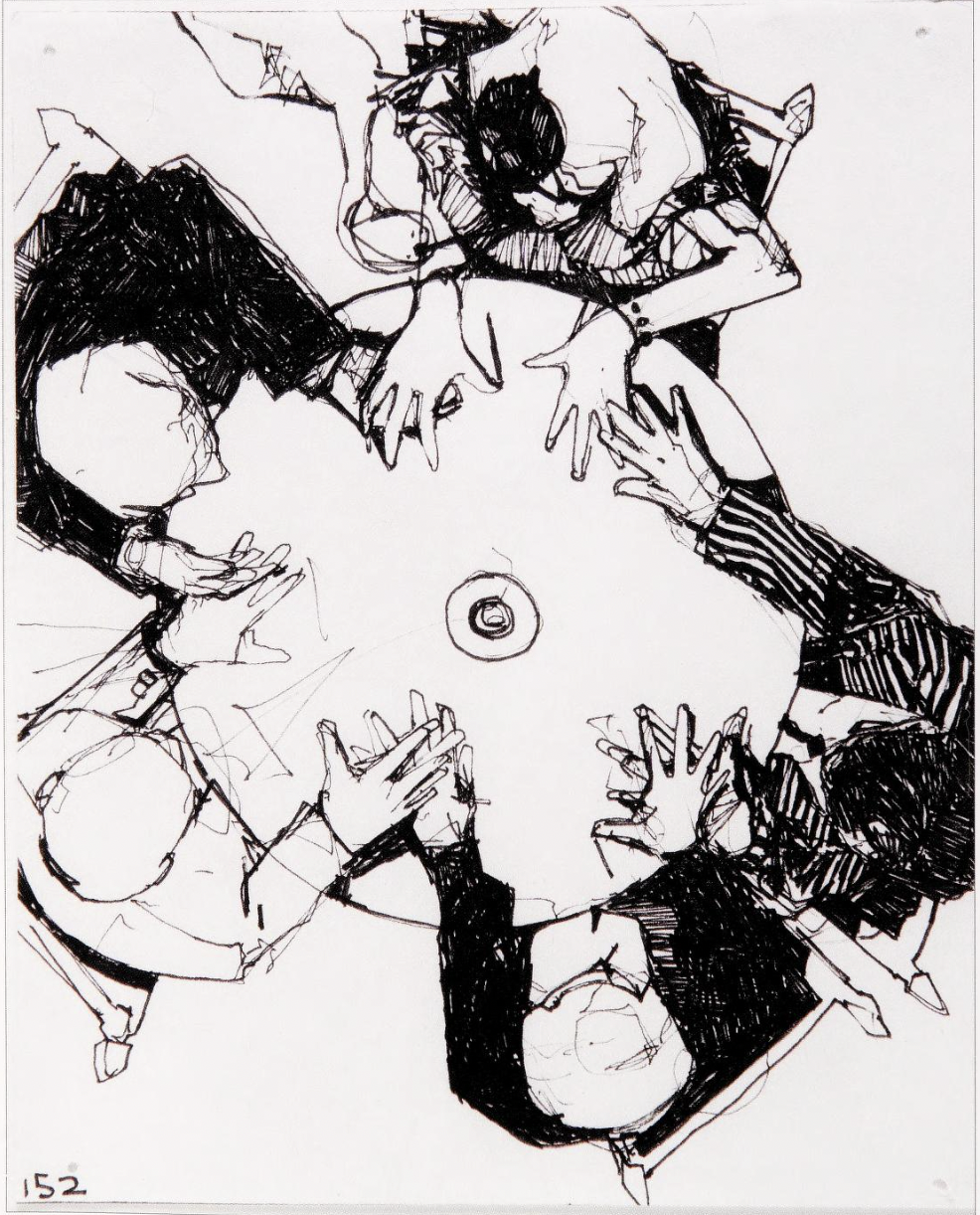
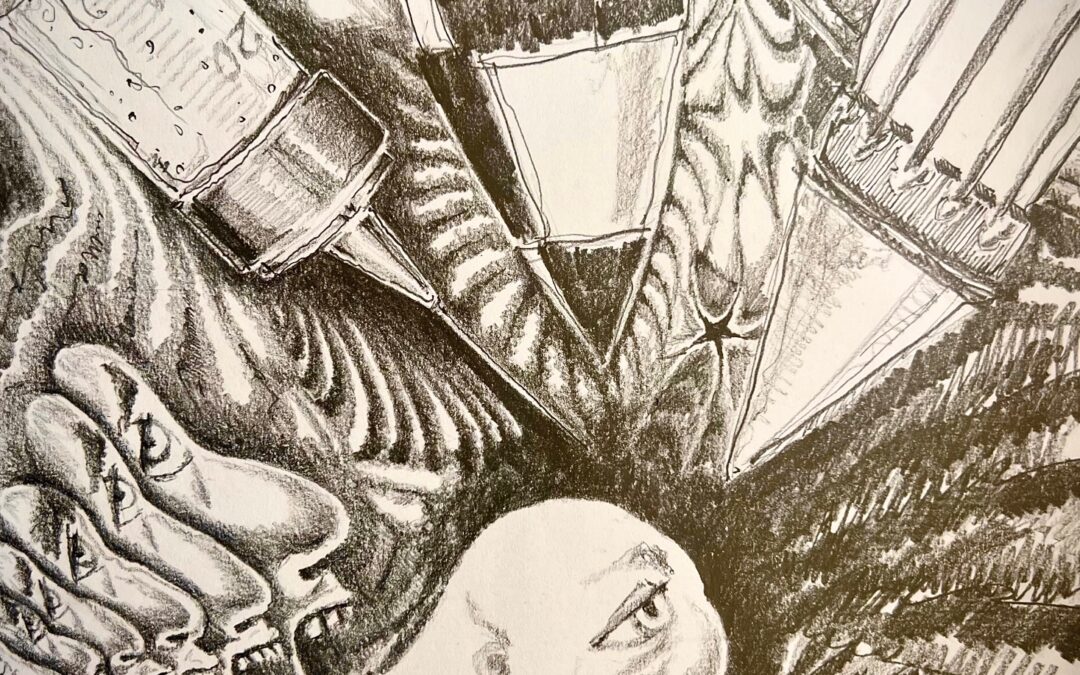
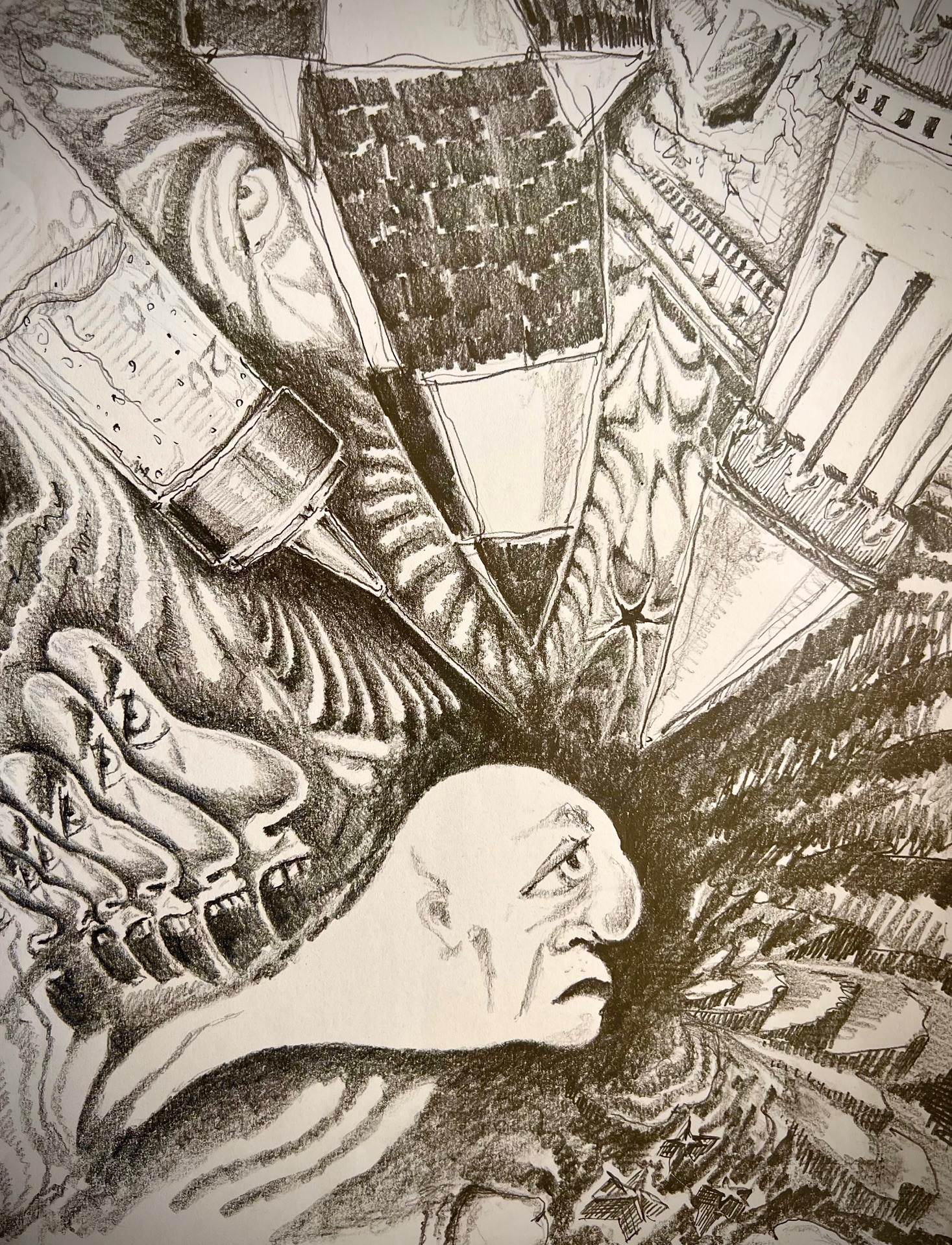
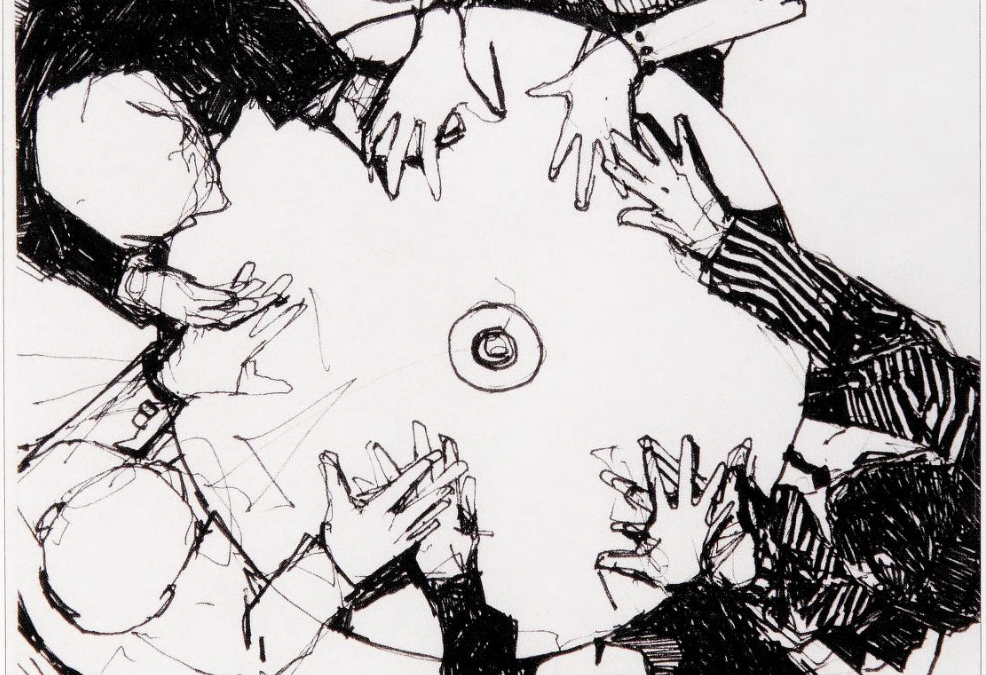
Illustration by Zak Smith – borrowed from the Internet Archive
Recap & Reflections
□ □ □ □ □ □ □
SCENE 1 (pages 147-156)
We start with Carroll Eventyr, the medium whom we first met back in Jessica’s introduction on page 31, and Nora Dodson-Truck, his romantic partner who is also a medium. Eventyr’s first experience of “his freak talent” is narrated: one day, walking down the street, someone suddenly starts talking through him, in German. (This person is later revealed to be Peter Sachsa, whom we meet in more detail later.) Nora’s response to observing this is quite reasonable: she immediately draws a pentagram on the ground, and they both step into it. This, apparently, is for their safety, since “there was always evil…” quite ominous.
How does this happen? Eventyr doesn’t really know, because when these episodes occur he completely loses all memory of them. It seems that he completely loses consciousness when someone takes him over. A unique contrast is given here, between the two different approaches others use on Eventyr in an attempt to understand what happens to him. Nora, a fellow medium, describes this phenomenon in mystical and spiritualistic terms: there is some sort of Wall between worlds, and Eventyr has had some sort of awakening to this other world. The scientists at The White Visitation, evidently, try to take a more “scientific” approach by hooking Eventyr up to an electroencephalogram, which is almost entirely normal except for some strange activity in his temporal lobes (the lobe of the brain responsible for many things, including memory, some spatial recognition, language, and emotional regulation). The scientists have different interpretations of Eventyr’s EEGs, and we get the impression that they too are grasping at straws, much like we are. An interesting tidbit is given about how Allen Lamplighter – one of the former owners of the Book, and a lover of betting – is somehow trying to prove the existence of the Afterlife by using Eventyr as a medium, thus far to no success.
Now, time for a fascinating section on “the freaks of the Psi Section” (one of the few remnants in The White Visitation of its psychiatric origins). We are introduced to three “freaks” here: Ronald Cherrycoke (fantastic name, by the way), Margaret Quartertone, and Gavin Trefoil. Cherrycoke’s ability is to access the past through physical objects; that is to say, he can access someone’s thoughts and emotions through their personal objects. This is proven when Cherrycoke, through the objects of a certain Group Captain St. Blaise, is able to narrate a story that St. Blaise hasn’t told anyone, a story which is described on a later page. Margaret Quartertone is able to manipulate recordings and physical objects without speaking or touching them. Gavin Trefoil, the youngest “freak” from the Psi Section, is able to manipulate his skin colour on-demand by metabolizing a certain amino acid. This makes him a great asset for PISCES in filming their Schwarzkommando propaganda/psy-op. Ironically, this isn’t because he can become dark-skinned. That would make too much sense. He’s useful because by bouncing light off of him, he can make the white balance better. Of course! (A short, and physiologically complex theory for how Gavin can do this is given, and it is a pleasure to read.)
We have an incredibly abrupt transition, marked by a new dialogue format. Here, we have two speakers: an older “operator” (which is Nora, presumably Eventyr’s partner), and a younger “operator” (a male, whose name is not actually given). They seem to be doing some sort of physiological testing on a subject’s central nervous system, but the conversation quickly strays to the spiritual: does Nora ever “get out” to “the Outer Level?” This section is very cryptic, but here’s what I was able to pick up from it. There seems to be a few “levels” to the world: the “Inner Level” (The central nervous system? The body? The mind? The physical world?), the “Outer Level” (the realm of the dead/spirits?), and “the Outer Radiance” (that which is beyond the “Outer Level”). Mediums are “interfaces” between the Inner and Outer Levels (?). Apparently, the current thought/cosmology/lore of mediums is that each person has a sort of spark or fragment of the Outer Radiance in them, which will be “gather[ed] back to home… at the last moment” (p151). This is straight-up Neo-platonism a la Plotinus, which is fascinating to me. Anyways, the interesting part to all of this is that Nora doesn’t believe that there is anything to the “Outer Radiance,” which gives her this nihilistic swagger that some find immensely attractive. On p153 she is described as “tak[ing] a little more of the Zero into herself” each time she visits (?) the Outer Radiance. Now, she seems to have organized mediums/“freaks” to be a part of “the ideology of the Zero” (p152), such as Cherrycoke, Quartertone, and possibly even Trefoil. What this all means is completely beyond me.
The scene starts to change a bit, when Cherrycoke’s abilities are shown with Nora’s belongings. This is how we learn more about Nora. Going back to our introduction to Cherrycoke, the events of St. Blaise are given. On a Palm Sunday bombing raid of Germany, St. Blaise and one of his wingmen see “the Angel,” which is some sort of apparition of a giant face in the sky. I found this description of the events to be quite disturbing. A face with eyes that go towering for miles? That just watch the bombing? That cause the bombers “to give up a strike at earth for a strike at heaven” (p154)? Does this apparition make the soldiers want to conquer the spiritual realm as well? The terrifying thing is that these sorts of spiritual appearances are common amongst the British army. Other soldiers have seen a Valkyrie or gremlins. Cherrycoke was used to confirm the existence of “the Angel,” because St. Blaise’s commanding officer wasn’t open to the idea.
Another gradual scene transition, this time to Peter Sachsa, the person who occasionally controls Eventyr. He too was a medium, and a narration of a seance back in “the Weimar decadence” (the years in Germany under the Weimar Republic, 1919-1933) is given. Some nasty stuff happens in the seance, that requires some drugs to bring someone back from a spiritual (or psychedelic?) vision. Perhaps more interestingly, prior to this event being narrated, Peter talks about “the Angel” described above, and how there is a sort of “storm that sweeps now among them all, both sides of Death” (p154) that prevents Eventyr from getting in touch with St. Blaise’s now-deceased wingman. Is there some sort of cosmic, spiritual war going on?
Another abrupt transition, this time to Edwin Treacle (researcher in the Psi Section) and our good friend, Roger Mexico. They’re talking about Treacle’s theories behind the mediums, and the spiritual realm as a whole. He proposes that the spiritual realm be studied with a rigorous scientific approach, arguing that there really is no difference between the “dead” and the “living.”
This section ends with a brief mention of Peter Sachsa again, and his relationship with Leni (whom we will learn plenty about, soon), as well as Leni’s relationship with her husband, Franz.
So, that was a lot. There’s far too much to talk about, and this post is already going to be incredibly long, so I’ll only mention a couple of things. Firstly, I find the categorization of Psi Section patients (inmates? prisoners? mediums?) to be noteworthy. They are “freaks,” but they are also useful to the war effort, and as such they are given preferential treatment compared to other “freaks.” This section seems to illuminate the various ways in which people are valued not based on any sort of rich or subtle value, but on their utility. A second idea that I find noteworthy is this theme that has popped up throughout the book thus far, of science vs. spirit. In this scene we see scientists, multiple times, theorizing about the spiritual. Treacle even argues that the spiritual can be studied like the physical, which is a comical statement from the perspective of any sort of philosophy of science. Of course the spiritual can’t be studied in a “scientific” way: science, by most definitions, is a study of the observable, physical, and measurable. But all throughout this book, we see scientists doing work that is, by definition, not scientific. And they don’t seem to be bothered by this. On the one hand, the spiritual realm in this book is almost incomprehensibly cryptic. On the other hand, many of the scientists in this book seem to be making fools of themselves, constantly. It’s either that, or they’re just grasping at straws. Perhaps Pynchon is poking fun at both the scientists and the spiritualists. Personally, I’m seeing an overconfidence in “science” as being a developing theme throughout the book, but that might just be me.
□ □ □ □ □ □ □
SCENE 2 (pages 156-170)
We’re in Germany, in a university dorm that is utterly decrepit and miserable. It smells bad, the walls are crumbling, and the walls are stained with urine and excrement. Here sits Leni (Peter Sachsa’s partner), and Ilse, her daughter. Leni has “moved in” (if you can call it that) here with nothing but a suitcase, and apparently she is obsessed with astrology. We know that Peter Sachsa is currently alive, since she is debating on going to him; as such, we know that this scene is taking place in the past, because Peter is alive. Leni is sitting with three women: Rudi (a token “La Boheme Student”), Vanya (a “token Slav”), and Rebecca (a “token Jewess”). The thread that seems to tie everyone together here is that they are all “revolutionary” communists, albeit of the school of thought of Rosa Luxemburg, and therefore strictly anti-Stalinist and anti-Bolshevik. This sort of anarcho-commune clearly isn’t doing too hot. We are told that these events are occurring “over these Weimar years” and as such the Nazis have not yet come into power; but as we’ll see later, they are already gaining influence. Our attention is drawn to a slogan that is being spray-painted around the commune: “AN ARMY OF LOVERS CAN BE BEATEN.” These words are supposed to invigorate the commune into action, but that doesn’t seem to be happening.
Vanya, our token student, and Rebecca, our token “Jewess,” are having a “conversation” (which is more of an intellectual rant on the part of Vanya) about capitalism and capitalist culture. Rebecca comes off as being quite innocent and ignorant, while Vanya is this sort of annoying ideologue, willing to preach to whoever will lend her an ear. Vanya is some sort of ascetic, almost monastic communist. Rebecca, on the other hand, is using the conversation for a bit of flirting. Leni is observing this, and after a bit of self-reflection on how men fail to take her seriously, starts to have sexual fantasies about Rebecca, albeit fantasies that are charged with antisemitism (“animal darkness”? ouch…). Leni leaves the conversation, moving to some baths, where she meets a childhood friend, Richard Hirsch, who has just come back from France (as a soldier?). They reconnect, fall in love, get married, the commune becomes nudist, the war suddenly ends, and Rosa Luxemburg becomes president of the Republic, and the Revolution succeeds! The end. Whoops, that was all a fantasy… Shocking. Where the fantasy starts is unclear. Did she ever even go to the baths? Unclear. But we snap back to reality with that slogan: “AN ARMY OF LOVERS CAN BE BEATEN.” Rudi and Vanya are now talking, but Leni seems to not really care, as that conversation quickly fades away into her thinking about her husband Franz, whom she has just left.
Leni seems to have had revolutionary ideals for quite some time, but Franz just can’t wrap his head around them. In this whole scene, Franz comes off as a pretty pathetic guy in many respects. He’s an inflexible thinker, he is passive, he’s given to daydreaming and fantasizing, he lacks courage, he sleeps through movies, and so on. Basically, he’s lame and boring. He is a man who is desperate for certainty in life. Hence his obsession with astrology (which seems to have had an effect on Leni). An episode from their past is narrated, back when Leni was pregnant with Ilse. Franz needed work, and got a job putting up movie posters for a film (that were, amongst other things, “swastikaed over”) that never seemed to be shown in theatres. We know this because when he goes to the theatre to watch the film, no one is there, except for a demolition crew. He starts walking around an urban wasteland, when he sees a rocket launch going on in the distance. In reality, it’s a “static test” that goes awry, and in the aftermath he connects with a university friend. Interestingly, the two friends were educated by Dr. Laszlo Jamf, the same researcher that did those erection-experiments on Slothrop. A beautiful full-circle moment. Anyways, the two friends reconnect, and grab some drinks at the bar to talk about the rocket experiment. Franz comes home full of excitement, in part because of how disastrous the experiment was. He then joins the “Society for Space Navigation,” which, in the words of Leni, is “wandering-bird” idiocy. Later, Franz will be “used” by the military due to his expertise in aviation. This is detestable to Leni, given her communism.
A bit more backstory is given on Leni, who grew up in a picturesque neighbourhood in Northern Germany. It’s evident that she felt stifled as a child, perhaps a passing comment by Pynchon on the monotony and agony of American suburban life. Things turn even darker when Leni’s views on men emerge, which are depressing and quite fatalistic.
Snapping back to the original scene at the university dorm, Leni decides to leave to finally go to Peter Sachsa’s. She is underdressed for the occasion – a seance – and she sees some high-up Nazis in attendance. The goal of this seance is to get in touch with Walter Rathenau, who was the foreign minister of the Weimar Republic from February to June of 1922. He was also an influential liberal economist and industrialist, and played a large role in managing the German economy towards the end of the First World War. He was also Jewish, and was smeared by the Nazis as being an integral part of Judaeo-Bolshevism, a conspiracy theory. Why do they need to get in touch with him? The answer is hilarious: a weapons-development facility has developed a new weapon that can make everyone in a 10km radius blind. This is problematic, not because of the gross inhumanity of it, but because of the dye industry: what will happen to all of our dyed goods, after people can’t see and they’ve been bleached by the blindness-ray? (Our discussion last week, about how the real business of war is buying and selling, might be just a tiny bit relevant here.)
The seance begins, but not without a cynical introduction from Pynchon (or Leni?): “Whatever comes through the medium tonight they will warp, they will edit, into a blessing. It is contempt of a rare order” (p168). The seance is fascinating: Rathenau first condemns everyone present for simply caring about things that don’t matter; or, as he calls them, “trivial side-trips.” Rathenau doesn’t seem to want to be there, but the seance continues. Despite Rathenau’s condemnation of the superficiality and meaninglessness of his being-called-upon, he goes on a long and obscure lecture about manufacturing and business logistics, part of which has to do with the spiritual meaning of the colour mauve. He ends his discussion with two questions that seem to have some more significance than the rest of his lecture: “First, what is the real nature of synthesis? And then: what is the real nature of control?” (p170). These are his parting words, and the scene ends with a Nazi asking him if God is Jewish.
Again, there’s a lot that could be said here, but I’ll limit my comments. Firstly, this seems to be the first time in the novel where we get to experience any amount of German suffering. Typically, all of the suffering and destruction in the novel has come from a British perspective, but the squalor in which the commune lives can’t help but make you at least a little bit empathetic to the Germans. Secondly, this scene is Pynchon’s first discussion of Communism in the novel, which is evidently a pretty important thing given the time in which this book was written. Vanya and Leni are the two communists we learn the most about, and while Vanya is annoying, Leni is a character whose communism can be sympathized with. As I commented on in my “summary,” Leni’s strangled upbringing, and the ways in which she’s seen young men’s idealism be stomped upon by necessity, still ring a bell today, especially amongst young suburbanites. Thirdly, I don’t know about the rest of you, but the seance scene lost me a bit. If anyone has comments on the significance of Rathenau’s lecture, please let me (and the rest of us) know… after re-reading a couple of times, I’m not tracking.
□ □ □ □ □ □ □
SCENE 3 (pages 170-177)
It’s the PISCES Christmas party. Pointsman is reflecting on all of his colleagues whom he has lost, and he is alone in the midst of a bustling London. But he’s feeling great. He’s got his present: Slothrop. This will be revealed at the start of Part 2, but Slothrop is in France, seemingly by the Riviera, and this is all a part of Pointsman’s plan. The news from the Riviera, whatever it is, is good, so Merry Christmas to Pointsman! And he had more funding now! Yipee!
Pointsman is feeling so good that he appears to be less of a repulsive bloke than normal. A certain Maudie Chilkes seems to pick up on this, and gives him some spontaneous fellatio in a closet. About ¾ of the way down page 171 Pointsman mentally lists out all of the substances that he’s on, and by golly it’s quite a bit. He’s on amphetamines every 6 hours, uses barbiturates to sleep, is constantly drinking alcohol, and takes plenty of vitamins in the morning. The last isn’t problematic, but if Pointsman were around today (and a real person) he’d be classified with polysubstance use disorder. No wonder he’s feeling so good… but he can’t share his plans for Slothrop with anyone, so for now he has to keep things under wraps.
Next we get a proper introduction to Thomas Gwenhidwy, a Welsh doctor and the only living owner of The Book other than Pointsman. He is a grandiose and attention-grabbing fellow, always on the move. At the party he is singing at the top of his lungs. He is also quite the heavy drinker. A brief description of Gwenhidwy’s patients is given: they are typically those who have been socially and economically marginalized. The description on pages 172-3 is both touching and horrifying.
The scene changes (?), and Pointsman and Gwenhidwy are walking to Gwenhidwy’s apartment. When they arrive, Gwenhidwy asks Pointsman if he is willing to hear a “paranoid” theory about his patients. Pointsman agrees. Here’s Gwenhidwy’s theory: the marginalized and poor have traditionally been placed in the East and South of the UK because those are the areas of the island that will first be invaded by an Army. The replaceable and disposable people are the ones who will first experience the horrors of war, because things have been physically arranged such that that is the case. Gwenhidwy sees this in where most of the German bombs are landing: on the poorer parts of London. Pointsman tries to get all analytical and statistical with him, but Gwenhidwy isn’t having it. Gwenhidwy emerges in this scene as a deeply empathetic person, enraged by the suffering of the marginalized and poor. Pointsman simply doesn’t seem to care all that much. So much for not being a repulsive bloke… he’s described as being “stylized, irritable, uncomprehending…” (p175), which seems very fair. The scene ends with a discussion about water-bugs in Gwenhidwy’s apartment. They are connected with water-bugs in the stable in Bethlehem on Christmas night, and their inability to sense the crying of the baby Jesus.
I’ve got to be honest, right now I’m really loving Gwenhidwy. I think that he is the only male character in the entire novel thus far who has had even a smidge of empathy. For that, he gets some golden stars from me. In this scene we learn more about the kind of person Pointsman is, his dependence on substances to feel good, the fact that Slothrop being in France is a part of his plan (or at least that he has incorporated it into his plan), and his strained relationship with the only living owner of the Book, Gwenhidwy. One thing that seemed to go over my head was the water-bug discussion that ends the scene. I wrote in my copy that I assume that this is some sort of metaphor for contemporary society, with its descriptions of the complexity and lack of contemplation and spirituality in modern society. That interpretation seems so boring though, and I feel like I’m missing something here. Maybe someone can help me out.
□ □ □ □ □ □ □
SCENE 4 (pages 177-180)
It’s boxing day, and Roger and Jessica are with some extended family. Earlier in the day they went to a pantomime of Hansel and Gretel, during which a German rocket landed down the street. The actress for Gretel uses the opportunity to bolster morale by singing a song that seems like it’s supposed to be patriotic, but comes off as being incredibly dark and ominous. What’s up with this peppermint face in the sky, and why do we care about a plastic home in the sky? Any song that ends with the line “are of children who are learning to die” can’t possibly be a happy and patriotic song. I must admit, this completely eludes me. The song uses psychedelic imagery and quite loose associations, so maybe it’s not meant to be interpreted? One of the few clues that I got in this section was the face in the sky; is that an obscure reference to “the Angel” from earlier in our readings?
After the song we’re back at home, and one of the children sees an apparition of their deceased father sitting in a chair. This, while scary for young Penelope, is completely normal, despite the fact that it is an actual demonic possession. Keith – the father – is dead, seemingly from the war. A moving paragraph is written on how the death of soldiers is justified to children, and how the death of a father might be preferable to the permanent destruction of a father through trauma.
Part 1 ends with our leading couple, Roger and Jessica, in an incredibly moving scene. Roger comes to the realization that Jessica could leave at some point in the near future. This will be either from her death in a rocket attack, or due to her leaving him for Beaver. As we have come to know about Roger, he is quite dependent on Jessica, but Jessica has started to see through to who Roger really is. It seems like Roger will have a complete psychological collapse when Jessica finally leaves: “If she leaves, then it ceases to matter how the rockets fall” (p179). This could mean different things, but I interpret it as meaning that Roger will simply stop caring about life.
What is so incredible is this scene is Roger’s sheer hatred for Beaver, which is worthy of a quote at length: “Damned Beaver/Jeremy is the War, he is every assertion the fucking War has ever made—that we are meant for work and government, for austerity: and these shall take priority over love, dreams, the spirit, the senses and other second-class trivia that are found among the idle and mindless hours of the day… Damn them, they are wrong. They are insane” (p179-180). Wow. Later, Roger thinks about how Beaver’s relationship with Jessica is so bureaucratic and commanding, and how Jessica will effectively die-by-subordination. “You’re catching the War. It’s infecting you and I don’t know how to keep it away. Oh, Jess. Jessica. Don’t leave me…”
Wow. What a way to end Part 1. Such a powerful and emotive way to tie this bow. Again, so many comments could be made, but I’ll leave that for Monday. Roger here seems to be at his most vulnerable, his most honest, and perhaps his most profound. He is encapsulating the beautiful side of anti-authoritarianism, which is a recognition of rich and subtle values as being more valuable than “work or government.” Yet he is also deeply needy and selfish, not wanting Jessica to leave for his own sake. Obviously he cares about Jessica, but he never stops caring about himself. I’m very much looking forward to discussing this part of the book with you all!
INTERLUDE: Looking back at Part 1
Originally, I was hoping to do a super-helpful, birds-eye view summary of all of part one, listing out major characters, but this post is already monstrously long, and we haven’t even finished the readings for this week. To honour your time, and to save me lots of time, I won’t bother with that sort of write up. Rather, I’ll ask you all two questions: what has been your favourite part of Part 1? And, what has Part 1 left unfinished that you want to see developed later on in the book? I’ll answer the latter question: give me more of Pirate! Pirate was given such a unique introduction, and his ability to take over dreams and fantasies is so unique and fascinating. Pynchon introduced him to us, and then immediately turned him into a minor character. How rude! What’s up with that? I want to see Pirate do more things and influence the book in a major way.
□ □ □ □ □ □ □
SCENE 5 (pages 181-191)
Part 2 kicks off with a blast: a quote from the director of the 1933 film King Kong to his female lead. Very, very different from the quote introducing Part 1. Will this set the tone for Part 2? If this brief scene has anything to say, it certainly will.
Slothrop, Tantivy, and Bloat – we’ve seen these three together already, way back in week 1’s readings – are at the Casino Hermann Goering in France. (Hermann Goering was at least in the top-5 most-important Nazis, possibly #3 behind Hitler and Goebbels.) France has been taken back by the allies, so the three men aren’t in enemy territory. While in the hotel, Tantivy and Bloat praise Slothrop for his womanizing, and ask him for help and advice so that they can get more women (truly thrilling conversation; the height of male interaction right here). Bloat follows some women to the beach, while Tantivy is shocked at Slothrop’s choice of a Hawaiian shirt as his attire for their beach day. The girls that Bloat has followed to the beach are dancers at the casino, whom a certain Cesar Flebotomo (perhaps my favourite name in the novel thus far, even more so than Cherrycoke) hired once the allies took France back over.
The beach day with the dancers is going well, until an octopus attempts to kidnap a mysterious woman! Oh no! The three military men come to the rescue, by… banging it on the head with a bottle of wine. Which doesn’t work, until they can lure the octopus away with a tempting snack. Who is this mysterious lady? Our good friend Katje, from week 3’s readings. Katje and Slothrop seem to have a special connection, and the scene ends.
Part 2 is already drastically different in tone from Part 1. It’s silly and goofy. While part 1 certainly had its funny moments (I’m thinking back to the British-candy-eating-scene), we haven’t had something this silly and slapstick. Most of the humorous moments in part 1 were tempered with something sinister or confusing (such as the dodo killing scene or the Adenoid), but I didn’t pick up anything like that here. But we can’t forget how pleased Pointsman is with this whole Slothrop-in-France situation. Maybe there is something sinister going on…
While I haven’t read ahead or anything, and I’m not reading about the book online much at all, I have heard that Part 2 is more straightforward than Part 1, which might be a welcome change in tone for some of us.
This first scene hasn’t given me much in terms of analysis. Perhaps the most intriguing thing is the introductory quote. Will there be themes of entertainment and escapism in Part 2? The fact that the gents are on leave in France at a casino seems to suggest so. I guess we’ll have to wait and see!
APPENDIX: Pynchon and Postmodernism
Those of us who met in-person last week ended our meeting with a conversation about the experience of reading Gravity’s Rainbow, and how difficult of a book this is. Comments were made about our various reading strategies for this book: do we pay attention to all of the details, re- and re- and re-reading a paragraph until we finally understand what is going on? Or do we let it all wash over us, and hope that, when taken as a whole, the novel will come together? Are utilizing either of these strategies missing the point? Do we have to use different strategies at different points in the work? If so, when do we know which strategy to use? (I have no definitive answers here.)
Two comments in particular really stopped me in my tracks. The first was that reading this book is a destabilizing experience. I love that word: destabilizing. I think it encapsulates so much of what the experience of reading Gravity’s Rainbow is. It seems like that is part of what Pynchon was going for: the rapid shifts in perspective, scene, and characters; the oscillation between relatively “straightforward” (for Pynchon, that is) exposition, exceptionally obscure word-salads of paragraphs, and incredibly beautiful and evocative writing that can make even the hardest of hearts melt; the themes and plot of the work, with the ever-looming threat of death and destruction for all of our characters; the obsession with Pavlov, animal experimentation, and sexual escapism… who writes like this?
The second comment, while closely related to the first, is different enough to greatly expand the conversation: this novel encapsulates the experience of living in the early 70’s; put another way (by me), this novel is grasping at the collective experience and mind of the early 70’s. To tie these two comments together, living in the early 70’s was a destabilizing experience; or, the early 70’s were a destabilizing time. Geopolitically, the world was an absolute mess: the Cold War raged on, despite the slow growing of detente; by 1973, the US realized the absolute disaster of the Vietnam war, and pulled its troops; within the decade, the USSR would invade Afghanistan; Mao’s China continued to emerge as the leading global threat to US foreign policy; the Cuban missile crisis… Domestically, there was the Kennedy assassination, just a decade before, and MLK’s assination, just a half-decade before; Nixon and Watergate; Roe v. Wade passess… Culturally, hippie counterculture was gradually dying, and a more sinister, angry underground movement was emerging (a la Robert Crumb); free jazz and jazz fusion became two of the leading forms of expression for black musicians; the Super Bowl was gaining traction; televangelism grew in popularity, and Billy Graham was preaching to millions on world-tours… what a time to be alive. It’s starting to make more sense as to why this book is so destabilizing: if Pynchon was trying to capture the spirit of the 70’s in a novel, he seems to have done so excellently.
One thing I’d like to comment on in the midst of all of this talk of destabilization is the emergence of postmodernism as the de facto philosophy of the mid-20th-century, up until our day. Geopolitically, domestically, and culturally, the 70s were a destabilizing time. Philosophically, they were also a destabilizing time. I’ve read that Gravity’s Rainbow is “the postmodern novel,” and that it is nothing more than a summation of postmodern thought, and a commentary on postmodernism itself; while I lack the qualifications and knowledge to evaluate that claim, I am going to spend a brief few paragraphs talking about some common characteristics of postmodern philosophy. I feel like this is a good idea, given that postmodern philosophy continues to dominate our lives today, and it is a genuinely destabilizing system of thought. Here we go!
- Postmodernism comes from a loose collective of diverse thinkers from diverse disciplines. It’s not a philosophical school of thought in the traditional sense. In part, postmodernism is the denial of certain things – such as truth, rationality, and authorial intent with stable meanings – that make accurate definitions possible. Primarily, postmodernism is a reinterpretation of what knowledge is and what counts as knowledge. It is a form of cultural relativism. Rather than precisely define postmodernism, it is easier to describe common characteristics of postmodern thought. Not all postmodern thinkers hold these ideas, but they are relatively common ideas within postmodernism. I’ll list these common characteristics in point-form, with brief explanations. This is a book club, after all; not philosophy school. (I started this post talking about Gravity’s Rainbow, right?)
- Postmodernism denies metaphysical realism. This is to say that there is no real, external world; all reality is socially and linguistically constructed, and as such what is real for one linguistic group is not real for another linguistic group. To use a religious example, God exists for theists, but not for atheists.
- Postmodernism denies the correspondence theory of truth. The correspondence theory of truth states that any claim is true if and only if it corresponds with an actual state of affairs in the world. So, for example, the claim “Thomas Pynchon wrote Gravity’s Rainbow” is true if and only if someone named Thomas Pynchon actually wrote Gravity’s Rainbow. Postmodernists either reject the notion of truth altogether, or adopt coherentist or pragmatic theories of truth (in short, something is true if it is coherent for you, or if it works for you).
- Postmodernism denies rationality. Postmodernists reject the idea that there are universal, transcultural standards for determining whether or not a view is rational or irrational. Because we cannot view the world in a neutral way, we cannot be properly rational in any objective way.
- Postmodernism denies foundationalism. Foundationalism is a theory of knowledge that argues that all of our knowledge is based upon some sort of “foundation.” Foundationalism is a quest for certainty in thought, and postmodernists believe that there is no such certainty, since all knowledge is culturally and linguistically defined.
- Postmodernism adopts nominalism and rejects essentialism. These are metaphysical terms. The first refers to the existence of “universals,” or things that can be in more than one place at the same time. Postmodernists reject the notion that universals exist: as such, there is no such thing as justice or redness; rather, these are names (hence, nominalism) that we give to groups of things. Essentialism refers to the notion that there is something essential to any given thing. For example, being of a certain height is not “essential” to any specific human being; if you were 1 inch taller, you would still be you. (This is what philosophers call “accidents,” or things that aren’t essential to any given thing.) Postmodernists reject the idea that any quality is “essential” to a given thing; rather, the dividing line between “essentials” and “accidentals” is socially and linguistically constructed.
- Postmodernism denies authorial intent and meaning. That is to say, the author of any item of language is in no privileged position to interpret their own work. The meaning of a text is created by a community of readers. In the case of this book club, a postmodernist would argue that there is no such thing as “Gravity’s Rainbow;” rather, there is only “the-Congress-Coffee-Book-Club’s-Gravity’s-Rainbow.”
- Postmodernism denies the referential use of language. That is to say, that we do not use language to refer to anything in the world. When I say that “I left my copy of Gravity’s Rainbow at home today,” it would seem that I am referring to an actual book in an actual place on an actual day. Postmodernists would deny that this is the case; rather, I’m just making words or making sounds in socially acceptable ways.
- Postmodernism denies metanarratives. A metanarrative, in this sense, would be something similar to a worldview. According to postmodernists, there is no means to decide which among competing worldviews is better, more accurate, or true. There is no single worldview that is true for everyone. There are no meta-narratives, but only local ones.
- Postmodernism denies non-linguistic thinking. The idea behind this is that not only are our values, preferences, and cultural institutions socially and linguistically determined, but our thoughts are as well. If there is any sort of external world beyond our minds, we have no access to it, because we literally cannot escape our own linguistic categories. As such, our worldviews are conditioned by our language. The external world is merely a social and linguistic construction.
That was a lot… thanks for reading. To be fair, I’ve never actually met a postmodernist who affirms all of this. Personally, I am of the opinion that postmodernism is deeply flawed in many ways, but that is besides the point. I hope in these points that I was able to illustrate how postmodernism itself is destabilizing. If postmodernism is true, so much of our lives fall apart: there is no external world, what is true is socially constructed, there is nothing that makes “me” me, I cannot be certain about anything, I cannot convince anyone that something is better than something else, I have no way of knowing if something I say or care about is true… and so on. How destabilizing is all of that? Despite the fact that wholehearted postmodernists are few and far between, I think we can all see how these ideas have planted themselves in western culture, typically in modified, less-extreme forms.
I guess what I’m getting at here is that Pynchon really is destabilizing us by capturing the spirit of the 70’s, and postmodernism itself is a core part of that destabilizing process. Maybe all of this is a roundabout way of saying this: if you’re feeling confused while reading this book, or that it is a garbled mess, or that you don’t know what’s going on half of the time, you’re in good company. These feelings are, if I’m right about all of this philosophical and cultural navel-gazing, part of the point of this book. These are some of the things Pynchon wants you to feel. It’s up to you to assess whether or not this artistic decision has any merit to it or not… personally, I’m enjoying the ride thus far.
Thanks for reading, and humouring me in this unnecessarily-long post. I hope it was helpful, and I’ll see you all on Monday!