Moby-Dick Week Nine – The End!

Moby-Dick Week Nine – The End!

Moby-Dick Week Nine – The End!

So here we are at journey’s end, and what a long strange journey it has been. Thank you all for coming on this voyage. I loved hearing all the different experiences people had with this text. There were epiphanies, frustrations, laughs, highs and lows, enlightenments and bafflements. I feel so lucky to have shared all these things with this group!

So for our last icebreaker, a simple question; What is your takeaway from Moby-Dick?

Recap – Chapters 121-135

Chapter 121 – Midnight – The Forecastle Bulwarks
Chapter 122 – Midnight Aloft – Thunder and Lightning
Melville continues the dramatic structure of Chapter 120. Now we see Stubb and Flask busy at the work of lashing down anchors. Stubb makes light of the danger they are in. Flask is dubious. When Stubb’s tarpaulin is blown overboard, he chides the winds for their bad manners. This dialogue is followed by a very short chapter where we see Tashtego up in the mainmast, securing the main-sail. Tashtego tells the storm to stop its thundering and that he’d like a glass of rum.

Chapter 123 – The Musket
As the storm continues, the wind suddenly seems to change direction, and now speeds the Pequod along rather than fighting against her. Starbuck, going to Ahab’s cabin to inform him of this change, sees the loaded Musket that Ahab had pointed at him earlier (Chapter 109 – Ahab and Starbuck in the Cabin). Realizing that Ahab is sleeping on the other side of the cabin door, Starbuck picks up the musket and contemplates killing Ahab. After much anguish, he puts the musket back and leaves the cabin.

Chapter 124 – The Needle
The storm has passed and the Pequod seems to be on course, when Ahab notices that they are sailing west, not east as the compass needle indicates. Ahab deduces that at some point in the storm the polarity of the needles has been reversed. Ahab then demonstrates his ability to create a new, true needle – a feat which has the effect on the crew as if Ahab has performed magic.

Chapter 125 – The Log and the Line
Ahab orders the log and line (a method of navigation to replace the destroyed quadrant) to be activated, however the line has rotted from disuse and brakes. Ahab orders a new log made and the rope repaired. Pip approaches, and Ahab and Pip form a strong bond. Ahab takes Pip to stay in the captain’s cabin.

Chapter 126 – The Life-Buoy
Chapter 127 – The Deck
One morning just before dawn the sound of wailing cries are heard. Speculations as to the source of the sound range from mermen to recently drowned sailors. Ahab opines that the sounds came from nearby coastal seals, but this does little to settle the disquiet of the crew. Later that morning a crewman falls from the rigging into the sea and is lost. The life-buoy which is thrown out takes on water and sinks. Queequeg’s coffin is offered up as a replacement life-buoy, and the disgruntled carpenter makes it water-tight. Ahab happens across the Carpenter at work and attempts to engage him in philosophical conversation, calling the carpenter “unprincipaled” because he can do so many different things, some which have contradictory purposes.

Chapter 128 – The Pequod meets the Rachel
The Pequod comes across another Nantucket whaling ship, the Rachel, which had lowered for Moby Dick the previous day. The captain of the Rachel begs Ahab to join in the search for a missing boat, which has the captain’s young son in it. Despite desperate entreaties Ahab refuses to join in the search.

Chapter 129 – The Cabin
Ahab tells Pip not to follow him now, because he is afraid the tenderness he feels for Pip will deflect him from his hate-fuelled mission. Pip is left sitting in the captain’s chair, imagining he is hosting a table full of grand sea commanders.

Chapter 130 – The Hat
The mood of the crew turns very serious and we sense the confrontation is near. Stubb stops trying to make people smile and Starbuck no longer tries to stop them from smiling as joy and sorrow alike are crushed beneath Ahab’s will. Ahab no longer retires to his cabin, and does not appear to sleep as he and Fedallah seem bound in silent communication. After a few days pass like this, Ahab decides to aloft and look for the whale himself. He is pulled up in a basket where a sea-hawk swoops down and snatches away his hat, which is carried away and dropped into the ocean.

Chapter 131 – The Pequod meets the Delight
The Pequod then crosses paths with the whaling ship the Delight, which had lowered for Moby Dick the previous day and lost five men, of which only one body was recovered. As the Pequod sails away, the splash of the corpse hitting the ocean is heard.

Chapter 132 – The Symphony
It is a beautiful day. Ahab emerges from his cabin and seems deeply moved; at the ship rail, a tear falls from his eye. Starbuck, sensing vulnerability, gently engages Ahab, urging him to think of his wife and child. Ahab seems to waver before finally resolving to continue his vengeful quest.

Chapter 133 – The Chase – The First Day
That night, Ahab smells a sperm whale. Hauled aloft, he spies Moby Dick. All boats lower except Starbuck’s (Ahab, knowing Starbuck’s desire to return to wife and child, leaves him to command the ship). The boats pursue Moby Dick from behind and the whale seems unaware of them, but then, with a mighty leap, dives. Moby Dick then comes straight up upon the boats from below. Taking Ahab’s boat in his jaws, Moby Dick bites it in half. The Pequod comes to Ahab’s rescue, driving off Moby Dick and allowing Stubb and Flask to collect Ahab and his crew, none of whom have been lost. All return to the Pequod, which continues to follow Moby Dick as night falls.

Chapter 134 – The Chase – The Second Day
After correctly predicting Moby Dick’s direction and distance travelled through the night, the Pequod comes upon him again, and again all boats save Starbuck’s are lowered. Moby Dick takes on all three boats in a terrific battle. With all boats getting a harpoon in the whale, Moby Dick twists and turns so that all the lines become hopelessly entangled. Stubb and Flask’s boats are pulled into each other and smashed to bits. Moby Dick then pops up below Ahab’s boat and sends it flying up into the air, spinning and spilling out its crew. Then Moby Dick uses his tail to smash things for a while before swimming away “as if satisfied that his work for that time was done.” Once again the Pequod picks up the crews of the whaleboats. Amazingly, most have only minor injuries. Ahab’s ivory leg has snapped in two. It is then discovered that Fedallah has been lost.

Chapter 135 – The Chase – The Third Day
Sensing he has oversailed Mob-Dick in the night, Ahab orders the ship to reverse course and Moby Dick is spotted once again. The boats lower and Moby Dick meets them in battle, quickly bashing in Stubb and Flask’s boats. These mates and their crews are picked up by the Pequod and frantically try to prepare new boats. Moby Dick breaches before Ahab, showing the body of Fedallah lashed to his side. Ahab realizes that this fulfills much of the prophecy; Fedallah has gone first and Ahab has seen him again being carried by a hearse not made by human hands. Moby Dick swims away. Ahab in his pursuit sails near the Pequod and seeing that the flag is missing from atop main-mast, orders Tashtego to nail a new flag to it. Even with sharks biting at his oars, Ahab gets close enough to dart his harpoon into the whale, causing Moby Dick to writhe sideways, knocking three oarsmen out of the boat – two of whom manage to scramble back in. The harpoon line snaps and Moby Dick turns to bear down upon the Pequod itself. A hole in Ahab’s boat occupies its crew as Starbuck, Stubb and Flask all see the coming whale and acknowledge their doom. Moby Dick hits the ship, knocking men over. Water begins to pour into the Pequod. Ahab, looking at the Pequod, realizes that it is the second hearse made from American wood. When Moby Dick surfaces again near Ahab’s boat, Ahab darts one more harpoon into Moby Dick, the line runs afoul and when Ahab tries to clear it, it catches him around the neck and yanks him from the boat. As the Pequod sinks, Tashtego continues to hammer the flag atop the mainmast, and at the moment even this about to disappear a seahawk lights on the mast. With one final blow Tashetgo’s hammer pins the bird’s wing to mast, and then all disappear beneath the waves.

Epilogue
Ishmael explains how he alone survived; that he took the place of the missing Fedallah as Ahab’s bowsman on that final day, and that he was the one thrown from the boat who did not scramble back in. After the Pequod sank, its life-buoy popped up near him, and he floated on Queequeg’s coffin until rescued by the Rachel, which was still searching for its own lost boat.
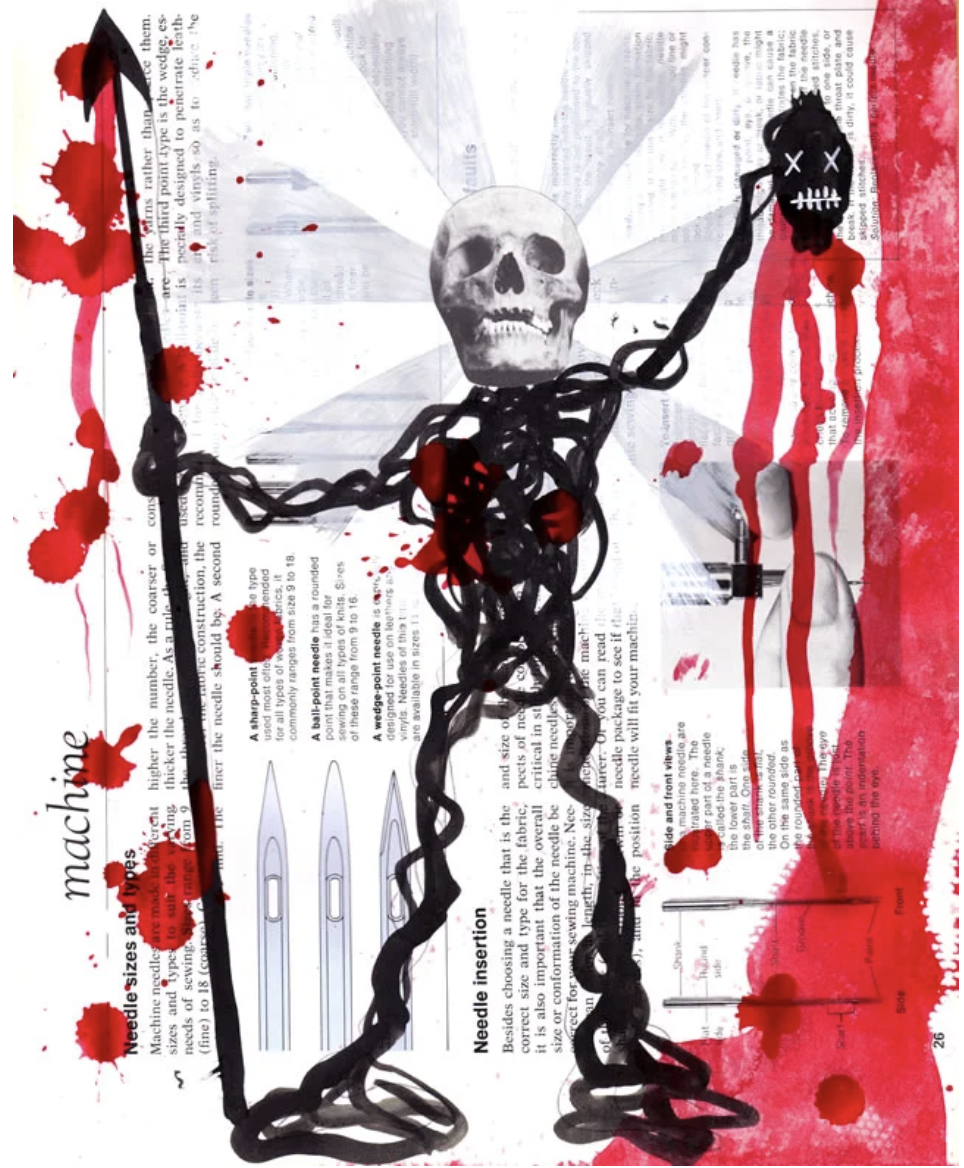
 

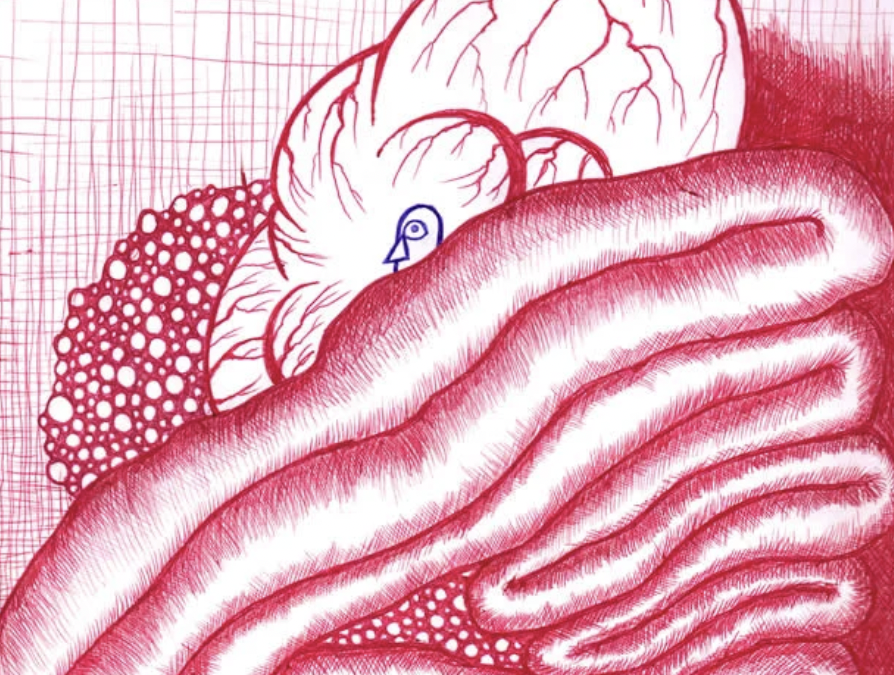
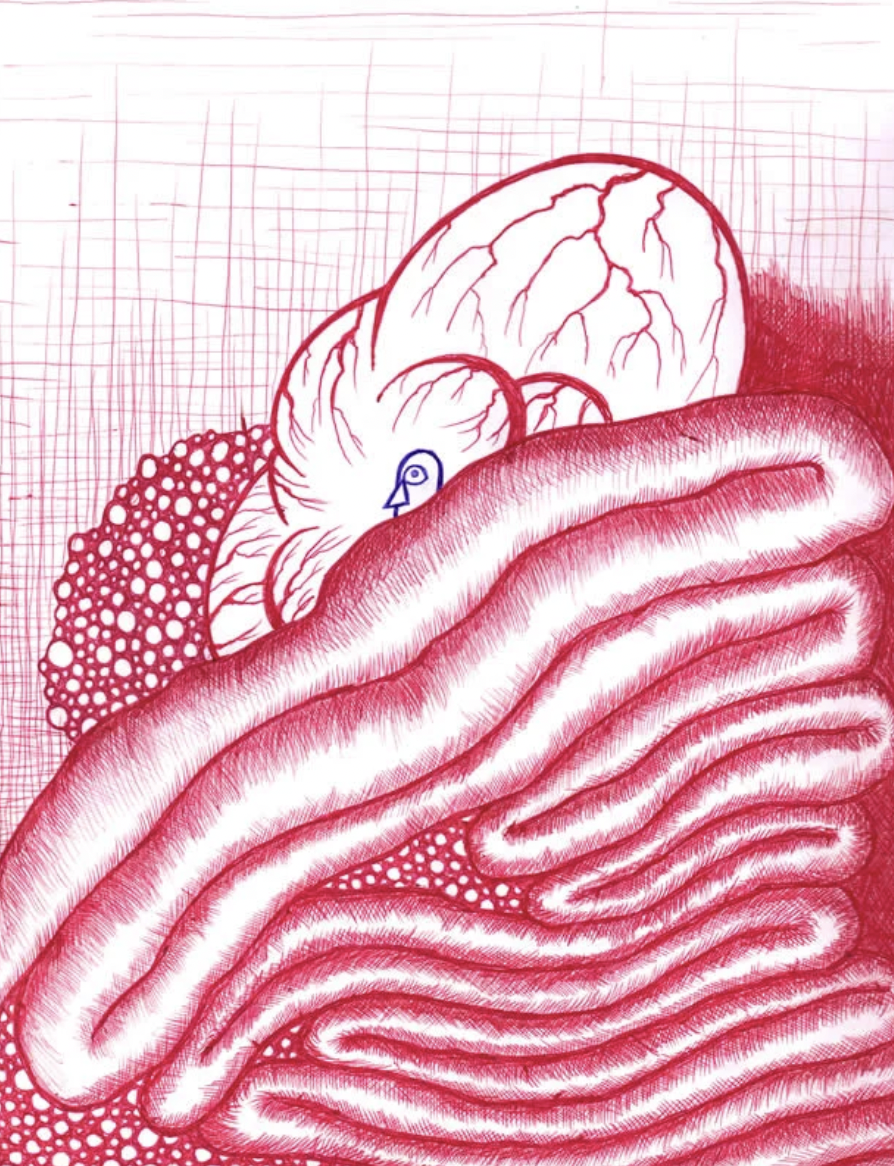
Illustration by Matt Kish

Reflections

The first two chapters of this section, taken with the last chapter of the previous section (120 – The Deck towards the End of the First Night Watch) are all written in dramatic form, and each reflects on the others. Chapter 120 is a dialogue between Ahab and Starbuck which underlines their differences, and in Chapter 121 the differences between Stubb and Flask are revealed. Who is Tashtego talking to in Chapter 122? Himself? The storm? If the storm, then this also completes a line of digression; Ahab defies the storm, Stubb jokes with it, Tashtego asks it for a glass of rum. I like the effect such digressions (moving from a spectacular defiance of nature, to a joke, to admitting you’d like a glass of rum) have on me as a reader. There is something musical in the tension and release.

The Musket (Chapter 123) is perhaps the climax of the novel in terms of the conflict of will between Ahab and Starbuck. It comes down to Starbuck realizing the only way to stop Ahab, and thus save the lives of the rest of the crew, is to kill him. And yet he can not. Can anyone read this and not ask themselves what they would do in Starbuck’s place?

We have talked a lot about the novel’s focus on cycles, particularly cycles of life and death. A great example of this is the use of a coffin as a life-buoy in Chapter 126.

I absolutely love how the moral decision Ahab is faced with in Chapter 128 (The Pequod meets the Rachel) is the flip-side of the moral dilemma Starbuck wrestled with in Chapter 123 (The Musket) – where Starbuck considers killing in order to preserve life, Ahab is asked to forgo his quest to kill in order to try to save life. I love how powerful this inversion is; Ahab has gone beyond the moral considerations that prevented Starbuck from killing him. I also love how even Stubb, who left Pip floating in the ocean, pleads to save the boy – throwing Ahab into even darker relief.

The relationship between Ahab and Pip is one of the most interesting and, for me, enigmatic aspects of the novel. What attracts them so strongly to each other? The words of the Manxman in Chapter 125 (The Log and Line) about the two are illuminating; “One daft with strength, the other daft with weakness.” Ahab is trying to impose himself over everything, whereas Pip has lost himself completely. Does this make them polar opposites – attracted to each other magnetically?

In Chapter 130 (The Hat) the Pequod approaches the spot where Ahab lost his leg to Moby Dick. Another circle seems about to be completed. Ishmael compares the loss of Ahab’s hat to the ancient story of Tarquin, who had his hat snatched away by an eagle, but whereas the eagle returned Tarquin’s hat (signifying he would become king) Ahab’s is lost to the sea.

Even as late as Chapter 132 (The Symphony) it seems that there is one last hope that Ahab may change his mind when Starbuck catches him in a mournful mood and almost convinces him to sail home. My reading of this chapter is that Melville is addressing the question of fate and freewill; he is showing that even at the eleventh hour Ahab can still choose to reverse course, and the fact he chooses not to does not mean that he could not have. I think that despite all the prophecies and omens and foreshadowing in the book, Melville is trying to say we still have agency. At least that is my reading. Ahab himself might disagree, because for all his bluster about being in charge of his own life, he now wonders if he is just an instrument of fate: “By heaven, man, we are turned round and round in this world, like yonder windlass, and Fate is the handspike.”

I love the description of how Moby Dick makes such short work of the three boats on the second day of the chase, and then so nonchalantly swims away. That was so badass. In the aftermath of this thrashing, Starbuck pleads that to continue is insane, but Ahab comes down firmly on the side of Fate: “This whole act’s immutably decreed. ‘Twas rehearsed by thee and me a billion years before this ocean rolled.”

When the end finally comes it seems so sudden. Even after 135 chapters culminating in a three-day chase, the end seems shockingly quick. It leaves me a little stunned every time I read it.
Moby-Dick Week Eight

Moby-Dick Week Eight

Moby-Dick Week Eight

We are in the wondrous Pacific now Shipmates. One senses the curtain is rising on the final act. We have voyaged far. With the end of the journey nearing, I would like to make this week’s icebreaker to be about the first stage in planning our next voyage. Where should we go next? Do we stick to fiction? Do we read something in translation? A book that has more than three women in it, possibly even written by a woman? Do we continue to hunt Folio Whales (yes, please)? I know we are not choosing the next book until week 10, but it is not too early to start thinking about such things. Besides, there is nothing more delicious than choosing a book to read!

Recap – Chapters 106-120

Chapter 106 – Ahab’s Leg
Chapter 107 – The Carpenter
Chapter 108 – Ahab and the Carpenter

Ahab finds his ivory leg has been damaged and he orders the ship’s carpenter to make a new one from the Sperm Whale’s jawbone. We learn that not long before the present voyage Ahab’s ivory leg splintered beneath him, stabbing him in the groin. In a scene presented in the form of a play, the carpenter measures Ahab for his new prosthetic. Ahab gives voice to grand philosophical musings while the confused carpenter just tries to do his job.

Chapter 109 – Ahab and Starbuck in the Cabin
Starbuck goes to the captain’s cabin to inform Ahab that the oil casks are leaking and need to be brought up and repaired. Ahab refuses to do so, not wishing to lose time in the pursuit of Moby-Dick. The two men argue, and Ahab is angered to the point that he points a loaded musket at Starbuck. Later, after cooling off, Ahab changes his mind and orders the casks to be brought up to be fixed.

Chapter 110 – Queequeg in his Coffin
In the process of bringing up the casks, Queequeg, working in the musty depths of the hold, catches a chill which quickly worsens. Wasting away, Queequeg asks the carpenter to make his coffin which, when finished, Queequeg tests and approves of. Just when it appears that Queequeg is ready to depart this life, he makes a remarkable recovery, which he explains by saying that he remembered he had an unfinished task to do onshore and so decided not to die.

Chapter 111 – The Pacific
Passing the Bashee isles (today’s Batanes in the northern Philippines) the Pequod passes into the Pacific Ocean. Ishmael immediately feels a deep connection to this immense body of water. To Ahab, this only seems to signify that he is getting closer to the end of his quest.

Chapter 112 – The Blacksmith
We are introduced to Perth, the Blacksmith, and are told his story of woe: a once prosperous husband and father who lost his home and family to drink. Wishing to leave his broken life behind, but not being of a suicidal nature, he goes to sea on a whaling ship.

Chapter 113 – The Forge
Ahab has Perth make him a harpoon, using the nail stubs of horseshoes and his own razors for materials, Ahab uses the blood of the harpooneers to temper the barbs of the harpoon head.

Chapter 114 – The Gilder
In the literary equivalent of a montage scene, Ishmael describes days passing wherein the crew spend countless hours chasing whales with little success. Then, in a peaceful moment, the sun gilds all in its golden glow. Ishmael imagines the calm sea to be like the western prairie. He then reflects that humans do not progress through life (in terms of their inner-states of being) in a straight line, but in cycles. The chapter concludes with comments from Starbuck and Stubb, who also seem moved to introspection.

Chapter 115 – The Bachelor
The Pequod now encounters the Bachelor of Nantucket, a whaling ship so successful that casks of oil have filled her hold and stored in every available space.

Chapter 116 – Dying Whale
Chapter 117 – The Whale Watch
Ahab kills a whale and, noting that the whale turns its head to the sun as it dies, calls the whale a fire-worshipper. He meditates on the sun as a life-giving force, and that the dark-force of death seems to be located deep in the sea itself. Three other whales are killed by the Pequod’s boats, and while these are brought alongside the ship, Ahab is left beside his whale through the night. Ahab and Fedallah speak of prophecies concerning Ahab: he will have neither hearse nor coffin, yet he must see two hearses (one not made by human hands, one made with wood grown in America) before he can die; that Ahab cannot die before Fedallah, and that only hemp can kill Ahab. Ahab thinks these things cannot come to pass, and declares himself “Immortal on land and on sea!” Obviously he has not read Macbeth.

Chapter 118 – The Quadrant
The crew waits upon Ahab who trains his quadrant upon the sun to know the precise moment to change course towards the equator, having determined that this will bring them upon Moby Dick. Ahab curses the Sun because it can only tell him where he is, not where Moby-Dick is. He destroys the quadrant, and gives orders for the course change. Starbuck laments that Ahab’s fiery life will end in ashes, to which Stubb (the laughing fatalist) replies that Ahab is only playing the cards he has been dealt.

Chapter 119 – The Candles
A typhoon hits the Pequod headlong, shredding the sails and destroying Ahab’s boat. Starbuck sees this as an obvious sign that the Pequod should turn around and let the typhoon blow them home. Corpusants – balls of electrical light – sit atop the three masts, making them appear like candles before an altar. Ahab addresses the fire as something to be worshipped not through reverence but defiance. In the destroyed boat Ahab’s harpoon begins to glow, causing Starbuck to cry out for Ahab to abandon his quest. The crew seem ready to back Starbuck, but Ahab grabs the glowing harpoon and threatens to kill the first man who moves against him. Then, in a spectacularly dramatic moment, he reminds them that they are bound by their oaths and then blows out flames of the harpoon.

Chapter 120 – The Deck towards the End of the First Night Watch
Starbuck approaches Ahab about the prudence of taking down the damaged parts of the ship for repair and is rebuffed by Ahab. Ahab mocks the wind, saying it is sick with colic and should take medicine.


Illustration by Matt Kish

Reflections

In Ahab and the Carpenter (Chapter 108), Ahab complains of feeling sensation in his “phantom leg” and concludes that if a non-existent leg should feel pain – then could not a whole phantom being? This seems another manifestation of his belief in the existence of things beyond the perceived world.

Ishmael, writing of Queequeg being “close to the sill of the very door of death”, tells of Queequeg being able to see those dark mysteries that elude mortal man: “For whatever is truly wondrous and fearful in man, never yet was put into words or books.” This failure of the written word to capture the truly wondrous is inverted later when we are told that in fact there is some writing that purports to be “a mystical treatise on the art of attaining truth” on the very tattoos on Queequeg’s body; the only catch is no one can read them.

Ishmael’s rhapsodic feelings for the Pacific Ocean make us feel that a significant barrier has been crossed.

Why are we introduced to Perth and told his story so late in the booK? His reason for going to sea is presented as substitute for suicide, which seems to me the opposite motivation that drove Ishmael who is seeking a new experience.

In Chapter 113 (The Forge) Ahab’s incantation over the blood-tempered harpoon,“Ego non baptizo te in nomine patris, sed in nomine diaboli” means ”I do not baptize you in the name of the Father, but in the name of the Devil.” Has Ahab renounced God, or is he just recognizing that his obsession is unholy?

I found Pip’s laughter at the sight of Ahab and his newly forged harpoon very unsettling.

The comparison of the whaling ship to the progress of pioneers on the American prairie (114 – The Gilder) is illuminating, and very discussion worthy. The concept of Manifest Destiny – the obvious truth that westward expansion is America’s divine right is brought up and, perhaps, questioned.

The captain of the Bachelor (115) is shown to be the opposite of Ahab, and does not even believe in the existence of Moby Dick. Lucky man! “How wondrous familiar is a fool!” mutters Ahab.

Science and religion mix in Chapter 118 (The Quadrant). Ahab uses his quadrant while Fedallah uses his sun-worshipping mystical mojo to determine when to change course. Ahab rejects science and destroys the compass.

Chapter 119 (The Candles) seems to be the climax of the slow revelation of Ahab’s character, for here he confronts the most powerful force of nature – a typhoon – and directly defies it. Any hope that he might be deflected from his chosen course is extinguished as completely as the fire around the harpoon. At least that’s how I read it.


Moby-Dick Week Seven

Moby-Dick Week Seven

Moby-Dick Week Seven

I find chapters we read this week to be among the most absorbing in the entire novel. So much happens. So many scenes have an epic, cinematic, quality to them. The philosophical digressions are profound and there are some great comic moments.

For this week’s icebreaker, imagine you have been chosen to direct a new film version of Moby-Dick. Which of the scenes in this week’s reading would you be most excited to include? Casting suggestions are always welcome!

Recap – Chapters 91-105

Chapter 91 – The Pequod Meets the Rose-Bud
Chapter 92 – Ambergris
The Pequod encounters another whaling ship, the Rose-Bud, which has two whales fastened to her, both which appear to be corpses found by the Rose-Bud, and both smell something awful. Stubb, thinking one of the whales may possess the valuable substance ambergris, tricks the French captain of the Rose-Bud into cutting the whales loose and manages to get some of the ambergris before Ahab demands he return to the Pequod. The next chapter then relates the uses of ambergris and ends with the refutation of the idea that whales are smelly.

Chapter 93 – The Castaway
We hear the story of how Pip is made to row in Stubb’s boat. In his second lowering, Pip becomes frightened by the bumping of a fast whale against the boat and leaps overboard where he becomes entangled in the harpoon line. Stubb, rather reluctantly, orders the line cut to save Pip and lose the whale. When, on another lowering, Pip leaps from the boat again, Stubb leaves him behind in the belief a trailing boat will pick him up. Unfortunately, the other boats change course in pursuit of whales and Pip is left adrift. By chance, Pip is rescued by the Pequod, but his mind has been altered.

Chapter 94 – A Squeeze of the Hand
Ishmael describes in almost sensual detail the job of breaking up the globules of spermacetti by hand. He then informs us of other by-products of the whale; white-horse, plum-pudding, slobgollion, gurry and nippers. He then takes us into the blubber-room, where many toes go missing.

Chapter 95 – The Cassock
If you thought Ishmael was going to leave any part of the Sperm Whale undescribed, then you would be wrong. What is this “enigmatic object”, this “unaccountable cone”, this “grandissimus”? It is the whale’s penis. We see the skin removed, stretched, dried, and made into a cassock for the blubber slicing “mincer” to wear.

Chapter 96 – The Try-Works
The process of rendering the blubber into oil is done on deck, using the massive brick furnace known as the try-works. The description of the flames burning through the night seems like a vision of hell. Ishmael, at the ship’s helm, becomes lost in thoughts of inferno and drifts off to sleep and nearly capsizes the ship.

Chapter 97 – The Lamp
Ishmael notes that the whaleman, unlike the merchant sailor, always has access to oil and does not have to stumble in the dark.

Chapter 98 – Stowing Down and Clearing Up
The final stage in the processing of the whale is described; the oil is poured into casks which are lowered into the hold of the ship. The ship, now covered in blood and soot, is then made clean using the oil and lye made from burnt whale scrapes, so that the whale provides the soap to clean away its own blood. The chapter ends on a meditation of this cycle of contamination and purification – suggesting that this is the human condition.

Chapter 99 – The Doubloon
Several of those aboard the Pequod approach the doubloon Ahab nailed to the mainmast as the reward to first one to spot Moby-Dick. Ahab, Starbuck, Stubb, Flask, the Manxman, Queequeg, Fedallah, and Pip all examine the doubloon and either comment on it or are themselves commented upon.

Chapter 100 – Leg and Arm – The Pequod, of Nantucket, meets the Samuel Enderby, of London
The Pequod encounters another ship that has not only seen the white whale, but whose Captain Boomer has lost an arm in battle with Moby-Dick. In the gam, Captain Boomer, with the assistance of one Dr.Bunger, tells the story of his encounter and his subsequent resolve never to mess with Moby-Dick again. Ahab goes into a fury and leaves Boomer and Bunger befuddled.

Chapter 101 – The Decanter
Ishmael recites the history of Enderby & Sons, whose founder is the namesake of the ship encountered in Chapter 100. This English company opened the Pacific Ocean to whaling. Ishmael recalls a visit to this same ship some years after the events of Chapter 100, in which much libations were consumed – a practice that the English whalers copied from the Dutch.

Chapter 102 – A Bower in the Arsacides
Chapter 103 – Measurement of the Whale’s Skeleton
We now turn our attention to the skeleton of the Sperm Whale, a (something) of which Ishmael had the opportunity to examine in detail as his friend, King Tranquo, had one. Short on paper and pen, Ishmael tattoos the skeleton measurements on his arm. He then relates those measurements, only to conclude that they do not give a proper idea of the whale’s size, and that it is “vain and foolish” to try to understand the whale by studying the skeleton.

Chapter 104 – The Fossil Whale
Chapter 105 – Does the Whale’s Magnitude Diminish? – Will he Perish?
We zoom out and consider the whale from an archaeological perspective, noting that as the fossil remains of whales have been found hundreds of miles inland they have frequently been mistaken for dinosaurs. The fossil record (at least that available to Ishmael) also indicates that the modern whales are larger than their ancestors. Ishmael also concludes that the whale, unlike the buffalo, they will not be hunted to extinction,


Illustration by Matt Kish

Reflections

It is quite curious that the captain of the Rose-Bud, who we are told is a former cologne manufacturer, should be unaware of the source of ambergris. And why do the Americans like to make fun of the French so much?

In Chapter 92 (Ambergris), Ishmael ponders the irony that this substance used to enhance the attraction of people should come out of decay; the diseased bowels of a whale. Does this idea simply mirror the larger narrative that out of the death of whales comes the stuff that enriches our lives? I feel, somehow, he is hinting at more than that.

Oh, Poor Pip! Whose bright idea was it to put Pip in a whale boat? Was there no better candidate among the ship-keepers to choose from? Why not Doughboy, who is “dull and torpid in his intellects” and less likely to be excitable? In the last sentence of Chapter 40 (Midnight, Forecastle) Pip says, “Oh, thou big white God aloft there somewhere in yon darkness, have mercy on this small black boy down here; preserve him from all men who have no bowels to feel fear!” Alas, this prayer seems not to have been heard.

Ishmael leaves plenty of space for us to see Pip’s madness as possessing a divine quality; “He saw God’s foot upon the treadle of the loom, and spoke it; and therefore his shipmates called him mad.”

I am very interested to hear what people have to say about Chapter 94 (A Squeeze of the Hand) and Chapter 95 (The Cassock). The mix of sacred and profane in the Cassock is amazing!

Chapter 96 (The Try-Works) concludes with one of the most examined passages in the novel:

“There is a wisdom that is woe; but there is a woe that is madness. And there is a Catskill eagle in some souls that can alike dive down into the blackest gorges, and soar out of them again and become invisible in the sunny spaces. And even if he for ever flies within the gorge, that gorge is in the mountains; so that even in his lowest swoop the mountain eagle is still higher than other birds upon the plain, even though they soar.”

I have my ideas about the meaning of the above passage, but I’d love to hear yours.

Those that try to interpret the meaning of the symbols on the doubloon (chapter 99) reveal more about themselves than they do about the coin. Pip’s comments, which at first seem merely simple-minded descriptions, also contain some dire prophecy concerning Ahab and the Pequod.

I love Chapter 100 (Leg and Arm). The visual of the two captains crossing their ivories gives me the giggles. Boomer and Bunger are like a comedy act, and Boomer’s complete lack of any thoughts of revenge toward Moby-Dick shows Samuel Enderby to be the complete opposite of the Pequod.

In Chapter 102 (A Bower in the Arsacides) Ishmael describes the glen in which the skeleton has been placed in terms of the loom; the floor of the glen a “living carpet” with ground vines forming the warp and woof and the sun a shuttle moving above it. This recalls Chapter 47, The Mat-Maker, as well as the comment about Pip’s transformation; “He saw God’s foot upon the treadle of the loom, and spoke it; and therefore his shipmates called him mad.”

Moby-Dick Week Six

Moby-Dick Week Six

Moby-Dick Week Six

I sometimes feel overwhelmed. By the news. By my job. By my garden. This week I was even a little overwhelmed by Moby-Dick, and by the realization that I am not a giant salamander. So for this week’s icebreaker, we are going to do an emotional check in. How are you all doing? Is this reading experience emotionally difficult at times? Is anybody strongly tempted to step into the street and start methodically knocking people’s hats off? To just look at pictures of puppies for a while? Consider this a safe space. You can even bring your teddy bear to the meeting if you like.

Recap – Chapters 76-90

Chapter 76 – The Battering-Ram
Chapter 77 – The Great Heidelburgh Tun
We return once again to considering the Sperm Whale’s head; this time as a battering ram. Ishmael foreshadows that this will play a role in “one of the most appalling, but not the less true events, perhaps anywhere to be found in all recorded history.” In the Sperm Whale’s head we also find the “case” – a large area containing the valuable spermaceti, which Ishmael compares to a giant wine cask.

Chapter 78 – Cistern and Buckets
In one of the strangest action sequences ever written, Tashtego slips while atop the head in the spermacetti extraction process, and ends up upside down inside the Sperm Whale’s head, which then breaks free of the Pequod and begins to slowly sink. Queequeg comes to the rescue; diving overboard with a sword to cut into the head from below and pull Tashtego out.

Chapter 79 – The Prairie
Chapter 80 – The Nut
Over two chapters, Ishmael applies physiognomy and phrenology (the study of facial features and skull shape) to the Sperm Whale, and (surprise!) concludes it bears the marks of genius and nobility.

Chapter 81 – The Pequod meets the Virgin
The Pequod meets the German whaling vessel Jungfrau (Virgin) which has been so unsuccessful that its captain begs for oil for his reading lamp. As the Jungfrau’s captain returns to his ship, both the Jungfrau and the Pequod spot whales. With their boat already in the water, the Jungfrau has a considerable head start, but thanks to both luck and pluck, the Pequod manages to reach the whale first. What follows is a horrifying killing of an aged, blind, crippled whale in a cruel manner. Once the whale is attached to the Pequod, it immediately begins to sink and very nearly pulls the ship down with it. Only the quick actions of Queequeq saves the Pequod. The chapter ends with Ishmael mocking the Jungfrau as it is observed chasing an uncatchable Fin-Back whale.

Chapter 82 – The Honor and Glory of Whaling
Chapter 83 – Jonah Historically Regarded
Ishmael creates a roll-call of the great whalemen of history, and comes up with some very creative interpretations of mythology in order to do so: “Perseus, St. George, Hercules, Jonah, and Vishnoo! there’s a member-roll for you!” Ishmael then presents very far-fetched arguments to try to verify the truth of the story of Jonah and the whale.

Chapter 84 – Pitchpoling
Another whale is killed, yet again by Stubb, who this time shows his mastery of hurling lance in the method known as pitchpoling.

Chapter 85 – The Fountain
Chapter 86 – The Tail
We return to an anatomical study of the whale, this time focusing on his respiratory system. The question of whether it is water or vapour that is expelled through the spout is given close examination. The chapter ends with Ishmael concluding it must be steam, as all great thinkers produce this almost invisible steam from the workings of their heads. Then our examination shifts to the tail; its structure and motions.

Chapter 87 – The Grand Armada
In chasing a pod of many whales the boats end up in the inner-sactum of the pod where curious baby whales come alongside the boats and are petted. Mothers suckle the young and other whales are observed in their love-making. This idyllic moment is then destroyed by the horrific violence of a whale dragging spears and lances which kill many other whales.

Chapter 88 – Schools and Schoolmasters
The social structure of Sperm-Whales is examined.

Chapter 89 – Fast-Fish and Loose-Fish
Chapter 90 – Heads or Tails
Ownership of whales is examined from a legal standpoint, with an example of the disputes that may arise when a whale is killed but abandoned. This question of ownership is then extended to the historical instance of the English nobility “owning” all whales captured on the coast of England.


Illustration by Matt Kish

Reflections

Boy did I ever struggle with this section of Moby-Dick. I don’t mean I had trouble understanding the concepts, but quite the opposite; by beginning to understand the concepts I felt tossed about; a very small boat on a very big sea. I think that this struggle is one of the things Moby-Dick is about.

Can I tell you something that might sound a little crazy? This week I have become convinced that Moby-Dick is a warning about the dangers of Artificial Intelligence, which obviously could not have been Melville’s intention. Or could it? Humans have not really changed in the last 175 years after all, and Melville is, I think, simply trying to warn us about the dangers of turning off our brains, or our souls, or both.

Yeah the struggle is hard, but if we forgo the struggle and just go with the flow, we run the risk of becoming like Stubb; unfeeling. The section that nearly broke me was when Stubb killed that old blind whale that only had one fin; he crossed a line between doing his job and revelling in the cruelty. I see a lot of people reveling in cruelty these days.

Anyway, that is my state of mind reading this section. I think what set all this off in me was the end of Chapter 76 (Battering-Ram) when Ishmael makes the statement; “But clear Truth is a thing for salamander giants only to encounter; how small the chances for the provincials then? What befel the weakling youth lifting the dread goddess’s veil at Sais?” This is a reference to the Friedrich Schiller poem The Veiled Statue at Sais, wherein a young man transgresses sacred boundaries in pursuit of absolute knowledge by lifting the veil of Isis, only to have his mind and spirit broken and be driven to an early grave. You can find an English translation of the poem here:
https://allpoetry.com/The-Veiled-Statue-At-Sais 

Is looking under the veil like punching through it? Are both equally bad ideas? The last two lines of Shiller’s poem are:
“Woe to that man who wins the truth by guilt,
For truth so gained will ne’er reward its owner.”
– which pretty neatly sums up my feelings about artificial intelligence.

Oh boy have I blathered on. Anyway here are a few more reflections:

The rescue of Tashtego in Chapter 78 is a scene of thrilling action which Ishmael describes in terms of obstetrics. Talk about a scene pregnant with meaning! The description of the “horrible oily gurgling” sound of Tashtego’s headfirst fall is a wonderful touch. What to make of Ishmael’s concluding the chapter by telling of the “delicious death” of the Ohio honey farmer drowned in honey? His question regarding how many have similarly perished in Plato’s honeyed head reminds me of his warnings to dreamers on the masthead getting lost in thought and falling into the sea.

The scene at the end of Chapter 81 (The Pequod meets the Virgin) where the sinking whale nearly destroys the Pequod is so cinematic and meaningful (I’m thinking “monkey rope” here). Yet again, it is Queequeg who saves the day. The role Queequeg plays in Moby-Dick may require a re-examination at this point.

The Grand Armada (Chapter 87), with its contrast of calm peace and chaotic death provokes a visceral reaction in me. The image of blood and mother’s milk co-mingling is overpowering. That Ismael can follow this with an examination of the social structure of whales is wrenching. Our sympathies are definitely shifting from the whalers to the whales if they were not there already.

And there is SO much more to talk about in this section, however I need to go watch some puppy videos now.

Moby-Dick Week Five

Moby-Dick Week Five

Moby-Dick Week Five

If the only part of Moby-Dick to survive centuries from now were Chapters 61 through 75, then one would not blame those future readers for concluding that Stubb is the book’s protagonist. For the coming meeting’s icebreaker, I’d like you to say something about your impressions of Stubb. Does he remind you of anyone real or fictional? If he were alive today, what would he be doing? Would you want to go for a beer with him? Cross the street to avoid him? Any and all comments on Stubb are welcome.

Recap – Chapters 61-75

Chapter 61 – Stubb Kills a Whale
Chapter 62 – The Dart
Chapter 63 – The Crotch
In a scene of intense action and graphic detail, Stubb kills a Sperm Whale. This is followed by a chapter in which Ishmael asserts that the harpooning of whales would be much more successful if the harpooneer were not tired out by rowing and could put all his strength into the throw. Further technical details of the hunt are revealed; how all the weapons are kept in near the bow, in easy reach of harpooneer and headsman, and how the second harpoon is attached to the same line as the first, so it must either be thrown at the whale or tossed overboard before it is dangerously yanked about. This ends with Ishmael hinting that the danger of becoming entangled in the line will play a role in events to come.

Chapter 64 – Stubb’s Supper
Chapter 65 – The Whale as a Dish
When the action returns to the Pequod, the whale is fixed to the ship. Sharks descend on the carcass, as does Stubb. Stubb complains to the cook, Fleece, about his whale steak (over cooked) and the sharks (too loud), and makes Fleece tell the sharks to keep the noise down. Ishmael then reveals the history of people eating whales, and concludes that all meat eating involves a certain amount of cruelty.

Chapter 66 – The Shark Massacre
In a rather nightmarish scene we witness the killing of sharks feasting upon the dead whale. The crew’s killing of sharks only drives the sharks to greater frenzy.

Chapter 67 – Cutting In
Chapter 68 – The Blanket
Chapter 69 – The Funeral
A very visual description of blubber being cut away from the whale like peeling an orange in one big spiral. Ishmael reflects on the blubber as the whale’s blanket. After the whale has been stripped of his blubber, the body is set adrift while the head remains attached to the ship.

Chapter 70 – The Sphynx
Chapter 71 – The Jeroboam’s Story
While the crew all go to supper, Ahab addresses the head of the Sperm Whale, beckoning it to tell all the secrets of the wonders it has seen. He is interrupted by the cry that a ship has been spotted. A boat from this ship, the Jeroboam, communicates at a distance from the Pequod. In the boat with the Jeroboam’s captain is a sailor with a “deep, settled, fanatic delirium” in his eyes, who believes himself to be archangel Gabriel. We learn how Gabriel has come to be held in fear and awe by the ship’s crew and that the Captain dares not to move against him. We hear from Mayhew (Captain of the Jeroboam) of how his first mate Macey went after Moby-Dick in spite of Gabriel’s dire warnings, only to be killed by a swat from Moby-Dick’s tail.

Chapter 72 – The Monkey-Rope
We flash-back to the securing of the whale to the side of the Pequod, and learn of the necessity of one sailor (the Monkey) having to stand upon the body of the whale while the blubber-hook is attached. In this case it is Queequeg who performs this dangerous task, while Ishmael is fixed fast to him by the monkey-rope, which he uses to jerk Queequeg away from danger. While this is going on, Tashtego and Daggoo are killing sharks near Queequeg, coming perilously close to him with their blades. Once his task is done Queequeg is hauled up and offered a cup of ginger and water by Dough-Boy, as per Aunt Charity’s instructions. Stubb gets Queequeg some strong spirits and pitches the ginger water into the ocean.

Chapter 73 – Stubb and Flask Kill a Whale; and Then Have a Talk over Him
While the Pequod did not hunt Right Whales before, now Ahab gives the order that one should be killed given the chance. This is accomplished in short order by Stubb and Flask. Flask says that he had overheard Fedallah saying that if the Pequod had a Sperm Whale head on one side and a Right Whale head on the other, then it would never capsize. Stubb opines that Fedallah is the devil and brags of the whooping he will give him.

Chapter 74 – The Sperm Whale’s Head – Contrasted View
Chapter 75 – The Right Whale’s Head – Contrasted View
Ishmael compares the head of the Sperm Whale to that of the Right Whale. The differences are quite great; jaws and teeth as opposed to lips; baleen, head shape, tongues and spouts all differ. Not surprisingly, Ishmael favours the noble Sperm Whale.


Illustration by Matt Kish

Reflections

The killing of the whale is very detailed in its description of violence; how the sun reflecting off the bloody sea casts everything in a red glow; the horrific death-throws of the whale bathed in its own gore. The violence of the scene is startling. It is almost as though Melville wanted to obliterate any romantic notions of whaling with this gruesome reality.

The scene in which Stubb makes Fleece tell the sharks to be quiet is, to a reader in 2026, very
cringy. On the face of it, it looks like an attempt at humour at the expense of the old black cook, but I think (and you may disagree) it is more of a dig at the arrogance of Stubb, who is punching down. Fleece gets the last laugh; “Wish, by gor! Whale eat him, ‘stead of him eat whale.”

Ishmael’s examples of the cruelty of eating animals in general echoes many arguments that animal rights activists would cite over a century later, such as the practice of force feeding geese to make foie gras. Just as Ismael reminds his readers that the whale oil they use so unthinkingly comes at the cost of human lives, he now admonishes us to be conscious of where our meat comes from.

With the words of Fleece about Stubb being more shark “dan Massa Shark hisself,” still ringing in our ears, we see sharks killing each other and even eating themselves in a frenzy of mindless violence. Given Stubb’s own declaration against thinking (“Think not, is my eleventh commandment,” he declares in Chapter 29) and his proven ability to kill, he does seem quite shark-like. Not surprisingly, it is Stubb who is an expert at beheading a whale.

When Queequeg is nearly bitten by a shark, he says “de god wat made the shark must be one dam Ingin.” That a racist remark like this is uttered by Queequeg seems startling since he is such an admirable character. Commentators have noted that “Injin” meant simply “trouble maker,” but regardless it is jarring. I read it as an example of the insidious nature of the casual use of racist language.

The comparison of the markings on the skin of a whale to old Indian characters chiselled into the banks of the Mississippi is interesting, as is the comparison of blubber to a blanket keeping the whale warm.

Chapter 69, The Funeral, ends with an interesting comment on superstition. Ishmael notes how the mass of sharks and flocks of sea birds continue to feed on the carcass of the whale long after it is cut adrift, and how other whaling ships who spy this feeding frenzy conclude that the roiling waters and feeding birds are token of shoals, and how these spots are then avoided.

The Chapter 71 ends with Ahab remembering he had a letter for an officer of the Jeroboam. The letter turns out to be for the dead Macey, and as Starbuck tries to deliver it to the boat, Gabriel impales it on the spade-pole Starbuck is holding, so it is returned to the Pequod. Gabriel says that the Pequod should keep the letter, as they are on their way to meet Macey. There is just so much in here about how authority is granted, and how a seemingly crazy person can hold sway over others; as Ishmael says; “Nor is the history of fanatics half so striking in respect to the measureless self-deception of the fanatic himself, as his measureless power of deceiving and bedevilling so many others.”

Jeroboam, like Ahab, was a wicked king in the Old Testament.

With the death of Macey, we have now heard two stories of Moby Dick killing individuals who had already been marked for destruction in some way. Despite Ishmael’s protests, I am having a hard time not thinking of this whale as an allegory.

Chapter 73 ends with Fedallah staring at the wrinkles in the Right Whales’ head and comparing them to the lines in his own hand, as though predicting the future. So many instances of attempts to read the unreadable throughout the novel.

The final two chapters in this week’s reading have us considering the heads of the two different types of whale. Ishmael uses these differences to represent different philosophies; the Right Whale a Stoic, the Sperm Whale a Platonian. My knowledge of philosophy is rather weak, so I welcome any enlightenment any of you can provide. I do know that Stoics focus on self-discipline (governing our shark natures) while Platonists believe in the existence of things beyond the visible world (striking through the mask). I hope this section sparks lively conversation.