Gravity’s Rainbow Week Three

Gravity’s Rainbow Week Three

Gravity’s Rainbow Week Three

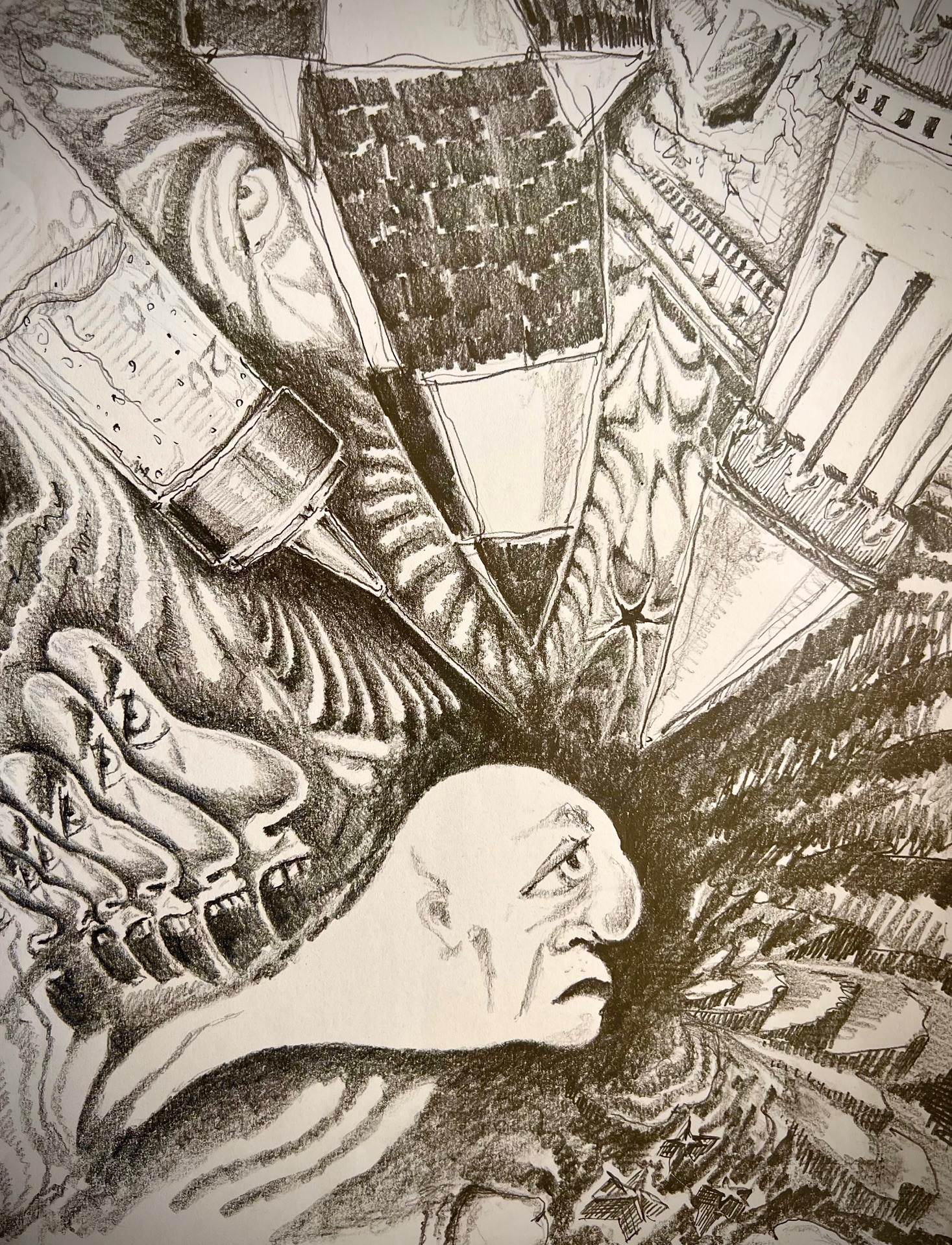
Image by Zak Smith

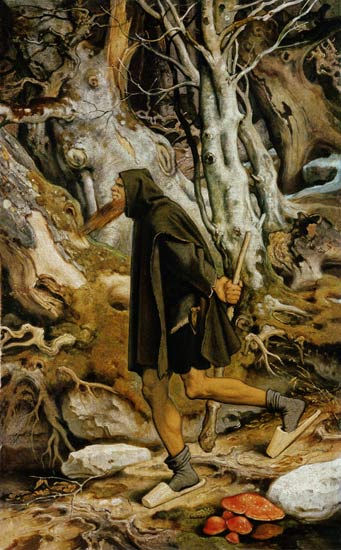
Moritz von Schwind‘s 1851 painting of Rübezahl features fly agarics.

Recap & Reflections

This section starts with a very evocative description new Dutch character – Katje. I struggled to figure out the prism style of this passage, is she being observed? Filmed? Is this from her perspective? Either way, it sets her up as a desirable and coveted operator and object, wherever she is. Currently, she is in the house with Osbie Feel, who is preparing Destroying Angel, a psychedelic mushroom they propagate on their roof, along with the bananas, i suppose. A little aside, when i looked the mushroom up, wikipedia tells me it can not be propagated – making its mythical properties more mysterious. I believe the reason there is such a focus on the mushroom is because its most famous pop culture depiction is Alice in Wonderland – this section is stuffed with fairy tale imagery.

Then we are back in Katje’s semi-recent memory of being kept in captivity by Captain Blicero. I think Pynchon is intentionally vague about the terms of the captivity, maybe that at one time it was voluntary, but maybe sometimes not. She is also kept in captivity with her “brother in slavery, brother in play” Gottfried. Unless i misunderstood, i believe Gottfried is actually captive in a cage when he is not at his post. He is a poor performing soldier under Captain Blicero, which gives him a little more of motivation for the arrangement. For how harrowing this situation is, I loved this section – it made me really think about how fairy tales usually involve gender and the domestic. We also get some background information on Captain Blicero, who seems to be on a world tour of terror before WWII. Katje ends up deserting her post and escaping to England, where she trades some secrets about the bombs, equipment and people in her camp, but does not give the location. She contemplates her own usefulness, her part in the big machine. There is some sexual tension with Pirate. Or something.

It is heavily implied that Katje was predetermined to abandon her loyalties and travel far away because of her bloodline. We then are catapulted into a pages long vignette about Katje’s ancestor, an OG Dutch colonizer and dodo murderer. I found this passage was a tiny prism to look at this grand sweeping narrative of colonization – a Dutch nobleman killing defenseless birds far, far away from home.

Just like that, we are back on the roof with Pirate and Osbie Feel who are discussing Katje going to “The White Visitation” as an “unforeseen dividend, for someone”. We then get a description of the film made to provoke a raid of a false camp. Wait? Real camp? not sure. Then it is implied that Katje is being filmed as a stimulus – also to stir up troops? or to stir up the animals in the lab?

□ □ □ □ □ □ □

Then we are free in the streets where Slothrop is roaming after being “cut loose” from St. Veronicas. He is back to work, with special permission, but something is off. He feels a presence, or like something is still watching. My mind went to some sort of possession/remote viewing. All of the sudden his routine is thrown. He runs into a nurse from St. Veronica’s and initiates an affair – because he feels off his game, is she misleading him? We then spend some time in the nurses flat, eating bonbons. This was incredible – the candies descriptions were like the worst dish at the Great British Bake Off. A bomb drops close the nurse’s flat, which is convenient for Slothrop’s usual post-bomb coitus programming.

□ □ □ □ □ □ □

With Roger and Jessica now, in a more hostile mood than the last time we visited. We find out some of the limitations of their relationship – Roger’s moodiness and paranoia, Jessica’s commitments to Beaver. This section is scrambled, really driving home how scrambled Roger and Jessica are when they are together. It seems like their physical magnetism even stops them from exchanging personal information, or speaking at all, really. I noticed that Roger says the 7th christmas of the war, while Jessica says the 6th. Then we are transported to Roger and Jessica in love or infatuation at a christmas market, a past year, and all that comes with it. Children, colonization, miracles, prisoners etc etc.

□ □ □ □ □ □ □

We are now in a dream – the perspective changes, who’s dream is this?
Back to Pointsman, who is taking stock of his life – and considering abandoning all his dogs for a single human mind – Slothrop.

All of the names mentioned in this section:
Osbie Feel, Pirate, Katje, Captain Blicero, Gottfried, Mme. Ophir, Mussert*, Rilke*, Young Rauhandel, Captain Prentice, Piet, Wim, Bela Lugosi*, Ernest Bevin*, Frans, Hendrik, Myron Grunton, Roger Mexico, Gerhardt Von Goll, Lang, Pabst, Lubitsch, Edwin Treacle, Rollo Groast, Aaron Throwster, Mitchell Prettyplace, Crouchfield, West Wardman, Whappo, Slothrop, Darlene, Mrs. Quod, Compton Mackenzie*, Austin, Hot Haragan, Tank Tinker, Yrjo, Beaver aka Jeremy, Maria Montez*, Jon Hall*, Bridgsby, Thomas Tallis*, Henry Purcell, Henrich Suso, Mr. Morrison, Mr. Noel Coward, Wendell Willke, ‘arry Pollitt, Thomas Gwenhidny, Spectro, Pointsman, Allen Lamplighter, Promond, Maudie Chilkes, Piotr*, Natasha**, Niolai**, Sergei**, Katinka**, Pavel Sergevich, Varvar Nikolevna, Pierre Janet*, Rechssieger von Thanatz**, Alpdruken, Vicar De Le Nuit.
*historical figures
**dogs

– Claire
 

Gravity’s Rainbow Week Two

Gravity’s Rainbow Week Two

Gravity’s Rainbow Week Two

“Jeepers Slothrop,” that was a hell of a reading! Lots of phobias and ‘philias this week. Negrophobia, homophobia, paedophilia, coprophilia…and what kind of ‘philia is a sexual attraction to rockets?

– Bruce

Image by Zak Smith

Illustration by Roberta Binotto

Recap & Reflections

Hospital of Saint Veronica of the True Image for Colonic and Respiratory Diseases

First encounter with Dr. Kevin Spectro. Spectro is one of the “original seven owners of The Book”, which appears to be Pavlov’s “Lectures in Conditioned Reflexes” (on pg 88, there is a reference to “Dr. Horsley Gantt’s translation” of The Book, and this is indeed a real book.)

Spectro and Pointsman are discussing their experiments, and in particular Pointsman’s intended experiments on Slothrop, which troubles Spectro, not for ethical reasons, but because a sample size of one is not scientifically robust.

A bit of background: Pavlovian psychology is based on “ideas of the opposite,” clusters of brain cells making binary differentiations. Sanity is defined as the ability of the brain to maintain binaries; insanity is the “weakening of the idea of the opposite.”

According to Pavlov, when sufficiently traumatized, a subject will enter an escalating sequence of three “Transmarginal phases”:

● Equivalent phase: the subject reacts with equivalent distress to minor and major stressors.

● Paradoxical phase: the subject no longer reacts to major stressors, but reacts catastrophically to minor stressors.

● Ultraparadoxical phase: the subject reverses responses to stimuli. A positive stimulus elicits a negative response; a negative stimulus elicits a positive response (an individual, for instance, might fall in love with an abuser.)

The V2 bomb is a metaphor for this ultraparadoxical reversal. The explosion comes before the sound, response comes before stimulus. Slothrop gets an erection in response to a stimulation that has not yet happened.

Abreaction: a moment of release after reliving a traumatic past experience. Patients who achieve an abreaction are reborn: “new children, painless, egoless…tablet erased…human palimpsests.”

Pointsman imagines he can “write…words of himself’ on the children of abreaction. Pointsman imagines these patients as literal children, lusts after them, like a paedophile. He imagines himself at a bus station, receiving into his care an actual child evacuee from London. “You have waited in the places into the early morning” to bring these children home to your “spermy sheets” (pg 51). Note that the narrative point of view changes suddenly, briefly, to second person. Is he talking to himself? (Is the reader being accused?) He hasn’t done it, only imagined it: all he will “score, presently, is an octopus.”

Roger and Jessica’s hideaway

Roger and Jessica are in their hideaway, and Jessica is woken from a dream by a bomb blast. She imagines the war as a kind of country fair, with barrage balloons “fat and friendly in the daybreak” and no-one has to die. In this way, Jessica and Roger are both Innocents in the war. Roger is a “statistical cherub, who’s never quite been to hell…” (pg 57). He blandly speaks of everyone being “equal in the eyes of the rocket,” but his insouciance is unearned, he hasn’t “paid the price” in action like Pirate Prentice has.

His Poisson equation guarantees everyone an equal opportunity to die under a rocket, but he fails to connect the equation, really, to death which earns him a reproach from Dr. Paul de la Nuit, “what will you do with the sieve that you’ve laid over London. How will you use the things that grow in your network of death?” Poinstman also notes Mexico’s naivetee, “How can Mexico play, so at ease with these symbols of randomness and fright? Innocent as a child…” (pg 56).

Perhaps Mexico finally makes the connection when, later in the reading, Jessica whispers “what about the girls?” and Roger restlessly wonders about their fate as they are converted from numbers in an equation, stars on a map, to real women killed by Slothrop’s predicted bombs. (Pg.87)

These pages develop the relationship between Mexico and Pointsman, reluctant colleagues, strange bedfellows. Mexico is the “Antipointsman,” able to live in the “domain between zero and one,” the binary code of Poinstman’s Pavlovian system. There is a new generation emerging from the war, a generation that will see the “end of history” (pg 56), the end of causality, the end of the binary. A touching scene of innocence as Roger tickles Jessica that is rudely brought to an end as another rocket lands, reminding the two of death’s imminence…”try to tickle me,” says death. (pg 60)

The Kenosha Kid and the toilet.

In the previous reading, Slothrop had been reassigned for psychological testing, “some Minnesota Multiphasic shit” (pg 21). Slothrop is now at “The White Visitation” in the hands of PISCES receiving Sodium Amytal and being questioned about his pre-war life in America. In his stupor, he is playing around with all the possible meanings of “You never did the Kenosha Kid,” a word game that brackets the episode. PISCES wants Slothrop to tell them about his time before the war: his memory takes them to Roxbury, a black neighbourhood in Boston. We’ll discover later in the reading that PISCES is particularly interested in Slothrop’s attitude to blacks as they build the propaganda campaign, “Operation Blackwing” and its fictional “Schwarzkommando” (pg 75).

He’s in a black jazz club, the harmonica in his pocket is a “jive accessory,” possibly playing on two meanings of the word, jive the dance and jive meaning deceptive, as if he’s a poser: “A woman turns to look at him…her eyes tell him…what he is” (pg 62).

Slothrop is vomiting into a toilet and loses the harmonica which, of course, he decides to pursue, wriggling all the way into the toilet, and narrowly escaping an anal rape by none other than Malcolm X (because of course there are always negroes loitering around white bathrooms looking for the opportunity). The section is a satire of racial fears of the white Harvard-schooled elite to which Slothrop belongs. As he drifts through the sewers, the shit-caked walls of the pipe seem to offer cryptic texts. (It seems that every surface in GR is sedimentary, offering paranoid hints of deeper meaning: Pirate’s banana-growing soil, Slothrop’s desk, this sewer, the ice-crusted walls of “The White Visitation” if not the entire building itself.)

Funny that Slotrop can identify the individual shit of his classmates, but the Negro shit, “that all looks alike” (pg 65).

The section perfectly captures dream logic. Slothrop drifts into the open sea, but finds himself seemingly on dry land in a post-apocalyptic, bombed out land, roofs missing from masonry ruins, the denizens of which (or “contacts”) Slothrop knows. Yet, despite smoke rising from fires and birds flying in the sky, the whole scene still seems to be under water (“The light is thick and water green”) as waves high above cause debris from the streets to rise and fall.

“Here now is Crutchfield,” and we momentarily enter a perverse spaghetti western featuring this “White Cocksman” who has fucked nearly every man, woman and beast of “terre mauvais”, and is considering finishing it all off with the only thing he hasn’t fucked, a rattlesnake. But still, despite us now being in a desert, the dream logic lingers, and we hear a harmonica in the background accompanying a song: “Down this toilet they say you are a flushing…” (pg 68).

Finally Slothrop’s journey down the sewer ends, on a snowy Roxbury hillside, and Godot-like, he expects to meet The Kenosha Kid, “the connection he’s travelled all this way to see,” but the Kid is a no-show, and a sinister “Never” is there to confess to his role in the disappearance.

Incoming Mail

Pirate is alone with his “mail,” the contents of the graphite cylinder delivered to him by rocket that morning. The note is written in an invisible ink that only becomes clear in the presence of semen. To encourage him to produce the required activating agent, Pirate is provided with a drawing of his former lover, Scorpia Mossmoon. There is something special about this drawing that hits Pirate right where it counts, almost as if “They” have access to his most private fantasies (English boys, conveniently, are “conditioned to get a hardon in the presence of certain fetishes…”). But how do the Germans know this about Pirate? How does Pirate know what the message means?

A rocket, “the third today,” explodes in the distance tying Jessica and Mexico to Pirate. The rockets are like drum beats punctuating each episode.

“The White Visitation”

The quotation marks that always surround the name suggesting the secretive nature of the former mental hospital. That it is a “Visitation” suggests its ghost-like presence. In this chapter, we meet its various denizens, Myron Grunton (BBC announcer and wartime propagandist), The Dog Vanya (housed in the ARF wing…haha, geddit?), Dr. Geza (Rosie) Rozsavolgyi (a Transylvanian immigrant who affects the mannerisms of a fey Dracula and is rumoured to have been seen “crawling headfirst down the north facade.“ (pg 83). The Reverend Dr. Paul de la Nuit is there to provide a more humane if not religious take on the goings on in “The White Visitation.” Brigadier Ernest Pudding is in charge of this lot. He is nearly senile, utterly incompetent, and has a fondness for serving foods with “surprise” in the title.

Just a thought here: “victims” of these “surprises” react with horror while, for instance, Roger Mexico barely reacts to a bomb blast. Is all of London in an “equivalence phase?”

We witness Le Froyd, a patient at the WV before its conversion to a military research lab, jumping to his death from the nearby cliff claiming to hear the “Lord of the sea” (or Bert to you). How many “Lords of this and that” have we got in this novel? At least one other, the Lord of the Night (pg 49). Something to track, perhaps.

We learn of Myron Grunton and his propaganda scheme, Operation Black Wing, to invent the “Schwarzkommando” using the real presence of “Heroros” in Germany as its seed (Genocidal Germans colonists, just decades before the war, wiped out 80% of the Herero population, so the possibilities for a feared revenge here are compelling). Slothrop’s fantasies help to fill out some of the racist propaganda.

Slothrop’s Origin Story

Pudding and Pointsman are debating the ethics of using Slothrop as a test subject, “meddling with another man’s mind.” We learn that Slothrop is already soiled goods having been subject to meddling as an infant by Dr. Lazlo Jampf, a visiting lecturer to Harvard while Slothrop was a baby. Jampf applies Pavlovian experimentation to human subjects, but needs a better, cheaper, reflex to study than salivation, so of course he chooses infant erections. Infant Tyrone Slothrop is conditioned to go erect in the presence of “stimulus x”: we don’t know yet what that is, but it seems proper protocols have not been followed to “extinguish” the reflex, so that it carries on into Slothrop’s adulthood and is somehow related to the rockets. “The White Visitation” scientists have their theories: Mexico thinks it’s a statistical oddity; Rollo Groast thinks it’s precognition; Edwin Treacle thinks Slothrop is guiding the missiles in through psychokinesis. Pointsman, it turns out, doesn’t particularly care about the rockets. He uses the mysterious correlation as “a sop” (pg 92) to get Mexico on board with his experiments. He’s more interested in Slothrop as a “psychopathological deviant,” an “obsessive” and a “latent paranoic.” A human, not a dog, who might be the ideal experimental subject to continue on with Pavlov’s work to prove that all mental illness is caused by a “point of pathological inertia” in the brain that leads to “confusion of the ideas of the opposite.”

Whatever it is that makes Slothrop special, he’s in for a world of pain as Drs Rosie and Pointsman plot their experiments.

In a way, Pynchon is doing a bit of house keeping in this chapter, tying up loose ends. Yes, Slothrop’s and Mexico’s maps are identical; yes, Slothrop’s missile kink has a cause and effect origin story; yes, there is a correlation between the Ultraparadoxical phase and Slothrop’s abilities. We also learn what The Book refers to: Pavlov’s “Lectures in Conditioned Reflexes.”

Maybe a question for our resident physicist, Ben, I’m curious about the fact that Pynchon never brings in quantum physics, especially in reference to Mexico’s work: “The next great breakthrough may come when we have the courage to junk cause-and-effect entirely and strike off at some other angle.” It just seems like low hanging fruit. And who the heck is the “black man” with the “magic face” down from London, skating on a pond, who generates such fear and respect in the children that skate alongside him….

Gravity’s Rainbow Week One

Gravity’s Rainbow Week One

Gravity’s Rainbow Week One

Welcome to the first week of our reading of Gravity’s Rainbow! I truly am your humble guide for the first week, as I am coming into this with a very limited reading history with this book.  I belive I tucked into it in high school, and never went back again…

I love Pynchon though, and have delighted in The Crying of Lot 49, V., Inherent Vice, Bleeding Edge, and recently finished Shadow Ticket (Sorry Mason & Dixon…maybe next time) so I am familiar with his density, his dark humor and propensity for ridiculous character names and acronyms.

But the role of guide this turn in book club is less specialist and more compatriot, so we can all muddle through together, and no one (including me) should feel less than for not “getting it” right away.

So let’s jump in!

– Johanna

Image by Zak Smith

Recap & Reflections

“A screaming comes across the sky…”

We are here, Britain during WWII. The bombs have fallen before, “but there is nothing to compare it to now.” We are at a precipice of new tech, new fears, new ways of destroying each other. And as we will soon discover, new (ancient?) ways to use our minds to compel, control, coerce.

The first vignette sets the tone of grey and dreary London – the years revealing themselves as evacuees are sent into catacombs of an old hotel, below the tracks. I love the image of the rats’ ghosts “still as cave painting, fixed stubborn and luminous in the walls” (p. 4).

In a classic Pynchon transition that you will miss if you blink, we are suddenly with Captain Geoffrey “Pirate” Prentice – the first of some 400 characters we will meet in this novel. Pirate is living in a maisonette with a variety of colorful characters including Teddy Bloat, who Pirate saves from falling off the balcony by pushing a cot underneath him.

As he wakes he sees an unusual contrail in the sky. “Incoming mail” he thinks to himself. The consideration of whether to tell anyone seem the start of a theme of fatalism – does it matter? Is it too late? You will hear it when it’s too late anyway.

Pirate instead decides to pick some bananas.

Pirate has created a lush greenhouse on the roof where he grows incredible bananas. Much description of delicious banana-based breakfast items ensues…This banana reverie is interrupted by a phone call – the mail has indeed arrived. (Love that he is driven by his “batman, a Corporal Wayne” p. 11).

And this is when shit gets weird. Because Pirate has the ability to see into people’s dreams, and we discover this has been weaponized by some shadowy org called the Firm, and Pirate is in their grasp.

□ □ □ □ □ □ □
Next we meet up again with Teddy Bloat and his office mates Tyronne Slothrop and Tantivy Mucker-Mafflick. I loved the description of the archaeological layers of Slothrop’s messy desk (p. 19). Bloat is spying on Slothrop’s map of gummed stars, each one indicating a girl he’s dallied with. Bloat doesn’t seem to know who he is bringing this intel to.

□ □ □ □ □ □ □
Pirate shows up to collect a piece of a rocket that Slothrop is also persuing through ACHTUNG – described as “the poor relative of Allied intelligence” (p. 20). We learn that the color code of Slothrop’s star map is based on the feeling he got meeting the girls. Slothrop and Tantivy have another conversation about the impending feeling of waiting for the big one, described as a “Word that rips apart the day” (p. 26).

There was some great descriptive language in Slothrop’s story of the northern lights and the light of the hotel fire he witnessed as a child and the connection to the “great bright hand reaching out of the clouds” (p. 30).

□ □ □ □ □ □ □
A seance, a room full of characters moving through the space, a description from the mouth of the medium of something that startlingly sounds like AI “A market needed no longer to be run by the Invisible Hand, but now could create itself” (p. 31) and Jessica Swanlake throws a perfectly aimed dart as rocket bombs fall. Is this a meeting of the White Visitation? It sounds like everyone gathered is in some way working on extra-sensory skills or study thereof. We get some backstory on Pirate’s abilities and his love of Scorpia Mossmoon.

□ □ □ □ □ □ □
Jessica and Roger Mexico have a little love nest. We learn about the “White Visitation” – the name for this group of tele-phaths, etc. Mexico is the stats man of the group. Then description of the fatigue of war is wrapped in the statistics of the “nth part of a body freed from the nth pile of rubble” (p.42).

□ □ □ □ □ □ □
Edward Pointsman is trying to ether a dog. Jessica and Roger are complicit in this for some reason not made clear (unless I’ve missed something). Jessica’s feelings for the poor creature “waiting for…the room to reassemble around it” (p. 44) are so sweet. And then Pointsman gets a toilet bowl stuck on his foot. Hilarity ensues. The dog TALKS?! (p. 45). There is a mysterious Book.