
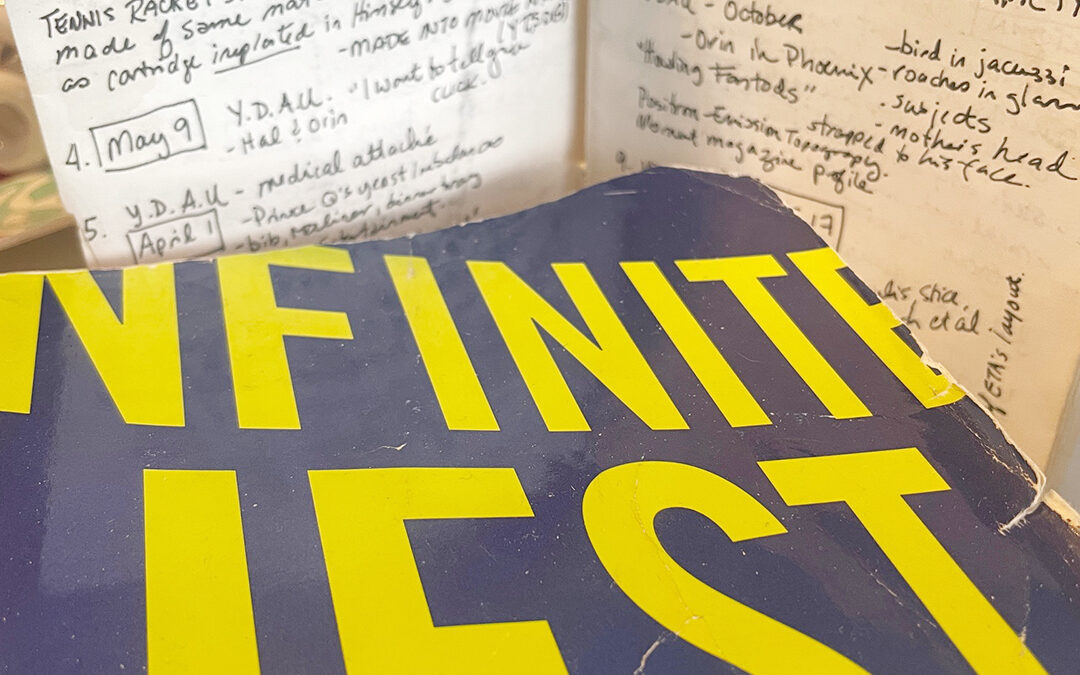
Week One
Week One
Welcome to the beginning of our Infinite Jest reading club, and the first of thirteen blog posts dedicated to recaps. reflections, and reactions to what we’ve just read:
amanuensis
festschrift
scopophilical
These words are all such delicious morsels.
Wallace has an incredible gift for voice. You can tell he relishes words, and his phraseology is delightful. And when IJ was published 30 years ago (!) his style was like no other. For me, this book works on three unique levels:
1. As a study in voice. You’ve already seen how Wallace moves between plot-driven sections and character studies. The two segments of Erdedy and Wardine could easily be stand-alone shorts. And while they are loosely connected to the main narrative, they exist mostly as studies in larger themes and mood.
2. As a really fun detective novel. Full disclosure – it took me a few re-reads to get to the actual gist of the plot, mostly because Wallace drops really key information often right in the middle of lengthy dialogue. As an interesting twist, the only person trying to solve the mystery behind the book (ie: who is disseminating the deadly samizdat) is you. You’ll meet the two characters whose narrative is mostly used to explain the plot next week (Marathe and Steeply) but even those two are acting as known agents. There really isn’t a character used as the proxy of the reader. We are on our own.
3. As a post-modern F.U. to narrative structure. As I mentioned in my intro email, while you can read this book on an e-reader or use the audio book, the physical heft of the paperback is in itself a narrative tool, and Wallace weaponizes his endnote structure to playfully fuck with us (at least that’s my take). The decision to place endnotes smack in the middle of a sentence, rather than waiting for the end, only to find yourself expected to read a multi-page conversation, essay or (hah!) filmography before coming back to finish your sentence is just ridiculous. To be asked to heave yourself all the way to the back just for a description of the chemical compounds of a street drug – so dumb, so funny.
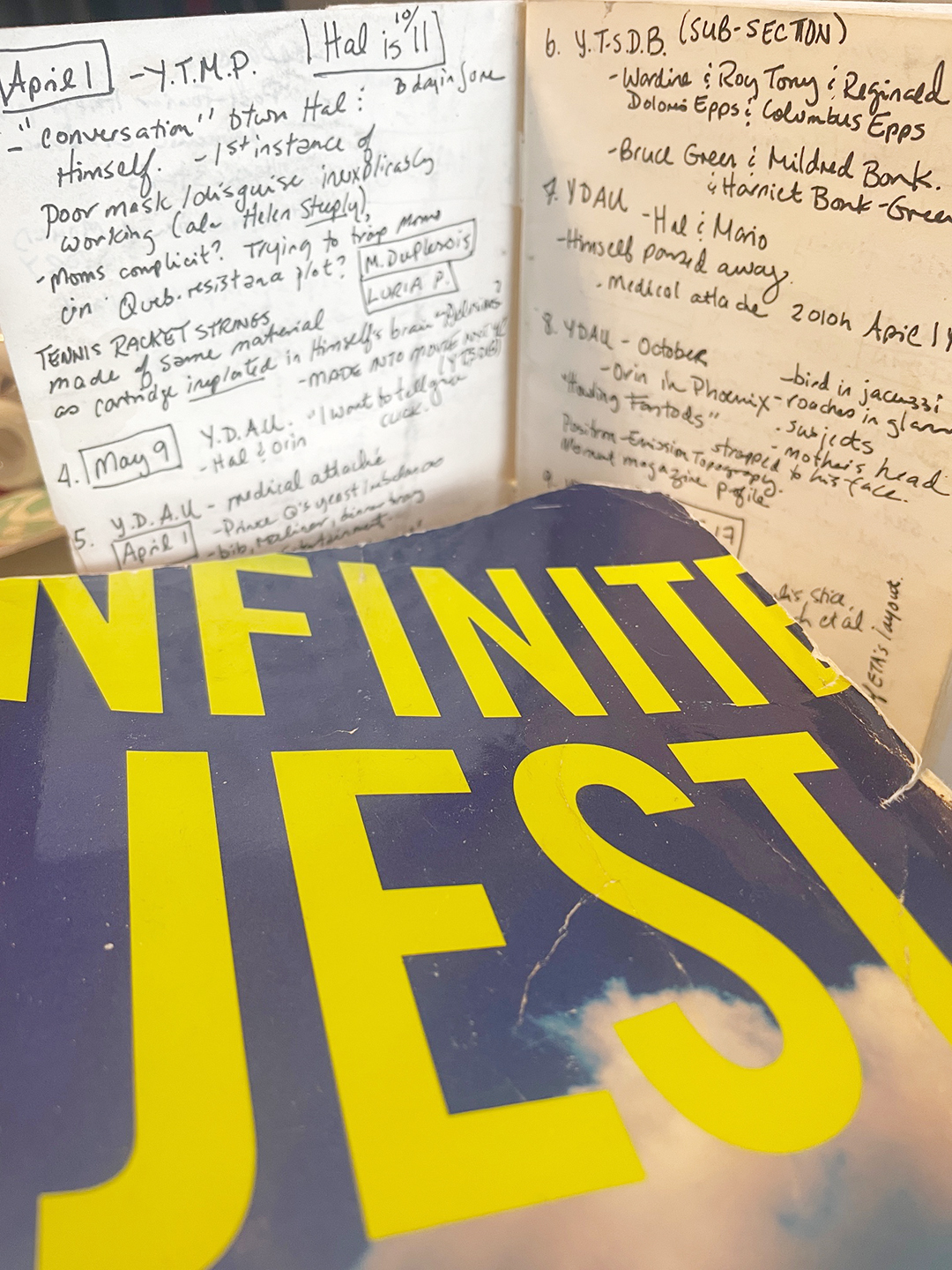
Who’s Who
A significant number of characters are introduced in this first section, and it can be difficult to determine who is key and who is secondary to the story. DFW is already making connections and links across quite a few characters, a technique that will continue through the book. So far we have met, in general order:
- Hal Incandenza, a highly intelligent tennis prodigy who we meet at age 18, age 10-11, and age 17.
- Uncle Charles Tavis (CT), half brother of Hal’s mother Avril and administrator at Enfield and Aubrey DeLint, alumnus & prorector at same.
- Orin Incandenza, Hal’s older brother.
- Avril Incandenza, aka “the Moms,” mother of Hal, neurotically afraid of germs and secrets, ‘mover and shaker in prescriptive grammar world,’ accused of cavorting with a series of political resistance agents by “professional conversationalist”
- Ken Erdedy – drug addict, buying weed from unnamed woman who buys from an unnamed man with a harelip and a snake in a trailer park.
- James O Incandenza, aka “Himself,” Hal’s father, serious drinker, ‘towering figure in optical and avante garde film circles,” and founder of Enfield Tennis Academy.
- The medical attache for Prince Q—- and his wife.
- The world of Wardine, Wardine’s momma, Reginald, Delores Epps (Dolores Epp), Clenette, Roy Tony.
- Mario Incandenza, the middle son of James and Avril.
- Bruce Green, Mildred Bonk, little Harriet Bonk-Green, and Tommy Doocey, their harelipped snake-keeper and drug dealer roommate.
- Students of Enfield – Michael Pemulis, James Troeltsch, Ortho “The Darkness” Stice, etc.
- Don Gately, drug addict, petty burglar, accidental murderer.
- Guillaume DuPlessis (deceased), powerful yet “meek-looking Canadian-terrorism-coordinator.” (p.59)

Recap
When I first re-read IJ I was astounded by just how much is set in motion in these first 60-odd pages. It is dense in character introductions, drops a volume of details about the setting, and contains foreshadowing out the wazoo. So here’s my quick recap:
Where/When are we?
We know that North American calendar years are now bought by corporations, and we are given some small details about the order – Hal is 10-11 during the Year of the Tucks Medicated Pad, 17 during the Year of Depend Adult Undergarment and 18 during Year of Glad, and James died at age 54 in the Year of the Trial Sized Dove Bar (p. 64).
There has been some sort of political rift between the US and Canada, with North America now referenced as “O.N.A.N.” and a Pan-Canadian resistance seemingly coming out of Alberta and Quebec regarding “the U.S.A’s Experialistic ‘gift’ or ‘return’ of the so-called ‘Reconfigured’ Great Convexity to its northern neighbour” (p.59).
Technology consists of Inter-Lace viewing cartridges, which can be ordered by mail or spotaneously disseminated, and there is a differentiation made between calling someone using ‘just audio’ and presumably video.
The primary locations of the story are Phoenix, Arizona and Boston, Massachusetts, which are also the two places that Inter-Lace has its manufacturing and dissemination hubs.
The Incandenza Family
Hal is in Arizonza participating in the Whataburger Southwest Junior Invitational tennis tournament. (nb. Whataburger is a real Southern US burger chain, popular in Texas, Arizona, etc). While attending the tourney, Hal is meeting with the U of Arizona to be considered as a student. He is there with his mother’s half-brother Charles Tavis and others from Enfield, the tennis academy he has recently graduated from. Something has happened to Hal. While he apparently is still an incredible tennis player, any attempt to speak, smile, or gesture in conversation results in horrific “sub-animalistic” noises and gestures. The U of A team are having none of it. Hal’s remark “Call it something I ate” is the (apparent) linking device to a memory Hal shares of eating a piece of mold when he was 5 years old. Could this be the cause of Hal’s current situation?
Hal’s father is deceased, but was a scientist, “a towering figure in optical and avante garde film circles” and the founder of the tennis academy. He was an alcoholic, and very paranoid, believing his wife was having scores of affairs. He once staged a bizarre session with Hal pretending to be a Professional Conversationalist, but his disguise began to slip, and Hal called him on it.
Hal’s oldest brother Orin is a professional football player, and we learn about his neuroses and fears (roaches, heights), his prediliciton for women (referred to as “subjects”) who have young children, and his nightmare about his mother’s face strapped to his own.
Hal’s other brother (Hal is the youngest of 3) Mario seems to be physically and mentally challenged. He lives with Hal in the dorm at Enfield and likes to ask a lot of questions.
The Beginning of the End
Another key movement in this section is the description of the medical attache’s deecision to watch an unlabeled video from the stack his wife had left on the front table. It is addressed to him, with the message “Happy Anniversary” but he doesn’t know what that is referring to. It’s April 1, Year of Depend Adult Undergarment. The last we see of him, he has been rewatching this video on repeat, and has soiled himself in his chair.
An Introduction to Don Gately
Don Gately’s burglary turned robbery at the home of M. DuPlessis (who is mentioned in James’ litany of accusations against Avril in the Professional Conversation section) has also set something critical in motion, as Don unknowlingly kills a very important Canadian terrorist.
Reflections
This section sets the tone for our journey alongside Hal Incandenza. Who is Hal, at his core? What motivates him? Is he a trusted narrator?
I can be an incredibly linear thinker, and so I enjoy reading Infinite Jest for the fabulous connect-the-dots plot rather than as an exercise in exploring the larger themes. Because themes, well you just feel them, you know?
But I also believe we should seek to see what it offers us as a path, a way to explore ourselves, our connection to those around us, and ultimately to perhaps provide a guide on How.To.Be.
Identity, self-awareness, and how we are perceived by others are strong threads of this book, and as such we begin in media res, dropped into the innermost core of Hal. We are trapped with him inside his head. “There is nothing wrong. I am in here,” says Hal (p. 13). He is aware of how monstrous he will present if he attempts to speak, but also seems remarkably chill about it. This young man is trapped, intellectually intact yet unable to express himself, being hauled around and propped up by C.T. and DeLint, and yet we really don’t get to understand exactly how this feels for Hal. He asks of the recruiters “Please don’t think I don’t care” (p. 12), but he spends more time reflecting on the aesthetic qualities of the bathroom floor than expressing the horror we can only believe he must feel because of his situation. Is Hal in a place of such self-awareness that he has hit upon some sort of godhead? There’s a tranquility to his demeanor that suggests this.
The other Hal-centric pieces in this section, including his painstaking efforts to get high in private and his loving yet still distant conversations with his brother Mario give us little understanding of Hal’s inner sense of self, but context a-plenty to better understand his family dynamic and how he is situated within that space. He moves through these scenes like an actor playing a role. There is a considerable lack of agency.
In the first of the flashbacks, Hal is just a child, whose consumption of this fuzzy piece of mold has accidentally set something incredible into motion (if we read p. 12’s “Call it something I ate” at face value). It is a pure action, bereft of intent, and really only affects Avril. In fact it is not even Hal’s own memory, but told to him by older brother Orin.
So let’s have a ‘conversation.’ This segment is so beautiful in its absurdist reveal, and asks for a serious suspension of disbelief, destabilizing the narrative. Who do we trust? Here 10-year old Hal watches and reflects as his father’s absurd attempt at disguising himself as a “professional conversationalist” unravels before his eyes. The theme of talking and not being heard eerily echoes the previous section. It is interesting to note that Hal and James seem to be able to communicate as long as James is in the persona, but as the mask slips, James seems to lose the ability to understand Hal. Again in this segment, Hal reads as emotionally distant, immersed in a ridiculous situation, yet remarkably capable of handling it. This may infer that he has lived in this sort of chaos for a long time, and can brush it off easily.
The character study of Erdedy is a fantastic piece – a short story really – that paints a remarkable picture of the addict’s twisted sense of self-awareness. Ken’s strategy that he employs when he decides that he is done with the weed (burning all of his bridges and throwing away all of his paraphernalia) has time and time again proven to be an absolute failure, yet it is a process that he holds steadfast to. He is able to be at once outside of himself with a clear understanding that this is a pattern, but also powerless to change. The final frame of this story – with Erdedy paralyzed between answering the phone and answering the door, is a perfect illustration of “analysis paralysis” and how Erdedy’s addiction has eroded his sense of self.
If we think of self-awareness as how closely we match the identity that is reflected back on us from others (can we think if it that way?), many of the characters in this section aren’t who they say they are, or they act outside of their stated code: Hal as a secret dope smoker; Don Gately as an accidental murderer instead of a burglar; JOI as a conversationalist; Erdedy as a “casual” dope smoker; even Bruce Green who changes for his love Mildred Bonk. And we are also privy to two sections with an undisclosed narrator, in both the story of Wardine and the face in the floor.
We are also introduced to the visual theme of heads (read into that what you will)…
- From the very first sentence, Hal is first surrounded by “heads and bodies”, before they resolve into the Deans of the U of Arizona.
- The stand-out sentence that seems completely out of place on page 16- 17 “I think of John N.R. Wayne, who would have won this year’s WhataBurger, standing watch in a mask as Don Gately and I dig up my father’s head”.
- Himself stating that a cartridge of identical material to tennis rackets has been implanted in his head. (p. 31)
- The phone conversation with Orin on page 32 when Orin says “My head is filled with things to say” as well as the first mention of Mario’s oversized skull.
- Orin’s dream on page 46 of “the Moms’s disconnected head attached face-to-face to his own fine head”
- the description of the paranoid schizophrenic’s treatment on the CBC program (pg 48).
- Don Gately’s “massive and almost perfectly square head“
- M. DuPlessis’s death from suffocation due to the gag and his terrible head cold.
- The terrifying “face in the floor” on page 62.
So what’s the take-away from this segment of the novel? For me it may be that we are skilled at self-sabotage, we bury our emotions, we allow others to manipulate our own intentions for their gain. In the arc of this narrative, it makes sense that we begin here, and as we follow Hal, and Don, and the rest, we hope to glean something from their journey towards their true selves.